
A virtual Mastercard that spends your USDC, with one fee to watch and one deadline to watch closer
 Available in US
The Simple Crypto card is a virtual Mastercard that spends a stablecoin balance rather than a bank balance. That single sentence explains most of what follows. There is no annual fee, no issuance fee, a generous list of countries, and top-ups that land almost instantly in USDC or USDT. There is also no physical card yet, a 2.5% fee on international card payments, a set of spending limits measured in USDC, and an announcement in the company’s own help centre about the closure of its custodial wallet services by 30 June 2026. Whether that combination suits you depends almost entirely on why you are reading this.
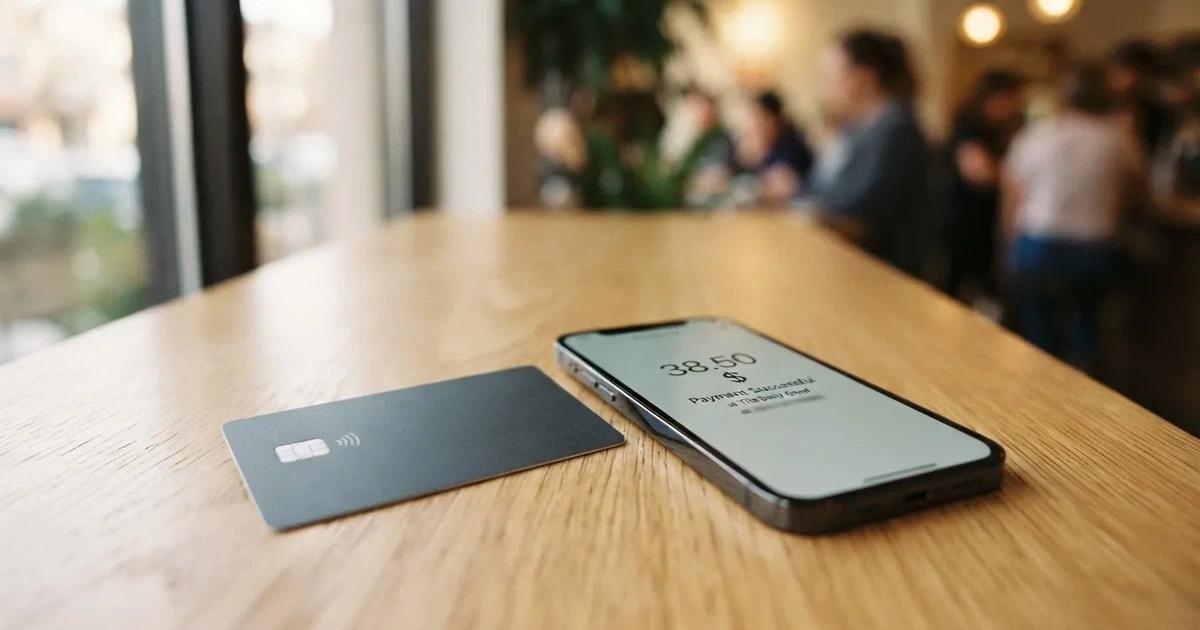
My overall mark is 6.9 out of 10. It is not a bad card. It is a narrow card, and its narrowness is the whole story.
The conditions described on this page are current as of October 28, 2026.
| Criterion | Mark | Why |
|---|---|---|
| Who can get it | 8 / 10 | A region list dated 24 January 2026 covers Europe, Asia-Pacific, Latin America, the Middle East, Africa and the CIS, plus the United States |
| Cost | 5 / 10 | Issue and monthly cardholder fees are 0, but international card payment costs 2.5%, ATM withdrawals cost 2% after the first three each month, and a replacement card is 20 EUR |
| Top-up options | 9 / 10 | USDT on Ethereum ERC20, Polygon, BNB Smart Chain, Arbitrum and Tron; USDC on Ethereum ERC20, Polygon, BNB Smart Chain, Arbitrum and Base, credited instantly |
| Reliability and complaints | 6 / 10 | Issued by Unlimit EU Limited (Cyprus), licensed by the Central Bank of Cyprus as an electronic money institution, number 115.1.3.7; custodial wallet services closing by 30 June 2026; Trustpilot 4.2 out of 5 across 7,046 reviews |
| Everyday use | 7 / 10 | Virtual Mastercard only, physical card in development; Apple Pay and Google Pay are supported; ATM withdrawals capped at 500 USDC a day |
| Total | 6.9 / 10 | A strong top-up experience wrapped around a virtual-only card with one significant payment fee |
Who should read further: you if you already hold stablecoins, you want a card that spends them without selling them into a bank account first, and you mostly pay inside Europe. Who should probably stop here: you who need a physical card, you who withdraw cash often, you who want a card that works everywhere without a per-payment charge, or you who keep meaningful balances on a platform account rather than in a wallet you control.
The single best fit, in my view, is the self-custody user spending USDC with Apple Pay. Someone in that position already has the token, already owns the wallet, and only needs somewhere to put it for a week of groceries and transport. Every one of the card’s rough edges is irrelevant to that person. Everyone else has to weigh at least one of them.
Who will give you the card
The help centre publishes a region list for the USDC Simplecard, dated 24 January 2026. It is long, and length is the reason this criterion scores 8 rather than lower. It covers six large blocks plus three islands:
- Europe, including Andorra, Austria, Belgium, Bulgaria, Croatia, Cyprus, the Czech Republic, Denmark, Estonia, Finland, France, Germany, Gibraltar, Greece, Hungary, Iceland, Ireland, Italy, Latvia, Lithuania, Luxembourg, Malta, Monaco, Montenegro, the Netherlands, Norway, Poland, Portugal, Romania, Slovakia, Slovenia, Spain, Sweden, Switzerland, the United Kingdom and Ukraine
- Asia-Pacific, including Australia, Hong Kong, Indonesia, Japan, Macao, Malaysia, the Philippines, Singapore, South Korea, Taiwan, Thailand and Vietnam
- Latin America, including Argentina, Brazil, Chile, Colombia, Ecuador, El Salvador, Mexico and Peru
- Middle East, Africa and the CIS, including Azerbaijan, Bahrain, Georgia, Ghana, Israel, Kazakhstan, Kenya, Moldova, Nigeria, Oman, Saudi Arabia, South Africa, Turkey, Uganda, the UAE and Uzbekistan
- Guernsey, the Isle of Man and Jersey
- United States
Two things this list does not tell you, and both matter. First, it does not say whether the test is citizenship or residence. The published pages do not address the distinction, so if you are a citizen of one country living in another, or the reverse, the only honest answer is that you will find out by applying. Second, it does not promise that every listed country is open today; it is a list of regions as of late January, and nothing in the card’s own pages confirms it has not narrowed since.
There is a broader reason to expect a country’s presence to matter more than it does with a bank. Merchants can look up the card’s issuing country from the card number itself, and some apply extra scrutiny when the issuing country differs from the billing address. A card issued in one country can simply look “foreign” to a shop in another, and some merchants decline cards from certain issuer countries as a matter of policy. So a wide eligibility list does not translate one-for-one into a card that works everywhere.
How to get it
The route is short and entirely digital. In the app’s Cards section you choose the virtual card, enter a phone number, and complete verification. The verification step is standard KYC: you upload a Proof of Identity document and a Proof of Address document. The card’s own description of the review time is that it “usually takes a few minutes but can take longer”.
For the address document, the accepted list is specific. Anything dated within the last six months counts, and the accepted forms are:
- a bank statement as a PDF
- an electricity, water or gas bill
- an internet or landline bill
- a tax bill or a government letter
- a utility bill from a government agency
There are also three specific ways people get this wrong, listed by the card as rejection reasons for proof of address: uploading a passport or ID instead of the address document, using a document older than six months, and submitting a screenshot rather than a PDF or photo. Each of those is avoidable in advance, and each is a wasted round trip.
What is not stated on the public pages: the minimum age, the KYC tiers the account moves through, and how the account behaves if verification fails partway. What you get in return is a virtual Mastercard. The card currency is EUR. A physical card is described as “currently in development”, so there is nothing to wait for in the post at this stage.
What it really costs: the Fees breakdown
Here is where the score drops to 5, and the reason is not the headline numbers. It is the 2.5%.

The fee schedule, published by the card as its custodial card fees page, is short and mostly flattering:
| Fee or limit | Value |
|---|---|
| Card issue | 0 EUR |
| Cardholder management | 0 per month |
| Non-active card maintenance | 0 per month |
| Card payment, domestic | 0 |
| Card payment, international | 2.5% |
| ATM withdrawal, domestic | 0 for the first 3 withdrawals per month, then 2% |
| ATM withdrawal, international | 1.75 + 2.5% (EUR figures as listed) |
| ATM balance inquiry | 0 |
| Reissue, renewal or replacement | 20 EUR |
| Chargeback | 40 EUR |
| Review of an unjustified claim | 40 EUR |
| Card payments | 30 000 USDC daily, max 15 purchases; 30 000 USDC monthly; 75 000 USDC per 3 months; 100 000 USDC per 6 months |
| ATM withdrawals | 500 USDC daily, max 5 withdrawals; 5 000 USDC monthly |
Two definitions sit under that table and are easy to skim past. First, “domestic” for ATM withdrawals means the EU Member States plus Iceland, Liechtenstein and Norway, which is a narrower idea than most people carry. Second, there is no separate currency-conversion line. The conversion is not hidden in a rate; what you see is a crypto conversion rate displayed on screen at top-up. That is more transparent than most cards in this category, and it is also the point at which your real cost is decided, before you ever reach the fee table.
Now, three everyday payments, and what actually applies to each:
- A 30 EUR grocery shop in Berlin. Domestic card payment at 0. The only cost is whatever spread appears in the conversion shown on screen when the balance was loaded. If your balance was already USDC sitting in your own wallet, there is no conversion at all at this moment.
- A 40 EUR dinner in Lisbon. Same 0 domestic card payment. The ATM rules do not apply, because you never touched an ATM.
- A 20 USD subscription billed from a US platform. International card payment at 2.5%, so 50 cents on a 20 USD charge, plus whatever the US-side issuer or merchant adds, which is outside this card’s control. If that subscription is your main use of the card, this single line item is what the card is worth.
Three observations follow. The 2.5% international fee applies per transaction. The ATM economics are genuinely generous inside the EEA for light users and poor for heavy ones: three free withdrawals a month, then 2% each, with a hard ceiling of 500 USDC a day. And the replacement fee of 20 EUR is the number most likely to surprise you in practice, because losing a virtual card you stored in a phone wallet is not the disaster it sounds like, and the price is not small relative to a free card.
How to top it up
This is where the card earns its highest score, 9 out of 10, and it earns it honestly. The top-up story is short, fast and unambiguous:
- USDT on Ethereum ERC20, Polygon, BNB Smart Chain, Arbitrum and Tron
- USDC on Ethereum ERC20, Polygon, BNB Smart Chain, Arbitrum and Base
The card is “linked directly to your crypto balance”, and the card’s own wording on timing is that your card balance updates immediately. Conversion details are shown on screen as you do it, which is the right moment to look, because that rate is where your real cost sits.
You can also buy crypto with your bank card or bank account inside the app, if you would rather not start from tokens you already hold. That route adds a step and an on-ramp provider you did not choose yourself, so if you already hold USDC the direct route is the better one.
Two cautions belong here rather than buried later. Blockchain transfers are irreversible. A deposit sent on a network the card does not support, or sent to an address belonging to a different network, can be lost or need manual recovery with no guarantee attached. The supported lists above are the ones to work from; do not assume a network is interchangeable because the token ticker is the same. Separately, on-chain network fees are charged by the blockchain itself, not by the card, so you need a little of the network’s own token available — a small amount of ETH for Ethereum-based sends, for instance, and Tron fees are paid through bandwidth and energy and often burn TRX. Sending USDT on a chain where your wallet holds only the stablecoin is the classic way to watch a top-up fail at the last step.
What is not stated: a deposit fee, a minimum top-up amount, or who pays the network fee for your deposit. None of those appear on the public pages.
To move money back out, there is a Withdraw button on the card dashboard that sends to a Custody Wallet or a Self-custody Wallet. The card states that “the withdrawal will be executed in cryptocurrency”. The fee amounts are not published as figures; they are visible in your card transaction history. That is a workable arrangement, not a comfortable one, because you will want to know the withdrawal cost before you need it, and the answer you will get is a number that depends on the route you pick on the day.
Paying with it every day
Day to day, this is a competent card with one structural limitation: it is virtual only. If you are someone who taps a terminal with a physical card and finds the absence of a card in your wallet mildly irritating, that irritation is the whole limitation. Apple Pay and Google Pay both work, which converts the virtual card into something you tap your phone for, and for most spending that is the intended experience rather than a workaround.
The limits are where the model becomes visible. Card payments run to 30 000 USDC a day with a maximum of 15 purchases, 30 000 USDC a month, 75 000 USDC per three months and 100 000 USDC per six months. ATM withdrawals are capped at 500 USDC a day with a maximum of five withdrawals, and 5 000 USDC a month. There is a single tier — no tiers are described — and limits are not stated to vary by verification level. If you are reading those numbers as a monthly budget rather than a technical ceiling, they are generous. If you are reading them as a constraint on a large monthly payment run, they are not, and you should check them against your own typical month before committing.
On rewards, nothing is stated: no cashback is mentioned anywhere in the card’s pages. That is not a criticism so much as a reminder that the value here is utility, not rebate.
The app’s own marketing puts the rating at 4.8 out of 5 on the App Store and 4.9 out of 5 on Google Play. I would treat those as the company’s claim rather than an independent measure; the number of ratings behind them is not shown, so a high average on a handful of reviews tells you very little.
What you should check before you depend on any of this: whether the merchant categories you need are blocked. The card’s public pages do not state a blocked-merchant policy, and this matters more than it might sound, because blocked categories are usually set by the issuer rather than by the card brand. Gambling is the usual example, where many issuers restrict certain merchant codes on their own initiative, and prepaid or foreign-issued cards get declined at some merchants as policy rather than because anything is wrong with your balance.
What can go wrong
The most important thing I found is not a fee. It is a heading in the company’s own help centre: “Urgent Legal Notice: Mandatory Closure of Custodial Wallet Services by June 30, 2026”. There is a general public announcement on the cessation of custodial services, and another article on moving your wallet to the new engine.
Read that carefully, because it narrows what this card is. There are two Simple entities behind it. Simple Europe UAB handles self-custody services from Lithuania, and Stored Assets Ltd handles custody services from Bulgaria, with wallet provider number BB-292, registered with Bulgaria’s National Revenue Agency. The Simple Account and the Mastercard itself are provided by Unlimit EU Limited in Cyprus, “licensed and regulated by the Central Bank of Cyprus as an Electronic Money Institution with license number 115.1.3.7”. When a custodial wallet closes, it is the custody side — the part where the provider holds your keys — that is going away, and the migration article describes moving your wallet to a new engine.
What this means for you, practically: a card funded from a self-custody wallet is a different proposition from a card funded from a platform-held balance, and the announcement is a reason to prefer the first. Programme closures tend to follow a pattern. There is a notice period, then loading and spending stop, then users are asked to withdraw what remains. So the thing to do is not to panic but to notice the dates in this card’s case, and to keep your balance where you can move it yourself.
Second risk: accounts and money getting stuck. On Trustpilot, read 21 October 2026, the score is 4.2 out of 5 from 7,046 reviews, of which 24 came in the last twelve months. The company does not reply to negative reviews. The recurring themes in user reports are blocked or suspended accounts with funds stuck, alongside growing verification requests; slow or silent support; failed card top-ups and transfers; allegations of scam behaviour and an unexpected charge; and complaints about fees and rates. These are user reports, not established findings, and I am not treating them as proof of anything. But a pattern that consistent, spanning months, is a pattern worth pricing in.
Third risk: support is email only, officially. There is a help centre, a “Get in touch” page and a complaints page, and the card’s stated position is that it communicates by email. Simple says it never asks for passwords, codes or seed phrases. That is a good security posture and a poor one for a frozen account, because the faster channel is usually the one that matters when funds are involved.
Fourth risk: the asymmetry of a small market. 24 reviews in twelve months against 7,046 overall means recent coverage is thin. That cuts both ways — it may mean recent problems are rarer, and it means recent problems are not well documented either.
Fifth, the ordinary stuff that applies to any card in this category. A decline can leave a hold on your funds for several days, sometimes up to seven. Electronic money is safeguarded by segregation or insurance but is not the same as a bank deposit, and deposit-guarantee schemes should not be assumed to cover it. A dispute you lose or file unsuccessfully costs 40 EUR for the chargeback and 40 EUR for the review of an unjustified claim, which is enough to stop you filing one over a small sum. And your rights here are not the rights of a US bank customer by default: prepaid-card protections vary by jurisdiction and should not be taken on faith.
On safety measures that do exist: the self-custody wallet is non-custodial, which means you hold the keys and no one can move your balance without you. Spending limits can be set. Where you hold a custodial balance instead, you are trusting a company, and the historical record of that is not encouraging — Mt. Gox at roughly US$350 million reported stolen between 2011 and 2014, Coincheck at about US$400 million in 2018, and Ronin Network at US$625 million in 2022. In-app freezing of the card is not stated as a feature.
What to take instead
I compared this card against three others in the same broad space. The scores are close, and the differences are structural rather than cosmetic.
| Card | Score | Card type | Zero-fee headline | The catch |
|---|---|---|---|---|
| Simple Crypto | 6.9 / 10 | Virtual Mastercard, EUR | Issue and monthly fees 0 | 2.5% per international card payment; virtual only; custodial services closing by 30 June 2026 |
| BloFin Wallet Card | 6.9 / 10 | Visa Platinum | Activation, annual, issuance and dormancy fees each 0.00; cancellation free | Spend fee from 1.00% down by tier, charged at payment; country list not published on the card page |
| Decaf | 6.2 / 10 | Visa, virtual or physical | No annual or monthly fee | Activation fee: 5 USD virtual worldwide, 10 USD physical in the US or 90 USD physical elsewhere; long restricted-country list |
| SafePal | 6.2 / 10 | Virtual Mastercard debit | No account creation or management fees | 1% FX fee on Mastercard non-USD settlement; swaps include an unquantified spread; regional page was empty when checked |
BloFin Wallet Card matches Simple’s score and inverts the cost structure. Instead of charging you per international payment, it charges a spend fee that starts at 1.00% and falls by VIP tier — VIP 1 at 0.90%, VIP 2 at 0.80%, VIP 3 at 0.50%, VIP 4 at 0.20%, VIP 5 at 0.00% — applied when you pay. Its strong suit is top-up simplicity: USDT and USDC on Arbitrum and Base. Its weak suit is transparency where Simple has it: the country list is not published on the card page (you select your country in the app), the starting data references 35 countries, and its own framing is “no waiting for cashback or rebates”, meaning lower rates rather than rewards.
Decaf takes the opposite approach again: no fee on the exchange rate, on the principle that “the FX is the one Visa offers”. Its cost is up front — 5 USD to activate a virtual card worldwide, and 10 USD for physical in the US or 90 USD elsewhere. You can pay by card, bank transfer or USDC, and the app runs on Solana and Stellar, but which coins and networks top up the card itself is not stated. It also has by far the longest exclusion list: Belarus, China, North Korea, India, Iran, Iraq, Israel, Myanmar, Nepal, Russia, Syria, Turkey, Cuba, Ukraine, Venezuela, Vietnam, Nicaragua, Puerto Rico and Nigeria, plus eleven restricted US states. Whether those rules follow citizenship or residence is not stated, which is exactly the ambiguity I flagged in Simple’s own list.
SafePal is the one to consider if you hold across many chains. Top-up from more than 40 blockchains, converted to USDC by default or to fiat, with transactions on Arbitrum. The costs sit in the fine print: a 0% standard top-up fee, 1% FX fee on Mastercard non-USD settlement, 1 USD/EUR/CHF/7 CNY for refunds, and swaps that include a spread the card does not quantify — though its own bank page advertises crypto top-up “as low as 0.4%” on the top tier. No cashback; instead referral commissions up to 40% of referred top-up fees and tier privileges tied to deposits, referrals and staking. Its eligibility wording is “citizens of supported regions who live in supported areas”, and the regions page was empty when I fetched it, which is a bad sign for anyone trying to check before applying.
My own judgement on the comparison: Simple’s 2.5% international fee is only painful if you travel or buy from foreign merchants. BloFin’s flat spend fee is arguably more honest at the checkout and more expensive at the top. Decaf’s fee-free FX is the most attractive for heavy international spend, paid for with a higher activation charge and a much narrower map. SafePal wins on chain coverage and disclosure on that point is weakest.
Who I would recommend it to
I would recommend this card, with its conditions understood, to four kinds of person.
To someone already holding USDC or USDT who wants to spend it directly rather than sell it first and sit in a bank account. That is the card’s actual purpose, and for that person the 2.5% international fee is a cost they may never pay, the instant top-up is a genuine advantage, and the non-custodial wallet means no one else can move their money.
To self-custody users in particular, because the custodial wallet closure is exactly the argument for keeping your balance in a wallet you control and letting the card be a thin layer on top. If you take one practical thing from this review, take that one.
To residents of the listed regions who have had ordinary banking turned down or restricted, and who need a card that works now. The 0 issuance fee, 0 monthly fee and wide country list are not incidental here; they are the point.
To light ATM users inside the EEA who will take three free withdrawals a month and do not need more. For them the ATM pricing is generous.
And I would not recommend it to you if any of these apply. If you need a physical card in your hand, the card does not exist yet. If your spending is mostly on foreign merchants or subscriptions, the 2.5% will accumulate quietly and you should pick a card with a lower international rate. If you withdraw cash regularly, the 2% after three withdrawals and the 500 USDC daily cap make it the wrong instrument. If you would rather not touch KYC at all, stop here — every regulated card in this category asks for identity and address documents. And if you intend to hold a balance on the platform’s custodial side, read the June 2026 notice again before you do.
There is one thing about the card’s stability that I would want a reader to hold onto above everything else in this review. A card programme can end. Visa terminated its global agreements with FTX on 13 November 2022 and the FTX US debit card was wound down by its issuer; WaveCrest, a Visa issuer that supplied several crypto card brands, was suspended by Visa in Europe in 2018, closing every programme it had issued. These are not hypotheticals from a crypto that barely existed. They are the ordinary way this product category behaves, and the reason this card’s own closure notice is the single most important fact on the page.
Frequently asked questions
What is the Simple Crypto card?
It is a virtual Mastercard that spends a crypto balance, principally USDC, rather than a linked bank account. The card currency is EUR, balances and limits are expressed in USDC, and a physical card is described as currently in development. The account and the card itself are provided by Unlimit EU Limited in Cyprus, an electronic money institution licensed by the Central Bank of Cyprus.
How does the Simple Crypto card work?
You top the card up with USDC or USDT from a wallet, the card converts or draws on that balance, and you spend it like an ordinary Mastercard, including through Apple Pay and Google Pay. The card is linked directly to your crypto balance and top-ups are credited immediately. Because it works from a stored balance, it behaves much like a prepaid card and cannot overdraw.
Who owns Simple Crypto?
Two companies appear in the card’s own pages. Simple Europe UAB handles self-custody services from Lithuania, and Stored Assets Ltd handles custody services from Bulgaria as wallet provider number BB-292, registered with Bulgaria’s National Revenue Agency. The Simple Account and the Mastercard are provided by Unlimit EU Limited in Cyprus.
Which countries can get the card?
A help-centre list dated 24 January 2026 covers Europe, Asia-Pacific, Latin America, the Middle East, Africa and the CIS, plus the United States, Guernsey, the Isle of Man and Jersey. The list does not say whether the test is citizenship or residence, so if you are a citizen of one country resident in another, you will only find out by applying.
Is the Simple Crypto card free?
Issue is 0 EUR, cardholder management is 0 per month and non-active card maintenance is 0 per month. Domestic card payments are 0 and the first three ATM withdrawals each month are 0. International card payments cost 2.5%, later ATM withdrawals cost 2%, a replacement card is 20 EUR, and a chargeback or an unjustified-claim review is 40 EUR each.
How do I top up the Simple Crypto card?
Send USDT on Ethereum ERC20, Polygon, BNB Smart Chain, Arbitrum or Tron, or USDC on Ethereum ERC20, Polygon, BNB Smart Chain, Arbitrum or Base. The balance updates immediately and the conversion details appear on screen as you do it. Check the network carefully: transfers are irreversible, and sending on a chain the card does not support can mean losing the deposit.
Is the Simple Crypto card safe?
The self-custody wallet is non-custodial, so you hold the keys, and spending limits can be set. Simple says it never asks for passwords, codes or seed phrases. Against that, custodial wallet services are closing by 30 June 2026, Trustpilot reviews report blocked accounts with stuck funds and slow support, and official support runs by email only.
Does the Simple Crypto card require KYC?
Yes. You upload a Proof of Identity document and a Proof of Address document dated within the last six months, such as a bank statement PDF, a utility bill, or a tax bill or government letter. The stated review time is usually a few minutes but can take longer. Uploading an ID instead of an address document, or a screenshot rather than a PDF, are common rejection reasons.
Can I add the Simple Crypto card to Apple Wallet?
Yes, the card states that it works with Apple Pay and Google Pay. Adding it to a mobile wallet replaces the card number with a device-specific number stored on the device, and each payment uses a one-time code. Note that the card is virtual only, so a mobile wallet is the intended way to tap in person rather than a convenience.
Is the Simple Crypto card worth it?
Worth it if you hold stablecoins, top up from your own wallet, and mostly pay inside Europe, because then the 2.5% international fee never applies and the top-up is instant. Not worth it if you need a physical card, pay foreign merchants or subscriptions, withdraw cash often, or want to sit on a custodial balance given the announced closure of custodial services by 30 June 2026.
Wallet cards: the entry point – cryptocardportal.com
Content created by the «cryptocardportal.com» team