
A self-custody card with sensible mechanics and an unhelpful public fee page
 Available in US
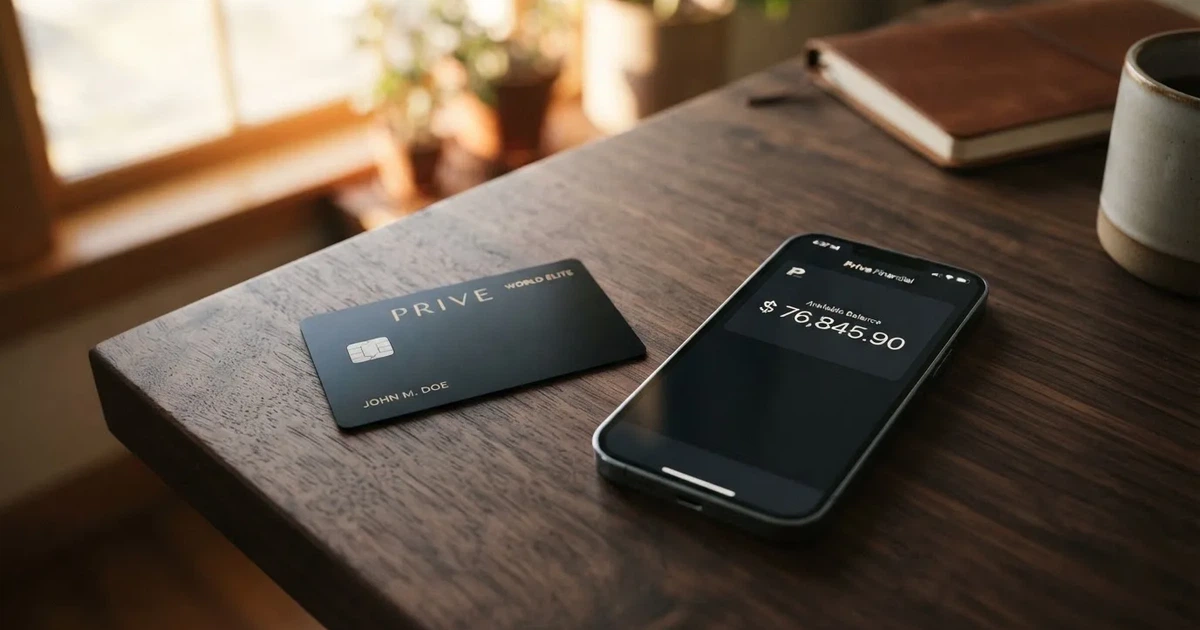
The Prive card sits in an odd middle ground that neither the crypto crowd nor the mainstream world has a neat word for. It is not a bank account with a crypto wrapper. It is a Visa Platinum card that draws on stablecoins you already hold in your own wallet, plus a handful of fiat balances, and it is sold on the idea that you keep your keys while spending real money at real shops. The mechanics are, on paper, sensible. The disclosure is not. Prive Technologies Limited describes itself as “not a bank”, does not name its card issuer on the pages I could read, publishes no country list, and does not publish daily or monthly limits. The fee schedule, dated 12 April 2026, is unusually clear in one respect — the numbers are there — but the largest number most people care about, how much you actually pay a month, is simply absent because there is no monthly fee. That is a good thing, and I want to be fair about it. My score is 5.1 out of 10, which is not a verdict of “bad”. It is a verdict of “unfinished disclosure on top of a workable idea”.
The conditions described here are current as of October 28, 2026.
Verdict: 5.1 out of 10
Let me put the score on the table first, then explain it, because a bare number tells you nothing about whether it suits you.
| Criterion | Mark | Why |
|---|---|---|
| Who can get it | 5 / 10 | No country list published; off-ramps to bank accounts in 80+ countries; site terms written for Hong Kong residents; sources disagree on Hong Kong availability |
| Cost | 3 / 10 | Metal card $99.00, virtual $10.00 (shown discounted to $5.00); top-up 0.50% plus $0.05 network fee; FX markup 2.00%; ATM 1.00% |
| Top-up options | 7 / 10 | USDC, USDT, EURC, PYUSD from a non-custodial wallet, plus fiat rails via FPS, ACH, SEPA; networks not named |
| Reliability and complaints | 5 / 10 | Prive Technologies Limited, “not a bank”; issuer and FCA number not named; reports of login failures after an update and slow support; iOS app 4.3 from 20 ratings |
| Everyday use | 7 / 10 | Virtual and metal card; ATM markup 1.00%; a Google Pay terms page exists; unofficial reports say Apple Pay and Google Pay are unsupported |
Total: 5.1 / 10.
Who this card is for, plainly: you already hold USDC or USDT in a wallet you control, you spend in currencies other than the dollar often enough that a 2% FX markup annoys you but does not ruin you, and you would rather your crypto stay in your own wallet than on someone else’s balance sheet. If that is you, the Prive card is one of the more honest attempts at the self-custody card problem, and the fee schedule does not hide anything once you find it.
Who it is not for: anyone who needs a predictable answer to “can I use this in my country”. The card’s own site shows no country list. The terms say the content is “intended exclusively for Hong Kong residents”. A third-party catalogue says the opposite — that it is not available in Hong Kong. I cannot resolve that contradiction from public pages, and you should not expect me to. If your country is not Hong Kong and not obviously one of the 80-plus off-ramp destinations, you are in the category where the answer is genuinely unknown until you apply.
Will they give you the card?
Short answer: probably, if you are 18 or over and your documents check out, but nobody outside Prive will tell you in advance whether your country qualifies.
Age requirement is 18 or the age of majority, per the Terms. Membership is “subject to application and verification” at Prive’s discretion. Identity checks run through two named providers, Sumsub and Bridge. The help centre carries eight articles about KYC but does not show the documents themselves. No country list appears on the site, though off-ramps reach bank accounts in 80+ countries.
Then there is the Hong Kong problem. Terms state the content is “intended exclusively for Hong Kong residents.” A crypto card catalogue, which is an unofficial source not confirmed by Prive, says the opposite: early access, invitation required, and not available in Hong Kong. Both cannot be right, and Prive’s own public pages do not confirm which is current. If you want to know whether you can open an account where you live, the honest answer is that Prive’s public pages do not tell you, and you would be relying on third-party sources to fill the gap.
There is one more limit worth naming here before it surprises you later: verification tiers set your card limits, and the tier names, what each tier unlocks, how long review takes and why a review can be rejected are not stated. A catalogue entry, unofficial and not confirmed by Prive, names a single level “ID Verification” and mentions complaints about slow KYC review. So even the shape of the ladder is guesswork.
How to get it
Short answer: install the app, onboard and verify, order the virtual card, then request the metal card inside the app. That is the published sequence, and it is short because there is no branch and no paperwork by post.
The card itself is a Prive Visa Platinum, available as a virtual card or as a physical “premium metal” card. The card currency is not stated on the schedule, which is worth pausing on: you hold fiat balances in GBP, USD, EUR, NGN, KES, MXN and BRL, and the card draws on them, but which currency a given purchase is priced in is not published.
Metal card shipping is $60.00, and that figure is included in the $99.00 headline price. Where it ships and how long it takes are not stated, which for someone outside Hong Kong is a real gap. Replacing a lost, stolen or damaged metal card costs $99.00 — the full price again, with no statement about whether shipping is included on a replacement.
On documents: an unofficial catalogue entry, not confirmed by Prive, says an email address, a phone number and an identity document are required, and that proof of address and a selfie are not. I would treat that as a useful expectation-setter and nothing more. What I will say is that with Sumsub and Bridge in the loop, both of which are identity-verification vendors that compare documents against records, you should assume your document will be read closely and that unusual lighting or an old document is a real failure mode. Anyone planning to apply from a place where their address documents are informal should expect friction.
And the thing to check before you invest time: the tier system. Because limits are set by tier and the tiers are not published, the amount you can spend may be materially smaller than the headline figure below until you have been a customer for a while.
What it really costs: Fees and limits
Short answer: the card costs $5.00 to $10.00 as a virtual card or $99.00 as metal, there is no monthly fee, and after that you pay a 0.50% top-up fee, a 2.00% currency markup and 1.00% at the ATM. The fee schedule is effective 12 April 2026 and the card says fees may change with 15 days’ notice.
| Fee or limit | Value |
|---|---|
| Metal card | $99.00 ($39.00 card fee + $60.00 shipping) |
| Virtual card | $10.00, shown discounted 50% to $5.00 |
| Monthly fee | None listed |
| Card closure | Free |
| Top-up fee | 0.50% ($0.50 minimum, $999,999 maximum) plus $0.05 network fee (USDT/USDC) |
| FX markup | 2.00% |
| Domestic transactions | No extra fee |
| ATM withdrawal markup | 1.00% |
| Declined authorisation | $0.50, only if your decline rate exceeds 5% over 10+ attempts |
| Per-transaction limit | Up to $100,000 per transaction |
| Daily and monthly limits | Not stated; limits depend on your verification tier |
| ATM free allowance | Not stated |
Now the everyday part, because a fee table does not tell you what a Tuesday costs. Consider three ordinary payments.
A $20 lunch paid in a currency you are not holding. This is where the 2.00% FX markup applies, and it is the fee most likely to surprise you because it never appears on a receipt line you were looking at. On $20 that is roughly forty cents, and it is charged on top of whatever rate the card network gives you. Prive states plainly that domestic transactions carry no extra fee, so if you are spending a balance you hold in the same currency you are transacting in, this does not touch you.
A $200 online purchase in dollars, funded from a stablecoin balance. Here you are looking at the 0.50% top-up fee with its $0.50 floor and the $0.05 network fee if the funding runs through USDT or USDC. On $200 the percentage fee is a dollar; on a $15 purchase the $0.50 floor does the work instead. The network fee is charged by the blockchain, not by Prive, so it is small but real.
A $60 cash withdrawal abroad. The 1.00% markup is on top of whatever your own bank or ATM operator charges, and Prive does not state a free allowance, so I would assume every withdrawal pays it. This is the single fee I would most want to see a number for and it is the one the page is thinnest on.
What is genuinely good about this schedule: no monthly fee, no dormancy fee, free closure, and a decline penalty that only triggers at a 5% decline rate over ten or more attempts. That last one is well designed — it targets people hammering a card with declines, not people having one bad week.
What is not good: the 2.00% FX markup sits on top of a Visa rate, which makes the real cost of a foreign purchase meaningfully higher than 2%. And an unofficial catalogue lists daily, monthly and ATM limits as unlimited while also listing every fee as free, which contradicts the official schedule so completely that I would not use it for anything except as a warning about third-party listings.
How to Top up the card
Short answer: from your own wallet with USDC, USDT, EURC or PYUSD, instantly, or with fiat through FPS, ACH or SEPA rails.
This is the strongest part of the offer and it earns the 7 out of 10 in my table. The design is the right one: your crypto stays in a non-custodial wallet, the card pulls from your balance, and top-ups are instant from that balance. There is no exchange step where a third party holds your funds while you wait.
The stablecoins named are USDC, USDT, EURC and PYUSD. The cost is 0.50% with a $0.50 minimum, plus $0.05 for the network on USDT and USDC. Fiat top-ups work in GBP, USD, EUR, NGN, KES, MXN and BRL via FPS, ACH and SEPA, and the fiat-side fees are not stated. A minimum top-up figure is not given either, apart from the fee minimum, which is a different thing entirely.
Here is the practical warning. The networks are not named. That sounds like a small omission until you try to move funds: blockchain transfers are irreversible, so a deposit sent on a network the provider does not support, or to an address belonging to a different network, can be lost outright or need a manual support recovery with no guarantee. If you have ever been told to “send USDT on Arbitrum” and then discovered the recipient expected Tron, you know exactly what I am describing. Before your first transfer, find out which networks Prive accepts for each token, and send a small test amount rather than your working balance. Circle also stopped supporting USDC on Tron in February 2024, so “USDC over TRC20” is not a native option you can assume.
Withdrawal works the same way in reverse: 0.00% with a $0.01 minimum, plus the $0.05 network fee on USDT and USDC, and off-ramps to local bank accounts in 80+ countries. The Terms state that on termination, outstanding balances become due. If you close the account with money still on it, that money is not simply forfeited by neglect; the terms say you owe it. There is an account-closure disclosure page, which is more than most in this category bother to publish.
Paying with it every day
Short answer: it is a Visa Platinum, so it works wherever Visa works, with a virtual card for online and a metal card for everything else — but whether you can put it in your phone’s wallet is genuinely unclear.
Everyday spending is where this card is at its most ordinary, and that is a compliment of a sort. Visa Platinum acceptance is broad. The virtual-versus-metal choice costs you nothing in function: the two differ by price only. Spending against the loaded balance means the card cannot overdraw.
Cash is the weak point, with the 1.00% ATM markup noted above and no free allowance published.
Mobile wallets are the mess. There is a Google Pay terms page on Prive’s site at /legal/prive-googletnc, which strongly suggests the wallet is supported. Apple Pay is not stated at all. An unofficial catalogue, not confirmed by Prive, says both Apple Pay and Google Pay are “not supported” — which directly contradicts the existence of that Google Pay terms page. I cannot tell you which is true. What I can tell you is that this matters more than it used to: many merchants and a lot of in-app billing now route through tokenised mobile wallets rather than card numbers, so an unsupported wallet can quietly shrink where you can actually pay. Check it yourself in the app before you rely on it.
Blocked merchant categories are not stated. In this category that usually means gambling and similar categories, which many issuers block by policy rather than law, and the list varies by issuer — so you cannot assume either way.
Points are earned on top-ups, payments, withdrawals and referrals, and can only be used inside the app. No cashback is stated. Read that as: this is a nudge back into the Prive app rather than money in your pocket.
The app itself: iOS sits at 4.3 out of 5 from 20 ratings, which I read on 21 October 2026. Twenty ratings is a small sample, so treat that number as a signal rather than a verdict. A Google Play listing exists under life.prive but its rating could not be read.
One thing that could matter a lot to you: the Terms place arbitration in Hong Kong under HKIAC, and the card chargeback process and time frames are not published — the card agreement page shows “content not yet available”. If a payment goes wrong, the published route to getting your money back is a legal arbitration framework in a jurisdiction that may not be yours.
What can go wrong
Short answer: the technical design is conservative, and the risk is concentrated in the gaps — who issues the card, which country you are in, and what happens when something fails.
Start with the corporate picture, because this is where a careful reader should slow down. Prive Technologies Limited states plainly that it is “not a bank”. Card services are delivered through unnamed “licensed card programme partners”. The issuer is not named. No FCA authorisation number is stated. The Terms are governed by Hong Kong law. So the card you are being offered sits behind a company that is not a bank, using a partner whose name it does not publish, under the law of a jurisdiction you may not live in. That is not automatically bad — plenty of legitimate companies operate exactly this way — but it does mean you are being asked for trust in a structure you cannot fully inspect.
On your money: the crypto side is non-custodial, under the slogan “Your Wallet. Your Keys.”, which is the correct default and the main reason I did not score this lower. Fiat balances are held with “regulated partners”. Safeguards listed are biometric login, two-factor authentication and real-time fraud detection. FSCS protection does not apply, per the FCA page — so any fiat balance you hold here is not a bank deposit and carries no deposit guarantee.
On reliability, I found no official incident reports. What I did find was a user report, via an unofficial catalogue summary from 2026: login failures after an update, slow and vague support, and payment links that require the payer to register and pass KYC. I searched Reddit and Trustpilot and found only unrelated shopping sites sharing the accented name — and no Trustpilot page for Prive Money exists. So the complaint picture here is thin, which cuts both ways: thin because there is little to complain about, or thin because few people are using it. With 20 iOS ratings, the second reading is hard to rule out.
Two general risks from this category that apply to Prive like any card of its type, worth knowing before you are surprised. First, stablecoins are not actually stable: USDC briefly lost its peg in March 2023 during the US banking crisis, and TerraUSD collapsed outright in May 2022. A 2% markup is a known, fixed cost; a depeg is an unknown one. Second, tokenised mobile payments can be restricted at the issuer’s discretion — a tokenised number can be blocked for phone or online use specifically — so a wallet that worked yesterday can stop working without anything you did.
Fees can change with 15 days’ notice, and the schedule itself is dated 12 April 2026, so anything you memorised from an older article may already be stale. The iOS app was at version 1.0.36 in October 2026.
Support is listed as Help Center and online support “24 hours a day, 7 days a week”, at [email protected], and the app is available in English and ten other languages; Russian is not confirmed. Round-the-clock availability is a claim, not a measurement — the user report above describes support as slow, and those two things can both be true.
What to take instead
Short answer: if your priority is a published, checkable answer about where you live and what you pay, the alternatives below are currently easier to verify than Prive is.
I want to be careful here. These are not better cards in every way — they are more legible cards, which is a different and narrower virtue. Prive’s self-custody model is genuinely distinct; none of the three below describe themselves the same way.
| Prive | BloFin Wallet Card | Decaf | SafePal | |
|---|---|---|---|---|
| Score in my comparison | 5.1 / 10 | 6.9 / 10 | 6.2 / 10 | 6.2 / 10 |
| Who can get it | No country list; terms say Hong Kong residents | No country list published; starting data lists 35 countries | Long published restricted list by country and US state | Regions list was empty when fetched |
| Card | Visa Platinum, virtual or metal | Visa Platinum; virtual/physical not stated | Visa, virtual or physical | Virtual Mastercard debit |
| Card cost | $5.00–$10.00 virtual, $99.00 metal | Activation, annual, issuance, dormancy all $0.00 | $5 virtual; $10 physical (US) or $90 (rest of world); no annual fee | Issuance fee not stated; no account fees |
| Spend or FX cost | 0.50% top-up, 2.00% FX, 1.00% ATM | 1.00% or lower by VIP tier, from 1.00% down to 0.00% | No FX fee of its own — “the FX is the one Visa offers” | 1% FX on non-USD settlement; top-up 0% standard, “as low as 0.4%” top tier |
| Funding | USDC, USDT, EURC, PYUSD from own wallet, plus FPS/ACH/SEPA | USDT and USDC on Arbitrum and Base | Card, bank transfer or USDC; coins and networks for card top-up not stated | 40+ blockchains converted to USDC or fiat |
| Rewards | Points in-app only; no cashback stated | No cashback; reduced spend rate instead | Not stated | No cashback; referral commissions up to 40% of referred top-up fees |
Where each one wins. If your objection to Prive is “I cannot find out if this works where I live”, Decaf is the only card here with a published answer — and its answer is a long restricted list covering Belarus, China, North Korea, India, Iran, Iraq, Israel, Myanmar, Nepal, Russia, Syria, Turkey, Cuba, Ukraine, Venezuela, Vietnam, Nicaragua, Puerto Rico and Nigeria, plus restricted US states including Arizona, Delaware, Georgia, Idaho, Louisiana, Maryland, Montana, Ohio, Oregon, Rhode Island, Washington and Wisconsin. Whether that is applied by citizenship or by residence is not stated, which is its own ambiguity. But at least you can read it.
If your objection is cost, BloFin is the cheapest to hold: zero activation, annual, issuance and dormancy fees. It charges 1.00% or lower at payment depending on VIP tier, and it says so with a full ladder — VIP 0 at 1.00% down to VIP 5 at 0.00%. That transparency is worth something on its own. Its weakness is that its country list is equally unpublished, and its top-up is limited to two tokens on two named networks.
If your objection is the FX markup specifically, Decaf adds no FX fee of its own and uses the rate Visa offers. Prive’s 2.00% sits on top of that same Visa rate. For heavy foreign spending, that difference is the whole argument. Decaf’s card cost is also the one to watch: $90 for a physical card outside the US.
SafePal is the odd one out — a virtual Mastercard debit with limits quoted in EUR, funded from 40+ blockchains converted to USDC, with a 1% FX fee on non-USD settlement and no cashback. Its regions page was empty when I fetched it, so I would not lean on it for geographic certainty either.
One option that is not on this list but you should consider: doing nothing and using a normal bank card with a self-custody wallet kept entirely separate. If the amounts you spend are modest and your country is uncertain, that is the choice with the fewest unknowns.
Who I would recommend it to
Three groups, and I want to be specific rather than generous.
If you hold stablecoins in a self-custody wallet and spend them regularly, and you have confirmed your country works, this is a reasonable card at a fair price. The $99 metal card is a real cost, but the virtual card at $5.00 to $10.00 is genuinely cheap, there is no monthly fee, and keeping your crypto in your own wallet until the moment of payment is the correct default that most of this category still gets wrong.
If you travel or receive money in several currencies, look at the FX markup first and consider Decaf as an alternative. At 2.00% on top of the Visa rate, a heavy spender in one country and a heavy spender in another pay meaningfully different totals, and you can do that arithmetic before you sign anything.
If you need to know exactly what you are signing up for, wait. Not because Prive looks like a fraud — it does not, and its fee schedule is more candid than most — but because an unnamed issuer, an unpublished country list, unpublished daily limits, unpublished verification tiers and an unavailable chargeback section are five gaps in a row. Each one alone might be forgiveable. Together they mean you cannot fully price the risk before you commit, and that is the honest reason my score sits where it does.
What would move this score up, in order of likelihood: naming the card issuer, publishing the country list, publishing daily and monthly limits, and filling in the chargeback page. None of those are expensive. All of them are the difference between a card you can evaluate and a card you have to trust.
Frequently asked questions
What is the Prive card?
The Prive card is a Visa Platinum debit card that spends stablecoins and fiat balances rather than a bank account. You hold USDC, USDT, EURC or PYUSD in a non-custodial wallet of your own, and the card draws on that balance at payment. Prive Technologies Limited runs the app; the card itself is issued through card programme partners the company does not name.
Is Prive a bank?
No, and it says so itself: Prive Technologies Limited describes itself as “not a bank”. Card services go through unnamed “licensed card programme partners”, the issuer is not named, and no FCA authorisation number is stated. The Terms are governed by Hong Kong law. FSCS protection does not apply, so any fiat balance you hold is not a bank deposit.
Who can get the Prive card?
You must be 18 or the age of majority and pass identity verification through Sumsub and Bridge, and membership is subject to Prive’s discretion. The site publishes no country list, its Terms say the content is intended exclusively for Hong Kong residents, and an unofficial catalogue says it is not available in Hong Kong. Those last two cannot both be true.
How much does the Prive card cost?
The metal card is $99.00, made up of a $39.00 card fee and $60.00 shipping, and replacing a lost or damaged metal card costs $99.00 again. The virtual card is $10.00, shown discounted by half to $5.00. There is no monthly fee and no dormancy fee, and closing the card is free.
What fees do I pay when I spend?
Beyond the card price, the costs are a 0.50% top-up fee with a $0.50 minimum plus a $0.05 network fee on USDT and USDC, a 2.00% currency markup, and a 1.00% markup on ATM withdrawals. Domestic transactions carry no extra fee. A declined authorisation costs $0.50, but only if your decline rate exceeds 5% over ten or more attempts.
How do I top up the Prive card?
You top up from your own non-custodial wallet holding USDC, USDT, EURC or PYUSD, and the top-up is instant from your wallet balance. You can also add fiat in GBP, USD, EUR, NGN, KES, MXN or BRL through FPS, ACH or SEPA rails. The card does not name which networks each token should be sent on, so test with a small amount first.
Can I add the Prive card to Apple Pay or Google Pay?
Unclear, and the sources conflict. Prive publishes a Google Pay terms page at /legal/prive-googletnc, which suggests support, while an unofficial catalogue says both Apple Pay and Google Pay are unsupported. Apple Pay is not mentioned at all. Check inside the app, because mobile wallet support decides where the card can actually be used.
Is Prive card safe to use?
The crypto side is non-custodial — your keys stay with you, which is the safer default. Listed safeguards are biometric login, two-factor authentication and real-time fraud detection. Against that, the issuer is unnamed, FSCS protection does not apply, arbitration sits in Hong Kong under HKIAC, and the chargeback process is not yet published.
What are the limits on spending and withdrawals?
The card is advertised as supporting up to $100,000 per transaction, and top-ups run from a $0.50 minimum up to $999,999. Daily, monthly and ATM limits are not stated; the card says limits depend on your verification tier, and the tiers are not published either. An unofficial listing claims they are unlimited, which contradicts the official fee schedule.
Is the Prive card worth it?
For someone holding stablecoins in a self-custody wallet who spends them often, the $5.00–$10.00 virtual card with no monthly fee is fair value. The 2.00% FX markup is the number to weigh if you spend abroad, and the missing country list, unnamed issuer and unpublished limits are the reason to wait rather than commit. Decaf publishes a restricted-country list and BloFin publishes a full VIP fee ladder, so both are easier to evaluate first.
Wallet cards: the entry point – cryptocardportal.com
Content created by the «cryptocardportal.com» team