
A Visa card that spends straight from your own wallet — and a fee page that says nothing
 Available in US
You probably did not come here from a bank. Maybe a normal card was declined, refused, closed, or never offered in the first place, and now you are looking at crypto cards the way you would look at a workaround. That is a reasonable place to start looking, and this page is written from that position: not as a product pitch, and not as a manual for dodging anything. It is what I could actually establish about NAKA as of the check date, what the public pages leave out, and how the card lines up against three alternatives with more of their numbers published.
The conditions described here are current as of October 28, 2026.
The short version: NAKA is a virtual, tokenized Visa Platinum card that spends USDT sitting in a self-custodial on-chain wallet, with each payment authorised by a signature from your own private key. That is a genuinely different model from most cards in this category, and it has one clear advantage and one clear cost. The advantage is custody — the funds do not sit with a provider. The cost is that almost none of the commercial details are published: price per user, fees, limits, card currency, issuer, licences, ATM allowance. My score is 5.1 out of 10, which reflects a promising mechanism wrapped in missing information rather than a bad product.
The verdict: 5.1 out of 10
Here is the score broken down by criterion, with the reason for each mark in my own words.
| Criterion | Mark | Why |
|---|---|---|
| Who can get it | 5 / 10 | Targets Latin America, app listed “worldwide” without a country list; US citizens are turned away |
| Cost | 5 / 10 | Cost and fees are not disclosed — pricing is “per user” with no figures |
| Top-up options | 3 / 10 | USDt in a self-custody wallet; the app store caption accepts only USDT on Avalanche C-Chain |
| Reliability and complaints | 6 / 10 | NAKA GLOBAL d.o.o. (Ljubljana), ISO/IEC 27001:2022, ISO 9001:2015, ISO 22301:2019; issuer and licences not named; no complaints found; App Store 5.0 from 11 ratings |
| Everyday use | 6 / 10 | Virtual Visa Platinum, Apple Pay and Google Pay present; ATM mentioned without conditions |
Total: 5.1 / 10.
Spending USDT from a self-custody wallet with a Visa card, NAKA suits someone who already lives on-chain, already holds a stablecoin balance, and wants a card that spends it directly without a custodial pool sitting in between. If you have USDT on Avalanche C-Chain, a wallet you control, and a tolerance for signing every payment yourself, the mechanics line up with your habits. If your card problem is that you have no reliable way to receive salary, hold a balance, or get a refund when something goes wrong, the missing information here matters less than the missing banking, and you should be clear-eyed about that difference.
Who it does not suit: anyone who needs published prices before signing up; anyone in the United States, who is excluded; anyone who needs a physical card, since only the virtual one exists; anyone who wants to know which institution actually stands behind the card, since the public pages do not name the issuer. It is also a poor fit if your USDT sits on Ethereum or Tron rather than Avalanche, because the store caption states that only Avalanche C-Chain USDT is accepted.
Will they give you the card
The card “targets Latin America”, the app is listed as “worldwide” without a country list, and the starting data says you must not be a United States citizen. That combination is the eligibility picture: a regional product with a global-sounding listing and one hard exclusion. Whether the Latin America focus is a soft orientation or a hard geographic gate is not something the public pages settle.
Legal documents are split by entity — NAKA Slovenia, NAKA Switzerland, NAKA El Salvador — and the site states that the specific provider depends on your jurisdiction and/or the product suite. A US-specific card agreement also exists. For you, that means the contract you are actually accepting may not be the one you read about. If it matters to you precisely which counterparty you’re contracting with, that is a question to put to the support team before you load anything, not after.
Onboarding itself is light. There is “a quick KYC verification” after you set up the wallet in NAKA Pay+, and no bank account is required. What documents you will be asked for, what proof of address looks like, what age is required, and what verification tiers exist — none of that is stated on the pages I could read. Since KYC is legally required of regulated providers, an absence of detail here does not mean no checks; it means you cannot predict them. Budget for the possibility that verification asks more than you expect.
Fees and the real cost of spending
This is the weakest part of the card, and I want to be plain about it rather than tidy it up. NAKA’s site says pricing is per user rather than per transaction — and publishes no figures. Fees are not stated. That leaves the single most important question for a spending card unanswered: what does a payment cost, and what does the money cost to put in?

The self-custody page says the cards work “online, in-store, and ATM use” with major card networks, but states no ATM fee and no allowance. The app description is of a virtual card. Spending limits are adjustable by yourself in the app, with amounts not stated. Card currency is not stated, and settlement is in USDT per NAKA’s own site. There is a single product, though partner-branded virtual cards are possible.
Here is what the table can honestly carry:
| Fee or limit | What NAKA states |
|---|---|
| Issuance | not stated |
| Monthly fee | not stated |
| Conversion fee | not stated |
| FX fee | not stated |
| ATM fee and allowance | not stated |
| Spending limits | adjustable by the user in the app; amounts not stated |
| Card currency | not stated |
| Settlement | USDT, per NAKA’s site |
| Pricing model | per user rather than per transaction, no figures |
Note that “not stated” here means the card’s public pages do not say — it does not mean the fee is zero.
Now walk three everyday payments through what that means:
A coffee abroad. You tap, Visa converts whatever currency the shop charged into your card’s currency, and your USDT is spent. Whether a conversion or FX fee applies on top, and in what amount, is not published. You also do not know which currency the card converts into. If the answer turns out to be your home currency while you hold only USDT, you are exposed to a second conversion you did not choose.
An online subscription in dollars. Straightforward in shape: the amount is converted and signed. But if the network fee for settling the underlying transfer is charged to you — on-chain network fees are set by the blockchain, not the card provider — then each small recurring payment carries a floor under which it becomes pointless. Nobody has told you what that floor is.
A withdrawal at an ATM. The card claims ATM use works across major networks. No fee, no daily allowance, no currency is published, and the app description only describes a virtual card. This is the case where the missing information bites hardest, because ATM access on other cards is precisely where the fine print lives.
Compare that with Decaf, which states an activation price and no annual or monthly fee and says it adds no FX fee of its own, or SafePal, which publishes a 0% standard top-up fee and a 1% Mastercard non-USD settlement fee. All three are imperfect, but you can do arithmetic with them. With NAKA, you cannot — not before you have signed up and seen the app.
How to top up
The funding story is the part of NAKA that is most clearly described, and also the part where a single mistake is most expensive. USDt is held in a self-custodial on-chain wallet, and each payment is “settled via smart-contract signature”. The store listing caption states that only USDT on the Avalanche C-Chain network is accepted.
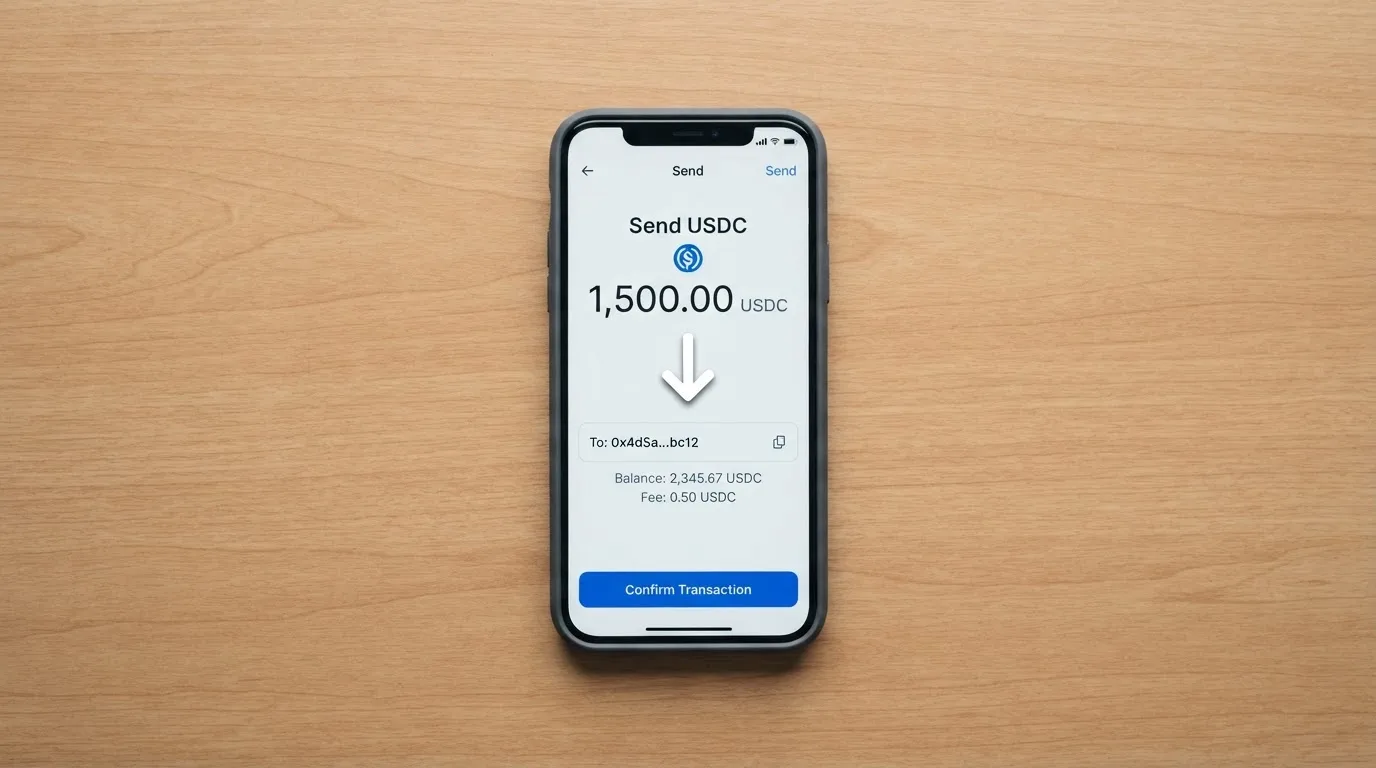
Read that network requirement twice. Blockchain transfers are irreversible, so a deposit sent on a network the provider does not support — or to an address belonging to a different network — can be lost outright or need manual support recovery with no guarantee. If your USDT sits on Ethereum or Tron and you assume any network will do, you are gambling with the deposit.
Two related points on getting money back and moving money in. Top-up methods are not stated beyond that. Withdrawal is not stated either — what is stated is that funds remain on-chain in your own wallet until a payment is signed. That is the defining characteristic of this model, and it cuts both ways: nothing to withdraw from the provider, and nothing for the provider to hold or to owe you.
One more thing you will meet sooner or later: stablecoins are not censorship-proof. Tether says it disables tokens in wallets on the OFAC sanctions list and has frozen funds tied to illicit activity. Self-custody means you control the key; it does not mean the token issuer has no reach.
Paying with it every day
Day to day, the card behaves like a prepaid instrument, and that is where it diverges from a normal bank card in ways worth understanding before you rely on it.
Most crypto cards convert your crypto into a stored fiat or stablecoin balance, and the card spends only that balance — which is why the card cannot overdraw. NAKA’s version is stricter: funds stay in your own wallet until you sign a payment. The practical consequence is that every transaction requires a cryptographic signature from your private key, the key never leaves your device, and there is no shared custodial pool. You can freeze or block the card and set limits in the app.
- Virtual, tokenized Visa Platinum card, stated to work at “over 150 million locations”.
- Apple Pay and Google Pay integration per the launch post; the store listing also mentions Apple Wallet tap-and-go.
- Blocked merchant categories are not stated. Note that gambling (MCC 7995) and other categories are commonly restricted by policy rather than law, and the list varies by issuer — you would need to ask.
- Rewards are not stated for the card. A blog post describes “programmable rewards” as a partner feature, which is not the same as a personal cashback scheme.
The app is NAKA Pay+, from developer NAKA GLOBAL d.o.o. Per a third-party report read on 2026-10-21, mwm.ai saw App Store rating 5.0 from 11 ratings, version 2.2. A Google Play listing exists but its rating was not obtained. Eleven ratings is a very small sample; treat 5.0 as almost no information.
Two everyday frictions deserve naming. First, address verification: AVS compares the numeric parts of the billing address you type with issuer records, and it is generally unavailable for foreign-issued cards, which causes declines. This is exactly the profile of a card issued in one jurisdiction and used in another. Second, a declined authorisation can leave a hold on your funds for several days, typically up to seven — and if the balance is your USDT rather than a bank balance, that hold sits in a self-custody wallet, not in a system with a support desk.
Disputes are another gap. Terms titled “NAKA Spend Card Terms” exist but were not read, so I cannot tell you how a chargeback works here, whether prepaid-card protections apply, or what happens when a merchant refuses. On US law generally, debit card reversal rights come from Regulation E and credit card rights from Regulation Z, and prepaid coverage varies — but I am not in a position to say which of those applies to this product, and you should not assume either.
What can go wrong
Let me separate things I found from things I could not find, because “no problems found” on a young product is weak evidence.
No complaints found. A search for reviews of this card turned up no Trustpilot or Reddit page, and no official incidents surfaced. Two readings are possible: the product is clean, or nobody has written about it yet. Given the launch post is dated October 24, 2025 in page metadata — with a conflicting October 6, 2026 date showing in the same metadata — and the NAKA Pay+ app first released October 9, 2025 per a third-party report, the second reading deserves weight.
Company. NAKA GLOBAL, finančne tehnologije, d.o.o., Letališka cesta 33F, 1000 Ljubljana, Slovenia, registration number 8106452000, with related entities NAKA CH SAGL (Switzerland) and NAKA SLV, S.A. de C.V. (El Salvador). The company holds ISO/IEC 27001:2022, ISO 9001:2015 and ISO 22301:2019. Those are real certifications and worth something. But the pages I read name no card issuer and no licences.
That distinction matters more than the ISO marks suggest. Visa and Mastercard do not issue crypto cards to consumers themselves; they license issuers, and they can suspend a programme. A card programme normally sits with a bank or an electronic money institution licensed under the network’s licence, while the crypto brand is often only a programme manager or front end. In the EU, an electronic money institution may issue e-money and payment cards but cannot lend. Without a named issuer, you cannot tell which licence underwrites your balance or what happens to the card if the relationship ends — because programmes do end. Visa terminated its global agreements with FTX on 13 November 2022 and the FTX US debit card was wound down; WaveCrest, a Visa card issuer that supplied crypto card brands, was suspended by Visa in Europe in 2018 and all its Visa programmes closed.
Key risk is yours. Self-custody removes counterparty risk and adds key risk. Your seed phrase — typically 12 to 24 words — is an unencrypted form of the private key, and anyone who obtains it can restore the wallet and spend its funds. Transfers are typically irreversible, and a stolen key has no built-in recovery; the network cannot freeze or return funds. With self-custody you bear sole responsibility for key loss, phishing, and clipboard-hijacking malware that silently swaps a copied address.
Sanctions and jurisdiction. Nationality is recorded and screened separately from residence because sanctions screening is usually applied to citizenship and country of birth as well as address. If you are a US citizen, you are out, plainly. For others, the entity that contracts with you — Slovenia, Switzerland, or El Salvador — may sit under a different regime than your home country, and the pages do not explain how that resolves.
Stability and enforcement. Stablecoins can depeg: TerraUSD collapsed in May 2022, and USDC temporarily lost its peg in March 2023 during the US banking crisis. And stablecoins are not risk-free instruments in a legal sense either — Tether’s freezing policy is stated above. If your balance is USDT and your card settles in USDT, you are spending a dollar-pegged token, not dollars.
Support. There is a “Talk to our team” contact page at naka.com/contact. That is a contact route, not a published response time, support-hours schedule, or escalation path.
A closing caution on numbers. Some of what is missing is legally required to exist somewhere — for EU-based e-money, MiCA’s transitional period runs to 1 July 2026 or until a provider receives or is refused authorisation, whichever comes first, and ESMA maintains an interim register of authorised crypto-asset service providers and non-compliant entities you can check. Card programmes are regulated separately from crypto under payment-services and e-money law. None of that tells you what NAKA’s issuer is. But it does mean a register exists, and if the answer matters to you, looking there costs you an afternoon.
What to take instead
Here is how the four compare on what is published rather than on what works.
| NAKA | BloFin Wallet Card | Decaf | SafePal | |
|---|---|---|---|---|
| Score | 5.1 / 10 | 6.9 / 10 | 6.2 / 10 | 6.2 / 10 |
| Card | Virtual Visa Platinum | “BloFin Wallet Visa Platinum card” (virtual/physical not stated) | Decaf Visa, virtual or physical with tracked delivery | Virtual Mastercard debit |
| Eligibility | Targets Latin America; app “worldwide” without country list; not for US citizens | 35 countries listed including US, Australia, Japan, UAE, Brazil, Mexico, Malaysia, New Zealand; citizenship vs residence not stated | Not issued in 18 named countries; 11 named US states restricted; whether by citizenship or residence not stated | “Citizens of supported regions who live in supported areas”; region list empty when fetched |
| One-off cost | not stated | Activation, annual, issuance, dormancy $0.00 each; cancellation no fee | Virtual $5 worldwide; physical $10 US only, $90 rest of world; no annual/monthly fee | No account creation or management fees; issuance fee not stated |
| Ongoing fees | not stated | Spend fee “1% or lower” by VIP tier (1.00% down to 0.00% at VIP 5), charged at payment; FX not stated | No added FX fee, “the FX is the one Visa offers”; crypto conversion fee not stated | Standard top-up 0%; Mastercard non-USD settlement 1% FX; refunds 1 USD/EUR/CHF/7 CNH; swaps include an unquantified spread; crypto top-up “as low as 0.4%” on top tier |
| Funding | USDt in self-custody wallet; only USDT on Avalanche C-Chain per store caption | USDT and USDC on Arbitrum and Base | Pay by card, bank transfer or USDC; runs on Solana and Stellar; which coins/networks top up the card not stated | Crypto from 40+ blockchains converted to USDC or fiat; transactions on Arbitrum |
| Rewards | not stated for the card | No cashback or rebates; lower spend rate instead | not stated | No cashback; referral commissions up to 40% of referred top-up fees |
The honest summary: NAKA loses on transparency, and it loses mostly on disclosure rather than on design. Two specific comparisons stay with me.
Against BloFin (6.9 / 10). BloFin publishes a full fee ladder — 1.00% at VIP 0 down to 0.00% at VIP 5 — and zeroes for activation, annual, issuance and dormancy. That is arithmetic you can do before you commit. Its trade-off is custody-by-proxy rather than self-custody, and its funding is on Arbitrum and Base rather than Avalanche.
Against Decaf (6.2 / 10). Decaf names its restricted countries and states outright that it adds no FX fee, using Visa’s own rate. It also gives you the most explicit geography of the four: 18 countries excluded including Russia and Belarus, plus 11 named US states — though it does not say whether the test is citizenship or residence. NAKA by contrast says “targets Latin America” and leaves the rest to a “worldwide” label.
Against SafePal (6.2 / 10). SafePal publishes a 0% standard top-up fee and a 1% non-USD settlement fee, and supports funding from 40+ blockchains — the broadest network coverage of the four, though its spread on swaps is not quantified. Its own region page came back empty when fetched, which is its version of NAKA’s missing country list.
None of them publish a clear answer to the question behind your search: which licensed institution stands behind the card. That is worth pressing every one of them on.
Who I would recommend it to
If you have USDT on Avalanche C-Chain, you already run a self-custody wallet confidently, you can afford to lose a mistaken transfer, and your card problem is specifically that custodial platforms keep failing you — this card is worth an afternoon of your time. The mechanism is coherent, the company is real and certified, the app exists on both stores, and the security posture of never letting the key leave your device is the strongest claim on this page.
If instead you need a card with known costs, or you need to know who is liable if it breaks, or you want a physical card, or you are in the United States — pick a different one from the table above and accept the custodial trade-off in exchange for numbers you can read. You are not losing much by trading self-custody for disclosed fees; most people’s actual problem is predictability, not purity.
And if your underlying issue is that you need a functioning banking relationship rather than a way to spend crypto, none of these four is that. Cards like these are a spending tool, not an account.
I will not tell you it is worth it or not worth it, because on the published evidence nobody can. What I will say is that a 5.1 is not a verdict on the product — it is a verdict on how much NAKA has chosen to tell us.
Frequently asked questions
What is the NAKA card?
NAKA is a virtual, tokenized Visa Platinum card that spends USDT held in a self-custodial on-chain wallet. The company says it works online, in-store and at ATMs across major card networks, and at “over 150 million locations”. Funds stay in your own wallet until you sign a payment. Only the virtual card exists; there is no physical version described.
How does a self-custody crypto card work?
Each payment requires a cryptographic signature from your private key, and the key never leaves your device. Because the balance stays on-chain in your wallet, there is no stored prepaid balance to overdraw and no custodial pool to trust. The cost of that model is responsibility: key loss, phishing and clipboard malware that swaps copied addresses are all yours to manage, and transfers are typically irreversible.
Is NAKA a bank?
The public pages I read do not present NAKA as a bank. The developer is NAKA GLOBAL, finančne tehnologije, d.o.o. at Letališka cesta 33F, 1000 Ljubljana, Slovenia, registration 8106452000, with ISO/IEC 27001:2022, ISO 9001:2015 and ISO 22301:2019. Related entities are listed in Switzerland and El Salvador. The card issuer and licences are not named.
Who can get the NAKA card?
The product targets Latin America and the app is listed as “worldwide” without a country list. Starting data says you must not be a United States citizen. Verification is “a quick KYC verification” after wallet setup, with no bank account required — but required documents, proof of address, age and verification tiers are not stated.
What does the NAKA card cost?
That is the central gap. NAKA’s site says pricing is per user rather than per transaction and publishes no figures; fees, ATM costs, card currency and spending-limit amounts are all not stated. You can set spending limits yourself in the app, but the amounts are not published either. I would not sign up expecting to know the cost first.
Which networks can I use to top up?
The store listing caption states that only USDT on Avalanche C-Chain is accepted, and NAKA’s model has USDt held in a self-custodial wallet settled via smart-contract signature. Since transfers are irreversible, sending on an unsupported network can lose the deposit or need manual recovery with no guarantee.
Can I add NAKA to Apple Wallet or Google Pay?
Yes — the launch post states integration with Apple Pay and Google Pay, and the store listing mentions Apple Wallet tap-and-go. One thing to understand: Apple Pay replaces the card number with a device-specific number in the Secure Element and each payment uses a one-time code, so a tokenised phone payment behaves differently from a card present in a terminal.
Is the NAKA card safe?
The security model is genuinely strong in one respect: keys never leave the device and there is no shared custodial pool, with freeze, block and limit controls in the app. But safety also depends on the institution behind the card, and the issuer and licences are not named. Visa and Mastercard do not issue these cards themselves — they license issuers, and programmes have been terminated before.
Why do I see no reviews of this card?
A search for reviews found no Trustpilot or Reddit page for this card, and no official incidents. The launch post is dated October 24, 2025 in page metadata, with a conflicting October 6, 2026 date, and the app first released October 9, 2025 per a third-party report. Absence of complaints on a product this young is weak reassurance.
Is NAKA worth it compared to BloFin, Decaf or SafePal?
On published information, no — BloFin (6.9 / 10), Decaf (6.2 / 10) and SafePal (6.2 / 10) each state fees you can calculate before committing, against NAKA’s 5.1 / 10. NAKA’s own advantage is custody: your USDT stays in your wallet. Choose it for that, not for value, and only if Avalanche C-Chain is where your balance already lives.
Wallet cards: the entry point – cryptocardportal.com
Content created by the «cryptocardportal.com» team