
A Visa card for USDT and USDC spenders
 Available in US
Before I go further: the conditions below are current as of October 28, 2026.
Score, and who this suits
The single most important thing to understand about Lydian is what kind of card it is. It is Visa-branded, it is issued through Rain (described by the card’s own page as a Visa Principal Member), it comes in physical and virtual form, and it loads from stablecoins. What it is not is a bank account. Nobody has told you otherwise in most places I looked, but “card” and “bank” get confused constantly, and it is worth being blunt: the money sits with a card issuer and a crypto company, not with a deposit-taking bank account in your name.
The score table below gives my mark for each thing I checked and why. The two halves of the picture are quite different: the card is strong on the everyday mechanics — you can pay, you can add it to a phone wallet — and weak on the disclosure side, where limits, networks, ATM fees and several key numbers are simply not published.
| Criterion | Mark | Why |
|---|---|---|
| Who can get it | 5 / 10 | No country list at all; features depend on country of residence and eligibility; adults 18+ |
| Cost | 7 / 10 | No annual fee, physical and virtual free to issue; conversion fees shown before a payment, figures not disclosed |
| Top-up options | 7 / 10 | USDT and USDC directly on supported networks; other assets swapped in the Lydian Wallet; networks not named |
| Reliability and complaints | 8 / 10 | Issuer Rain, a Visa Principal Member; no complaints about the card found; unofficially, backed by Tether and Cantor Fitzgerald |
| Everyday use | 8 / 10 | Visa, physical with chip and tap plus instant virtual, Apple Pay and Google Pay; ATM terms not disclosed |
| Total | 6.9 / 10 | A competent payment card with thin published detail |
Who should read on? Someone who already sits in dollars on-chain, holds USDT or USDC, and wants a card that reads as Visa in a shop rather than a crypto-branded thing that gets declined at the counter. The Visa Platinum framing helps there: the card’s own material lists car rental insurance, purchase protection, extended warranty and 24/7 Visa customer service, with acceptance at “more than 150 million merchants”. If a shop declines a card because it looks unfamiliar, a Visa is the least unfamiliar card there is.
Who should close this tab? If you are in a country where the card turns out not to be available, the answer is no, and I am not going to suggest a way around that. If you need a bank account with a card attached, Lydian is the wrong instrument entirely. And if your priority is low, predictable per-payment costs, this card does not publish the numbers that would let you check that — you would be taking the cost on trust. See the fees section, because that is where this card’s biggest gap sits.
Will they give you the card
Short answer: yes, if you are 18 or over and pass a quick identity check — but nobody will tell you in advance whether your country is one of the supported ones, and that is the single most frustrating thing about applying.
The card publishes no country list. Its stated position is that “availability of features may vary depending on your country of residence and is subject to eligibility requirements”. Read that twice. It means two separate things: whether you can be served at all, and which features you get afterwards, are both decided by internal criteria that are not on the page. Residence-based, not citizenship-based as far as the page goes — but do not read that as a promise about citizenship, because the page does not address it, and country of birth and country of address get screened separately in this industry.
There is one level of verification only: a “quick identity verification” for individuals aged 18 and up. No tier system, no stated processing time, no stated list of reasons a verification can fail. That single point covers a lot of ground, and it cuts both ways — it is simple if it goes well, and opaque if it does not.
How to get it
The flow, as described on the card’s own pages, is short enough to put in a sentence: download the Lydian Wallet app, complete identity verification, get a virtual card in the app instantly, and have the physical one shipped to you.
That last part is the one with gaps. The card says the physical card “ships to your doorstep” and stops there. Which countries it ships to, how long it takes, and what delivery or replacement costs apply are all not stated. If you need the physical card quickly, you are planning around an unknown.
On the card itself: a Visa Platinum, physical with a chip and contactless, plus a virtual card issued instantly in the app. Both are free to issue. The card currency is not stated anywhere on the pages I read — and that matters more than it sounds, because it decides what you are actually converted into at each till. More on that under Fees.
Fees: what it really costs
Here is the honest summary: there is no annual fee and both card forms are free to issue, and then the card stops publishing. Every other figure you would use to work out your own cost is missing from the public pages.
The good part first, and it is genuinely good. No annual fee. Physical and virtual both “free to issue”. Conversion to your local currency happens automatically at the point of sale, and any applicable conversion or network fee is “clearly shown before you complete a transaction”. So you are not asked to guess at the moment of paying — the cost appears in front of you and you accept it.

The problem is that the figures behind that promise are not disclosed. I cannot tell you what a four-dollar purchase costs you in fees, because the card does not say.
| Fee or limit | What the card states |
|---|---|
| Annual fee | No annual fee |
| Card issuance | Physical and virtual free to issue |
| Conversion fee | Shown before you complete a transaction; figures not stated |
| FX and network fee | “Any applicable network or conversion fees are clearly shown before you complete a transaction”; figures not stated |
| ATM withdrawal | Not stated |
| Deposit or top-up fee | Not stated |
| Minimum top-up | Not stated |
| Daily and monthly limits | Not stated; balance “subject to applicable fees and limits” |
| Card currency | Not stated |
| Rewards | “Collect rewards” listed as a feature; no rate or terms stated |
Two everyday payments, taken through what is actually stated:
- A coffee abroad. Your balance is in USDT or USDC. At the till the balance is converted to local currency instantly and automatically, and the applicable network or conversion fee is shown to you before you confirm. What you do not get is a percentage: I cannot tell you what share of the total the fee eats, because no figure is published.
- An online subscription in a currency other than your balance. Same automatic conversion, same pre-payment display. What I cannot tell you is whether there is a second layer — a foreign-exchange margin on top of the network fee — because the FX side is not broken out anywhere.
One structural point makes this less bad than it sounds. This is a pre-loaded balance card, not credit: the card spends only the balance you have loaded, so it cannot overdraw and you cannot wake up to a surprise negative balance from a large purchase. It also means the balance cannot quietly go below zero while you are asleep, which is the failure mode that actually hurts people on cards that draw on a bank account instead.
Top up options
You fund the card natively with USDT and USDC “on our supported networks”. Anything else you hold — bitcoin, ether, a token you picked up in a launch — you swap into the card balance inside the Lydian Wallet.
Getting it wrong has a specific, well-known failure mode in this category, so it is worth being concrete about what is at stake. A blockchain transfer is irreversible. If you send USDT on a network the card does not support, or send it to an address belonging to a different network, the funds can be lost outright, or recovered only through a manual support request with no guarantee. The network’s own fee — gas on Ethereum, bandwidth and energy resources on Tron — is paid by you on top of the card’s fees, because those are the chain’s charges, not the provider’s.
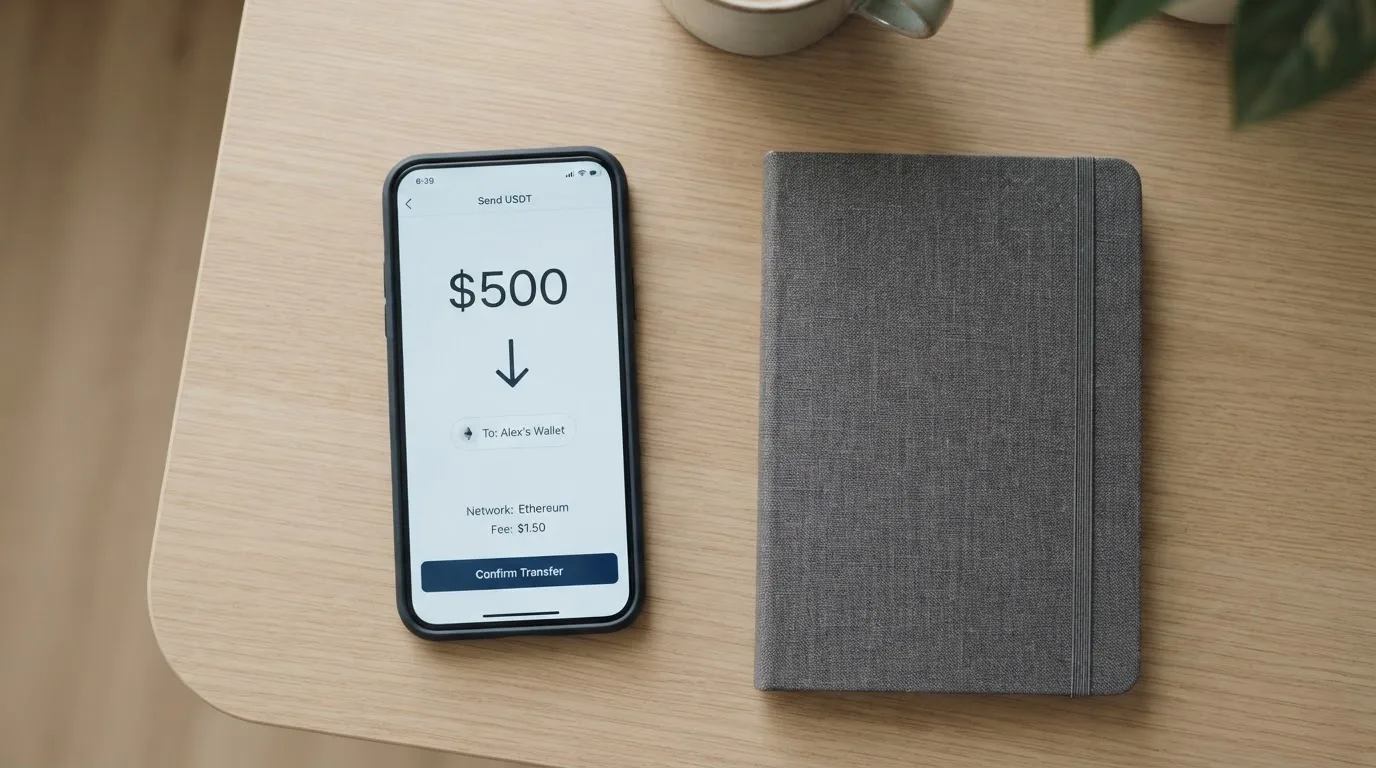
There is one more trap specific to your two main coins, and it catches people out constantly:
- USDT has been issued on Ethereum, Tron, Solana, Polygon, Avalanche and others. Which one you hold, and which one this card wants, are different questions.
- USDC is natively supported on 38 networks as of 16 September 2026, per Circle, including Ethereum, Solana, Base, Polygon PoS, Avalanche, Arbitrum and Stellar. But Circle stopped supporting USDC on Tron in February 2024, so “USDC over TRC20” is not a native option on anyone’s list.
Before your first transfer: get the supported networks from support, and send a small amount first. Withdrawal from the card balance is not stated, which is worth knowing too.
Paying with it every day
…
Where it is thin: blocked merchant categories are not stated, so you cannot tell in advance whether gambling is off the card, and in this industry the answer is often that it is blocked by issuer policy rather than by law. The dispute process is not stated either — the page names Visa purchase protection and stops there. That is the gap that hurts when a charge goes wrong, and it is exactly the moment you will want to know who to call.
…
Also worth knowing about the app: the Lydian Wallet app is paired with a web dashboard. Store and Google Play listings and ratings are not on the card’s pages, so I have no read on how people rate it day to day.
What can go wrong
The problems here are not disasters I have invented for this card — they are the ordinary risks of holding money with a card issuer and a crypto company, and Lydian sits squarely in that space.
Sending to the wrong network. Covered above, and it is the most likely way to lose money with this card. Irreversible, with no published network list to check against.
The issuer is Rain; the brand is Lydian. Two parties, and the card’s page says so plainly: it operates over the Visa network with fraud monitoring and cardholder protections, and it calls these “collateralized credit cards issued through Rain”. The crypto company markets the programme; the issuer holds it. Rain’s own footer describes Visa debit cards issued by Cross River Bank, Member FDIC, with Rain Products as programme manager — though that is general Rain material and may not describe this particular card.
Neither is a bank you can claim against in the ordinary way. A card programme running on e-money or payment-services rules has different protections from a bank deposit. Customer funds are meant to be safeguarded, but that is not the same as a deposit guarantee scheme covering you.
Programmes close. Visa terminated its global agreements with FTX in November 2022 and the FTX US debit card was wound down. Visa suspended WaveCrest in Europe in 2018, closing all WaveCrest-issued Visa programmes. The pattern is always the same: a notice period, then loading and spending stop, then you are asked to withdraw what is left. When that happens to a card holding your monthly money, the timing is the problem.
Your money, someone else’s keys. The card says the Lydian Wallet lets you “maintain control of your assets”. A custodial platform holds your keys, which makes a platform failure your problem: Mt. Gox, Coincheck and the Ronin bridge are all reminders of what that has cost people. A seed phrase is 12 to 24 words in plain form, and crypto transfers have no built-in recovery.
What I found, and did not find. This is the honest part. I found no complaints about this card. Search brought back unrelated brands — Lydia, Sumeria, Lyk Card — and nothing at all about the Lydian card itself, on Trustpilot or on Reddit. No reviews, good or bad. With a card this new, silence is not a quality signal; it means there is no track record yet.
Officially, the card’s launch was announced in a press release dated 20 April 2026: a co-branded Visa Platinum issued via Rain, with 300-plus supported digital assets and instant virtual issue. Unofficially — a third-party report I could not confirm on the card’s own pages — Lydian has been described as backed by Tether and Cantor Fitzgerald.
What I could not find matters as much as what I could: no registration country or licences for Lydian on the page, no card freeze, no two-factor authentication, no spending controls, no insurance detail, no ATM terms, no stated support hours. Contact is a form or live chat at lydian.com/contact, and the page is English only.
What to take instead
None of the three alternatives is obviously better. I include them because the comparison shows what this card chooses to emphasise, and the differences are mostly about what gets published.
| Lydian | BloFin Wallet Card | Decaf | SafePal | |
|---|---|---|---|---|
| Score | 6.9 / 10 | 6.9 / 10 | 6.2 / 10 | 6.2 / 10 |
| Who can get it | No country list; 18+ | No list on the page; starting data names 35 countries incl. US, Australia, Japan, UAE, Brazil, Mexico, Malaysia, New Zealand | Not issued in Belarus, China, North Korea, India, Iran, Iraq, Israel, Myanmar, Nepal, Russia, Syria, Turkey, Cuba, Ukraine, Venezuela, Vietnam, Nicaragua, Puerto Rico, Nigeria; restricted US states listed | “Citizens of supported regions who live in supported areas”; list empty when fetched |
| Card | Visa Platinum, physical and virtual | Visa Platinum; virtual or physical not stated | Visa, virtual or physical with tracked delivery | Virtual Mastercard debit; physical not stated |
| Card issuance cost | Physical and virtual free | Activation, annual, issuance and dormancy $0.00 | Virtual $5; physical $10 (US only) or $90 (rest of world) | Not stated |
| Ongoing fee | No annual fee | No annual fee | No annual or monthly fee | No account or management fees |
| Per-payment cost | Shown before payment; figures not stated | Spend fee 1% or lower by tier, from 1.00% (VIP 0) to 0.00% (VIP 5) | No FX fee added; Visa’s rate used | 1% FX fee on non-USD Mastercard settlement |
| Top-up | USDT and USDC on supported networks (not named) | USDT and USDC on Arbitrum and Base | USDC shown; which coins and networks top up the card is not stated | Crypto from 40+ blockchains to USDC or fiat; Arbitrum |
| Rewards | “Collect rewards”, terms not stated | No cashback; reduced spend rate by tier | Not stated | No cashback; referral commissions up to 40% of referred top-up fees |
Three things stand out.
BloFin publishes its spend fee. From 1.00% at the base tier down to 0.00% at the top, with the tiers named. That is a number you can budget with. Lydian shows you a fee before you pay and does not say what it is, which is arguably better in the moment and worse for planning.
Decaf is the only one that tells you where it will not work. A long restricted list of countries and US states — Russia and Belarus both on it — and the page still does not clarify whether the rule runs on citizenship or on residence. Lydian, by contrast, publishes no list at all.
SafePal’s region list was empty when I fetched it, which is not the same as “available everywhere” and should not be read as either.
Who I would recommend it to
Someone who holds USDT or USDC, has already accepted that an ordinary bank card is not realistic for them, and wants to pay for ordinary things without selling crypto first. For that person this card does what it says, at no annual cost, on Visa, with a virtual card in minutes.
I would not push it on anyone who needs the numbers up front. If you are going to run this card through a currency you do not hold, rely on cash withdrawal, or need to file a dispute, you are relying on things the card has not published. Read the fees section again and notice what is missing there.
My own checklist before I would use it: get the supported networks from support before transferring anything; send a test amount first; find out the card currency and the conversion percentage; and ask what happens to a frozen balance. Four questions, one support form, and I would know most of what I currently cannot.
Frequently asked questions
Is Lydian a bank?
No, and the distinction is worth holding onto. Lydian is a crypto card brand; the card is issued through Rain, which its own page calls a Visa Principal Member. The card’s site does not state Lydian’s registration country or licensing. Rain’s general material describes Visa debit cards issued by Cross River Bank, Member FDIC — but that is Rain-wide and may not describe this card specifically. Your money sits with a card issuer, not in a bank account in your name.
Is the Lydian card safe?
“Safe” splits into two questions. The card side is ordinary: Visa network, fraud monitoring, cardholder protections, 3-D Secure, Apple Pay and Google Pay on both card forms. The custody side is where the risk sits — your balance is with a provider, not in a wallet whose keys you hold. And the card publishes no card freeze, no two-factor authentication, no spending controls. I found no complaints, but also no reviews at all, so there is no track record either way.
Does the Lydian card require KYC?
Yes, one quick identity verification, for individuals 18 and over. That is the only level stated: no tiers, no processing time, no list of what fails a check. The specific documents required are not stated on the card’s public pages — not what proof of address, and not whether one is needed at all. Identity checks are standard in this category and there is no way around them, so plan for it rather than looking for a shortcut.
How do I top up the Lydian card?
With USDT or USDC directly, “on our supported networks” — and the supported networks are not named on the card’s pages. Other assets are swapped into the card balance inside the Lydian Wallet. Before your first transfer, ask support which networks apply, then send a small test amount. Blockchain transfers are irreversible, so a wrong-network deposit can be lost or need a manual support recovery with no guarantee.
Is the Lydian card free?
Mostly. There is no annual fee, and both the physical and the virtual card are free to issue. After that, the card stops publishing: the conversion and network fees are “clearly shown before you complete a transaction” but no figures are given, and the ATM fee, top-up fee and minimum top-up are all not stated. So the card is free to hold, and unpriced to use.
What are the Lydian card’s limits?
Not stated. The card refers to “applicable fees and limits” without numbers. Daily limits, monthly limits, ATM limits — none of them appear. If a large payment is the reason you are considering this card, that is the first thing to pin down in advance, because a low ceiling combined with no published number is a bad pairing.
Where can I use the card, and can I use it in my country?
Anywhere Visa is accepted, says the card, citing “more than 150 million merchants”. Whether it is available where you live is a separate question: no country list is published, and availability “may vary depending on your country of residence”. As for using it while travelling, that depends on the merchant’s own checks rather than the card’s terms — a card issued in one country can read as foreign to a shop in another and be declined.
Is Lydian a safe place to keep my money?
I would not treat it as one. This is a card programme, not a savings product, and the balance you spend is money the provider is holding. Where that balance sits, what safeguarding applies and who provides it are not stated on the card’s pages. Card programmes do close — Visa ended FTX’s agreements in November 2022 and suspended WaveCrest in Europe in 2018 — and when they do, you get a notice period and then a request to withdraw.
What rewards does the Lydian card have?
“Collect rewards” is listed as a feature. That is the entire disclosure: no rate, no programme name, no terms, no eligibility. If a cashback rate is part of your decision, treat it as unconfirmed rather than as a number to plan around. Two of the alternatives publish their earning structure more clearly, even where that structure is a reduced spend rate rather than cash back.
Does Lydian let me withdraw money, and how do I close my account?
Withdrawal from the card balance is not stated on the public pages, so I cannot tell you the method or the fee. Closing an account is not described either. Both are routine questions with routine answers — put them in the same message as the supported-networks question and ask support to confirm, rather than finding out at the point where you need the money.
Wallet cards: the entry point – cryptocardportal.com
Content created by the «cryptocardportal.com» team