
A young crypto Visa with both virtual and physical cards, a collateral-based spend model, and surprisingly little published about how it actually works day to day
 Available in US
The Pay3 card is a Visa debit product from a young Hong Kong fintech. It offers virtual, physical, Apple Pay and Google Pay cards, a multi-currency account, and a collateral-based spending model in which the crypto you post sets the limit. The product looks tidy on paper, but the public pages leave many practical questions unanswered: which coins and networks you can use to top up, what everyday fees look like, and what consumer protections sit behind the card. This review walks through what Pay3 publishes, what it doesn’t, and who the card actually suits.
The conditions described here are current as of October 28, 2026.
Verdict
Pay3 earns 6.3 out of 10 in this review. That is a middling score for a card that has the basics in place but leaves the reader doing a lot of guesswork. If you are someone who already keeps crypto in a self-custody wallet and wants a Visa you can throw at everyday spending, the feature set is appealing: virtual and physical cards, mobile wallet support, and free top-ups. The downsides are the gaps in published information (no coin or network list, no monthly fee, no ATM allowance, no published support hours) and the inconsistent numbers inside the card terms themselves.
| Criterion | Mark | Why it counts |
|---|---|---|
| Who can get it | 7 / 10 | Open to users outside “Restricted Locations” with an unpublished list; US citizens must sign an attestation |
| Cost | 5 / 10 | Issuance from $5, per-transaction spend from $0.15, conversion from 1.15%, FX/cross-border up to 3% |
| Top-up options | 6 / 10 | Stablecoins or fiat into a multi-currency account, top-up fee 0%, but no published coin or network list |
| Reliability and complaints | 6 / 10 | Pay3 Limited in Hong Kong since 2024, not a bank, card issuer “Third National”, no insurance; little public complaint data |
| Everyday use | 8 / 10 | Virtual and physical Visa, Apple Pay and Google Pay, ATM withdrawals “may” be supported |
| Total | 6.3 / 10 | A workable crypto Visa with too many unanswered questions for a confident recommendation |
The card is a reasonable fit for collateral-based spenders — people who keep stablecoins or other crypto in a self-custody wallet and want a Visa they can pay with directly, online or in store, without first selling the crypto on an exchange. It is a poor fit for anyone who needs a published fee schedule, an ATM allowance with clear numbers, or a card backed by a household-name issuer.
Will they give you the card
Pay3 does not publish a country list. The card terms say the product is open to users outside what Pay3 calls “Restricted Locations”, defined as countries under trade sanctions, export controls, or crypto and fintech prohibitions. The actual list of those locations is not on the public site and may change without notice. Users who are citizens or residents of a Restricted Location are excluded, which means the rule looks at both your passport and where you live. The card terms also require you to attest that you are not a US citizen and not blocked by the US Office of Foreign Assets Control (OFAC). If any of those conditions applies to you, you cannot get the card.
In practice this is a softer filter than a published country list, but it is also less predictable. You will not know in advance whether your country is on the internal Restricted Locations list; you only find out when you try to sign up and the check fails. Because the list can change at any time, even someone who is approved today could be excluded later.
The card is described as a Visa product issued “under license from Visa”, but the actual issuer is named in the terms as “Third National” — a company the public pages do not describe in any detail. The brand behind it, Pay3 Limited, is a fintech incorporated in Hong Kong in 2024. That is a young company with no public track record of running a card programme at scale, and no named banking or e-money licence. You are dealing with a programme manager, not a bank.
How to get it
Sign-up is done in the Pay3 app. The brand’s app lives at app.pay-3.io and runs as a Telegram Mini App and a web app; the App Store and Google Play presence, and any app-store ratings, are not described on the public pages. Identity verification is handled by Sumsub, a third-party KYC provider, and is run once in the app. The same check is reused for your account, your card and any in-app swap activity. You must be at least 18 years old, or the legal age in your country, and you may be asked for an extra document such as proof of address depending on the partner and your region. The card terms do not publish verification levels, processing times, or the reasons an application might be rejected, but a failed KYC can lead to account suspension.
The flow itself is short: verify in the app, apply for a card, fund it. Once your application is in, the virtual card is ready immediately. The physical card is described as arriving within “3–5 business days”, but the public pages do not state which countries it is shipped to, how much shipping costs, or how much a replacement costs if it is lost or stolen. If the card is lost or stolen, you can order a replacement through your account, and it is possible to be issued a new card number.
You can choose between three card formats: a virtual card, a physical card, and a tokenised version in Apple Pay or Google Pay. The card terms refer to a “Pay3 Credit Card” and a “Pay3 Black” tier but the public pages do not publish any differences between them — no separate fees, no separate benefits, no separate eligibility rules.
What it really costs
The fee picture is partial. Pay3 publishes some headline numbers but leaves the schedule incomplete, and the document that does publish numbers contains an internal inconsistency.
| Fee or limit | What Pay3 says |
|---|---|
| Card issuance | “Starts at $5” |
| Per-transaction card spend | “From $0.15” |
| Monthly or annual fee | Not stated |
| Currency conversion | “From 1.15%” |
| Foreign exchange (non-USD) | Up to 3% |
| Cross-border fee | Up to 3% |
| Foreign transaction fee | Up to 3% |
| ATM cash withdrawal | Not stated; card terms say cash advances and balance transfers are not available; platform terms say physical cards “may support” ATM withdrawals |
| Top-up fee | 0% |
| Daily and monthly spending limits | No fixed limits; limit equals USD market value of posted collateral and can be changed by Pay3, including to $0 |
To make this concrete, here is what three common payments would actually trigger, based only on the fees Pay3 publishes.
- A coffee in your home currency, paid in store with the physical card. The card spend fee of at least $0.15 applies, and if the merchant settles in a currency other than the card’s base currency, the FX or foreign transaction fee (up to 3%) is added.
- An online subscription paid in US dollars. If your card balance is not in USD, the conversion fee of at least 1.15% plus any non-USD FX fee (up to 3%) is layered on.
- An ATM withdrawal in a foreign currency while travelling. The card terms say cash advances are not available, but the platform terms say physical cards “may” support ATM withdrawals subject to partner policies. If the withdrawal does go through, you are looking at the per-transaction fee, the FX fee, and the network’s own ATM fee, with no published cap.
Two further issues are worth knowing about. The card terms contain an internal inconsistency: the fee table lists a returned-payment fee of $29, but the same document puts the same fee at $50.00. Pay3 has not published a clarification. The published fees also “vary by card type, currency and location”, which means the numbers above are floors, not what you will necessarily pay.
The card is collateral-based: you post crypto, the system sets a spending limit equal to the USD market value of that collateral, and the card cannot be overdrawn. Pay3 can change the limit at any time, including dropping it to zero, with or without notice. If you hold a debit-style expectation of “my money is there when I need it”, a collateral model is a different animal — your spending power moves with the market.
How to top up the card
The card is funded two ways: by sending stablecoins, or by sending fiat into a multi-currency account that the card draws from. Adding funds is free; the top-up fee is listed as 0%. The minimum top-up amount, who pays the on-chain network fee, and the specific coins and networks Pay3 supports are not stated on the public site. The card supports a multi-currency balance, and the account shows cash, stablecoin, and card balances side by side, but the list of currencies and tokens is not published.
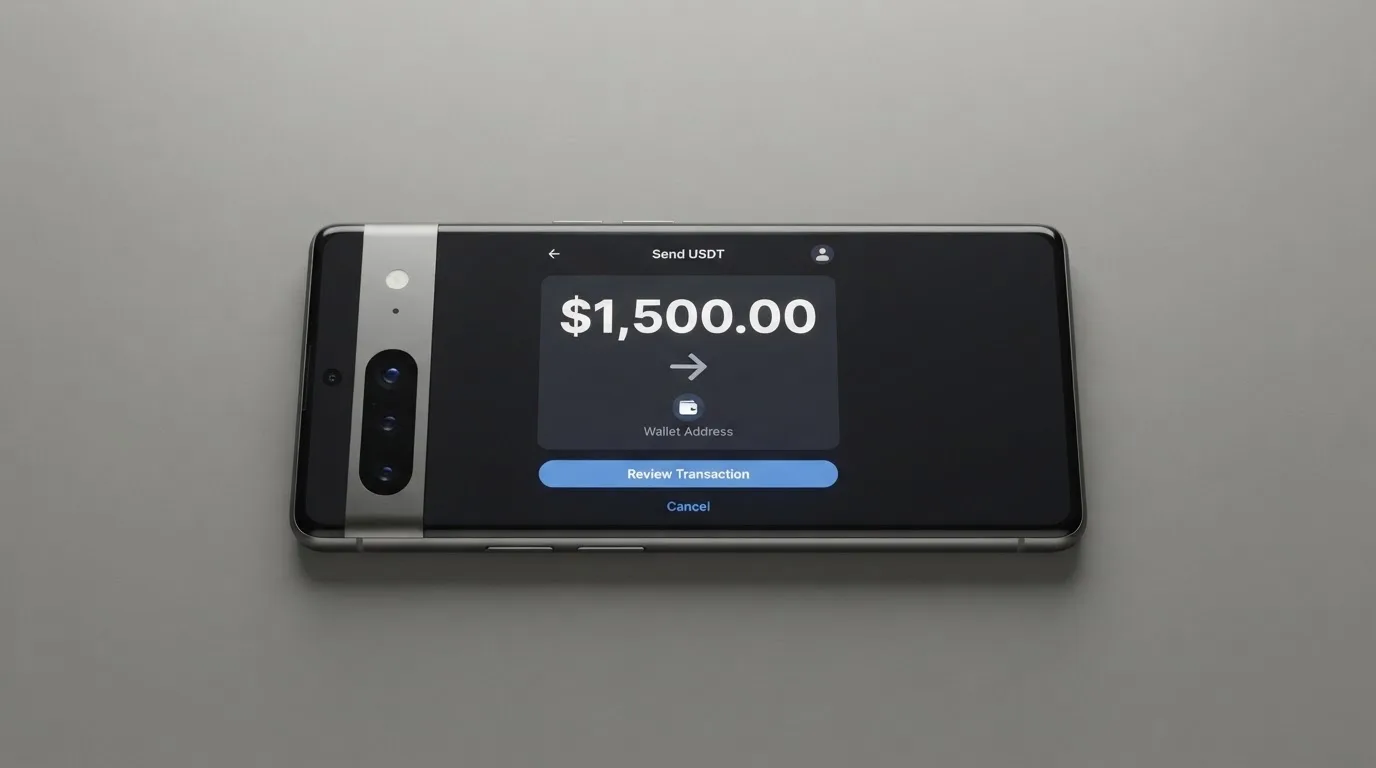
This is the part of the product where the absence of information matters most. With a card that supports stablecoins, sending USDT on the wrong network is the single most common way users lose money in this category: the blockchain transaction is irreversible, the funds arrive at an address the card provider does not recognise, and recovery is at the provider’s discretion with no guarantee. Pay3 is silent on the supported coins and networks, which puts the burden of double-checking on you.
Withdrawals are described as “available” in the terms, with no fees published. The terms do not describe a withdrawal process, and they do note that retrieving residual balances after the account is closed may require additional verification.
Paying with it every day
For everyday spending, Pay3 covers the basics. Virtual and physical Visa cards are available, and the card can be tokenised into Apple Pay and Google Pay, which means tap-to-pay on a phone or watch works wherever contactless Visa is taken. There is no published list of blocked merchant categories, but the terms note that cash-like transactions — foreign currency, crypto, money orders — may be limited.
Cashback or other rewards are not described in the official terms. One unofficial source (cryptocards.so, 2026) says the Black tier has no spend cashback and that the only reward is non-transferable P3P referral points redeemable toward card issuance, but Pay3 has not confirmed this on its own pages.
The Pay3 account runs as an app at app.pay-3.io. App Store and Google Play ratings are not stated. Disputes follow a familiar pattern: try the merchant first, then open a dispute in the account within 60 days of the charge posting, with chargebacks run under the card network’s rules. Unresolved complaints can be escalated to arbitration at the Hong Kong International Arbitration Centre (HKIAC) after 60 days.
A few everyday behaviours are worth knowing about. The card currency is not stated outright; the FX fee for “non-USD” transactions implies the base is USD, but the card terms do not confirm this. Foreign-issued cards can be declined by some merchants, especially US merchants using Address Verification Service, which is generally not available for cards issued outside the US. Authorization holds can sit on your balance for typically up to 7 days, even on transactions that later drop off. The card is non-custodial, which means Pay3 does not hold your crypto or your fiat; it only liquidates the amount needed to repay any debt at the time of settlement.
What can go wrong
Several risks cluster around Pay3 that are worth understanding before you apply.
A young company with thin public history. Pay3 Limited is a fintech, not a bank, incorporated in Hong Kong in 2024. The card is issued by a company called “Third National”, with no country stated, no licence named, and no insurance or deposit-guarantee scheme covering your balance. The public record on Pay3 is short: there are no dated news events, no published incident reports, and no Trustpilot page for the brand. Community evidence is very thin, with only a few organic complaints — a card that failed to open with an error, and support reachable only through a Telegram bot and a help section. The card’s own terms contain an internal fee inconsistency ($29 versus $50.00 for a returned payment) that the company has not clarified.
A collateral model is not a deposit. Your spending power is set by the USD market value of the crypto you have posted, and Pay3 can change the limit at any time, including to $0. If the market moves against you quickly, or if Pay3 adjusts its policy, the card can stop working.
No insurance and no custody protection. The card terms are explicit: “Pay3 does not offer custody of any digital or fiat assets”, and there is no insurance or guarantee scheme. If something goes wrong on Pay3’s side, there is no backstop. Two-factor authentication and an in-app card freeze are not described in the public terms.
KYC can close you out. The single verification runs once and is reused, but if a check fails the account can be suspended. The verification levels, processing times, and rejection reasons are not published. If Pay3 needs more documents — for example proof of address — it can ask, and the outcome of that request is not guaranteed.
Stablecoin deposits are irreversible. Because the supported coins and networks are not listed publicly, sending USDT on the wrong chain to Pay3’s deposit address is a realistic way to lose money. Crypto transfers cannot be reversed on the blockchain, and Pay3 does not commit to a recovery process for misrouted deposits.
Programme-level risk. The card runs on Visa rails under a licence. The card network can suspend a programme — Visa did this with FTX’s global agreements in November 2022, and earlier with WaveCrest in 2018. If Pay3’s issuer relationship or the programme itself is suspended, cardholders typically get a notice period, then loading stops, then spending stops, and remaining balances have to be withdrawn.
What to take instead
Pay3 is not the only crypto Visa in this space. If you are choosing between cards, three commonly compared alternatives are Nexo, Exa, and Cardex. None of them is a perfect substitute — each has its own gaps — but they are useful reference points.
Nexo also scores 6.3 / 10 in this review. It is open to residents and citizens of “selected European countries, including the EEA and the United Kingdom”, with an unpublished country list and excluded jurisdictions. Cards are virtual (activated in the app) and physical, and the page carries a Mastercard trademark notice (the network is not stated explicitly). The physical card is shipped free but requires a digital-asset balance above $5,000 and at least a Gold loyalty tier. There is no monthly, annual or inactivity fee, but a virtual card needs at least $50 in the account to activate. FX on weekdays is 0.2% in the EEA/UK/Switzerland and 2% elsewhere, rising to 0.7% and 2.5% on weekends. Cashback is paid in NEXO tokens or Bitcoin on Credit Mode purchases, with rates that depend on your loyalty tier (Platinum 2% / 0.5%, Gold 1% / 0.3%, Silver 0.7% / 0.2%, Base 0.5% / 0.1%), and you must hold more than $5,000 in digital assets in the account. The crypto conversion fee is not stated. News reports (Cointelegraph) describe a 2025-era Bulgarian police raid on Nexo’s Sofia office over alleged Russia-sanctions and AML issues; no official Nexo statement addressing Russian users was found on the public site.
Exa scores 6.2 / 10. It is issued in 45 countries (Argentina, Brazil, Japan, Kenya, Mexico, Singapore, South Africa and the UAE are explicitly named, with Nigeria conditional) and 31 US states. Eighteen countries are ineligible, including Belarus, China, India, Iran, Israel, Turkey, Ukraine, Vietnam and Russia, and the rule is by residence: Russian residents cannot be issued a card, and spending is blocked in Cuba, Iran, North Korea, Russia, Syria, Ukraine and Venezuela. The card is a virtual Visa Signature, accepted at “over 150 million merchants in more than 150 countries”, and the help centre has an article on a physical card whose answer was not read. The card is marketed as free with no amounts published; the help centre has a fees article that was not read. Funding comes from the self-custody Exa App as collateral, with spending via Pay Now or in instalments against a credit line. No cashback is published, and the help centre lists Visa Signature benefits, an Airalo eSIM discount and a US activation reward ($100 spend, $20 in XRP via Uphold).
Cardex scores 5.6 / 10. The site says “one crypto card, 200+ countries”, with no country list or exclusions; the App Store listing is Naira-focused (pay in Naira). The card is a debit crypto card on VERVE, Visa, Mastercard and UnionPay, available as virtual and physical, with the card currency listed as Naira in the App Store. Cost is not stated. Funding is from USDT, USDC and BTC wallets, with networks not stated. Cardex markets an “AI-Powered Conversion Rate” that scans global exchange rates and picks the best one at the moment of payment, but no fee percentage is published. No cashback or rewards are stated.
If you want a card with a published FX fee and a European banking partner, Nexo is closer to that. If you want a self-custody card with collateral-based spending and a wider country list, Exa is closer. If you are in Nigeria or a VERVE-accepting country and want a Naira-denominated debit, Cardex is the local fit. Pay3 sits between these — it is the most “Visa-first” of the four, but the one with the least published detail.
Who I would recommend it to
I would point Pay3 at a fairly narrow reader. If you already keep stablecoins (or other crypto) in a self-custody wallet, you are outside the US and outside an unpublished list of Restricted Locations, you can tolerate a collateral-based spending model where your limit moves with the market, and you do not need a published monthly fee, an ATM allowance or a deep rewards programme — then Pay3 is a workable Visa with a free top-up and Apple Pay/Google Pay support. The virtual-plus-physical-plus-tokenised card lineup covers the everyday formats.
I would not point it at a reader who needs clarity before signing up. If you want to know the monthly fee, the ATM fee, the supported coins and networks, the support hours, the KYC rejection reasons, or the tier differences between Pay3 Credit Card and Pay3 Black, the public pages do not tell you. If you are a US citizen, the card terms require you to attest you are not, which closes the door. If you need a card backed by a household-name issuer with a long public track record, “Third National” is not that. And if you are the kind of person who wants the comfort of insurance, a deposit guarantee or a clearly named regulator, Pay3 is explicit that none of those apply.
The honest summary: Pay3 is a young, lean product that has built the right skeleton — virtual, physical, mobile wallet, multi-currency account, free top-up — and has not yet published enough flesh on top of it to recommend it with full confidence.
Frequently asked questions
What is the Pay3 card?
The Pay3 card is a Visa debit product from Pay3 Limited, a fintech incorporated in Hong Kong in 2024. It offers virtual, physical, Apple Pay and Google Pay cards linked to a multi-currency account, and it works on a collateral basis: you post crypto, the system sets your spending limit, and the card cannot be overdrawn.
How does the Pay3 card work?
You verify your identity in the app, apply for a card, and fund it. The card draws on the balance you have posted as collateral, and Pay3 can change your limit at any time, including to $0. Card currency is not stated outright, though the FX fee wording implies a USD base.
Is Pay3 a bank?
No. The card terms describe Pay3 Limited as “a fintech company, not a bank”, and the card is issued by a separate entity referred to as “Third National”. No banking or e-money licence is named on the public pages.
Who owns Pay3?
Pay3 Limited is incorporated in Hong Kong in 2024. Ownership, investors and named licences are not published on the public site.
Is the Pay3 card available in my country?
The card terms say it is open to users outside “Restricted Locations” — countries under trade sanctions, export controls, or crypto/fintech prohibitions — with the actual list unpublished. US citizens must sign an attestation saying they are not, and the list can change without notice.
How do I get a Pay3 card?
Verify your identity in the app through Sumsub, apply for a card, and fund it. The virtual card is available immediately; the physical card is described as arriving in 3–5 business days, with shipping countries, shipping cost, and replacement cost not stated.
Does the Pay3 card require KYC?
Yes, once. The same identity check is reused for the account, the card and any in-app swap activity. You may be asked for extra documents such as proof of address, and a failed check can lead to account suspension. Verification levels, processing time and rejection reasons are not published.
How do I top up the Pay3 card?
You can send stablecoins directly, or send fiat into a multi-currency account that the card draws from. Top-up fee is 0%. The specific coins, networks and minimum top-up are not stated on the public site, which is worth checking carefully before sending anything.
How do I add the Pay3 card to Apple Wallet?
The card supports Apple Pay and Google Pay, so you add it through the wallet app on your phone using the card details from your Pay3 account. The Pay3 app itself runs as a Telegram Mini App and a web app at app.pay-3.io.
Is the Pay3 card safe?
There is no insurance or deposit-guarantee scheme covering your balance, and Pay3 does not custody your assets. The card is non-custodial in the sense that the company only liquidates the amount needed to repay debt at settlement, but the public pages do not describe two-factor authentication, an in-app freeze, or support hours. The young age of the company, the thin public complaint record, and the fee inconsistency inside the card terms are all worth weighing before you fund the card.
Credit and cashback cards: the entry point – cryptocardportal.com
Content created by the «cryptocardportal.com» team