
A crypto card that works well on the rails and less well at the counter
 Available in US
I have read the RedotPay card’s own pages — the KYC list, the fee table, the delivery pages, the App Store listing, the Singapore terms — and then read what users say about it. Here is where I land.
The short version: this is a competently built card wrapped around a faintly worrying balance of trust. Loading money in is cheap and quick. Paying out is close to free if you keep the card in its own currency. What you give up for that convenience is a layer of anonymity you did not strictly need anyway, and a meaningful chance that one day your money sits frozen while support takes its time answering. My score for the whole thing is 6.9 out of 10.
The conditions described here are current as of October 28, 2026.
The verdict: 6.9 / 10
Before the details, the table of how I scored it and why.
| Criterion | Mark | Why |
|---|---|---|
| Who can get it | 8 / 10 | 47 places are closed for card issuance as of a list dated 28 August 2026; the rest of the world is open, and the service claims 9 Million+ Users |
| Cost | 6 / 10 | Virtual card 10.00 USD, physical 100.00 USD, maintenance free; 1.00 % transaction fee, 1.20 % for another currency, 2 % at ATMs up to 10,000 USD a month |
| Top-up options | 8 / 10 | Crypto on-chain to the card, USDT-TRC20 from 1 USDT, USDC and ETH; topping up the card balance is free, and the deposit page shows which networks are live |
| Reliability and complaints | 4 / 10 | The issuer is not named (only a BIN Sponsor), the programme manager is Redotpay Technology Pte. Ltd.; complaints centre on KYC and source-of-funds freezes, with 778 reviews on Trustpilot |
| Everyday use | 9 / 10 | Virtual and physical cards, Apple Pay and Google Pay, ATMs around the world |
Who it suits. If you hold crypto, you sit outside the restricted list, and what you want is a card that behaves like an ordinary one — you tap for coffee, you top it up when the balance runs low, and you never think about it again. The virtual card at 10.00 USD is the sensible starting point, and if it works for you the 100.00 USD plastic version is a convenience upgrade rather than a different product.
Who it does not suit. If your priority is knowing exactly who holds your money and what happens to it in a bad week, this is a weak choice: the issuing institution is not named on the public pages, the terms let the company freeze accounts, and insurance and two-factor arrangements are not stated. If you are in one of the places where issuance is closed, none of this is about you at all.
Will they give you the card
Yes for most of the world, no for a long and specific list — and the interesting wrinkle is that the card publishes two lists that do not agree.
The KYC list, titled “Unsupported Countries/Regions”, puts it bluntly: “If you are a citizen of any of the countries or regions listed below, you will not be able to complete identity verification (KYC) or use RedotPay’s services”. The stated reason is “based on local regulations and sanction policies—not on individuals” — a fair framing, since these rules follow citizenship rather than conduct. On that list: Afghanistan, Albania, Belarus, Bosnia and Herzegovina, Bouvet Island, Burkina Faso, Burundi, Central African Republic, Congo (DR), Croatia, Cuba, Eritrea, Ethiopia, Guinea-Bissau, Haiti, Iran, Iraq, Kosovo, Lebanon, Liberia, Libya, Mainland China, Mali, Montenegro, Myanmar, Netherlands Antilles, Nicaragua, North Korea, North Macedonia, Russia, Serbia, Slovenia, Somalia, South Sudan, Sudan, Syria, Ukraine, United States, Venezuela, Yemen, Zimbabwe.
The second list, for card issuance, is dated 28 August 2026 and covers 47 places. It adds India, Indonesia, Morocco, Nepal, Singapore, Turkey to the shared set, and says: “Residents of these areas are ineligible for both virtual and physical cards”. Those places also cannot be used as a billing address. Notice what this list does *not* say: it says residents, not citizens. Citizenship is not mentioned there.
That difference is the single most useful thing to take from this section. Russia, Belarus, Ukraine and Serbia appear on both lists. Georgia, Armenia, Kazakhstan and the UAE appear on neither. So if you are a citizen of a country on the first list, this is not your card regardless of where you live; and if you are a resident of India, Indonesia, Morocco, Nepal, Singapore or Turkey, you are excluded from the card even though your passport may be perfectly clean.
One more limit worth knowing before you start: the US is on the KYC list, so “available almost everywhere” is a slightly misleading summary of this particular card.
How to get it
The signup path is short and, on paper, reasonable. Minimum age is 18. You install the app, sign up with email or a Google or Apple ID, verify your identity, fund the account, open the Card section, and choose virtual or physical.
Two requirements in there will catch people out. First, identity documents: only originals, and the card says it plainly — “Do not use copies, screenshots, or photos of a screen”. The document must be valid for at least three months from submission, and both sides if there is data on the back. Extra documents in JPG, PNG or PDF up to 10MB are only uploaded if the system asks for them. Second, the address: you enter the “true, current address in full”, and no separate proof-of-address document is mentioned. There is a single verification level described — identity plus address, with extra papers on request — but the processing time and the official rejection reasons are not stated, so there is no published answer to “how long will this take” or “why was I turned down”.
For the physical card, two things cannot be undone later: the billing and shipping address must be given in English, and the cardholder name printed on the back cannot be changed.
Two card forms, two currencies. The virtual card and the physical card both come as a USD card (USD BIN) or an HKD card (HKB BIN). On the network, the Singapore terms describe a Visa debit; the card page itself only says “leading card networks”, so I would not build a plan on the exact wording of the marketing page.
Shipping: standard mail is waived, and DHL Express “varies by country”, calculated at checkout. As of 21 July 2026, delivery is unavailable in the issuance-restricted places plus Egypt, Palestine and Tunisia, “due to logistical and customs constraints”. How long it takes is not stated.
Fees: what it really costs
There are two separate charges to keep apart: what RedotPay charges, and what the blockchain charges. Only the first is in the card’s fee table, and that table took effect on 1 December 2025.
| Item | Amount |
|---|---|
| Virtual card application | 10.00 USD |
| Physical card application | 100.00 USD, not cancellable or refundable once paid |
| Virtual card replacement | 5.00 USD first, 10.00 USD each later |
| Account maintenance | waived — no monthly or annual fee, no inactivity fee mentioned |
| RedotPay Pro | 12.90 USD monthly, 129.00 USD annual |
| Transaction fee | 1.00 %, the crypto conversion fee |
| Payment in the card’s default currency | waived |
| Payment in another currency | 1.20 % |
| ATM, HKD card | 2.00 % |
| ATM, USD card | 2 % while monthly ATM withdrawals are 10,000 USD or less, 3 % above |
| Per transaction | 100,000 USD |
| Per day | 1,000,000 USD (both BINs) |
The fee is taken from the balance. There is a 5 USD welcome reward, but it “can’t be used toward the issuance fee” — it is spending money, not setup money. The card itself is a single tier; RedotPay Pro is a separate paid plan, and the annual version includes ATM fee waivers.
The small charges are where card costs usually hide, so here they are in full. A small authorisation of 1.00 USD or less: the first five per card per month are waived, then 0.2 USD. A declined transaction: the first three per month are waived, then 0.5 USD. Some merchants carry an extra 1.5 % with a minimum of 0.50 USD, first three per month waived — Gulf Health Counsel, Free Fire, PUBG Mobile, Brawl Stars, eFootball, Facebook Ads, Discord. That last list is a small warning: the merchant-side surcharges land on advertising, gaming and a few niche services.
Three ordinary payments, so the fees have something to happen to:
Coffee, 5 USD, paid on the USD card. You pay 5 USD, the 1.00 % conversion fee applies, and nothing else. This is the everyday case and it is the one the card is built for.
A 30 USD online subscription, card currency USD. Same shape: 1.00 %, no foreign-currency fee, nothing extra. If the merchant blocks prepaid cards, you find out here.
A 30 EUR subscription on the USD card. Now the 1.20 % non-default-currency fee lands on top of the 1.00 %, and you are paying in euros you do not hold. The app lets you toggle which currency a card uses; a currency switched off is declined rather than converted, which is a sensible safety net.
Cash, 40 USD at an ATM in another country. The USD card charges 2 % while monthly withdrawals are 10,000 USD or less, plus any fee the ATM operator itself charges.
Limits worth reading before you rely on them: per transaction 100,000 USD, per day 1,000,000 USD on both BINs, balance unlimited. ATMs are 3 per day and 30 per month; daily 23,000 HKD on the HKD card or 3,750 USD on the USD card; monthly 75,000 HKD or 50,000 USD. There is a second set of numbers for USD cards in some countries and regions: daily 3,000 USD and monthly 10,000 USD. Which set applies to you depends on where you are, and the card does not say how it decides.
How to Top up the card
Two real routes, and one is clearly the better one.
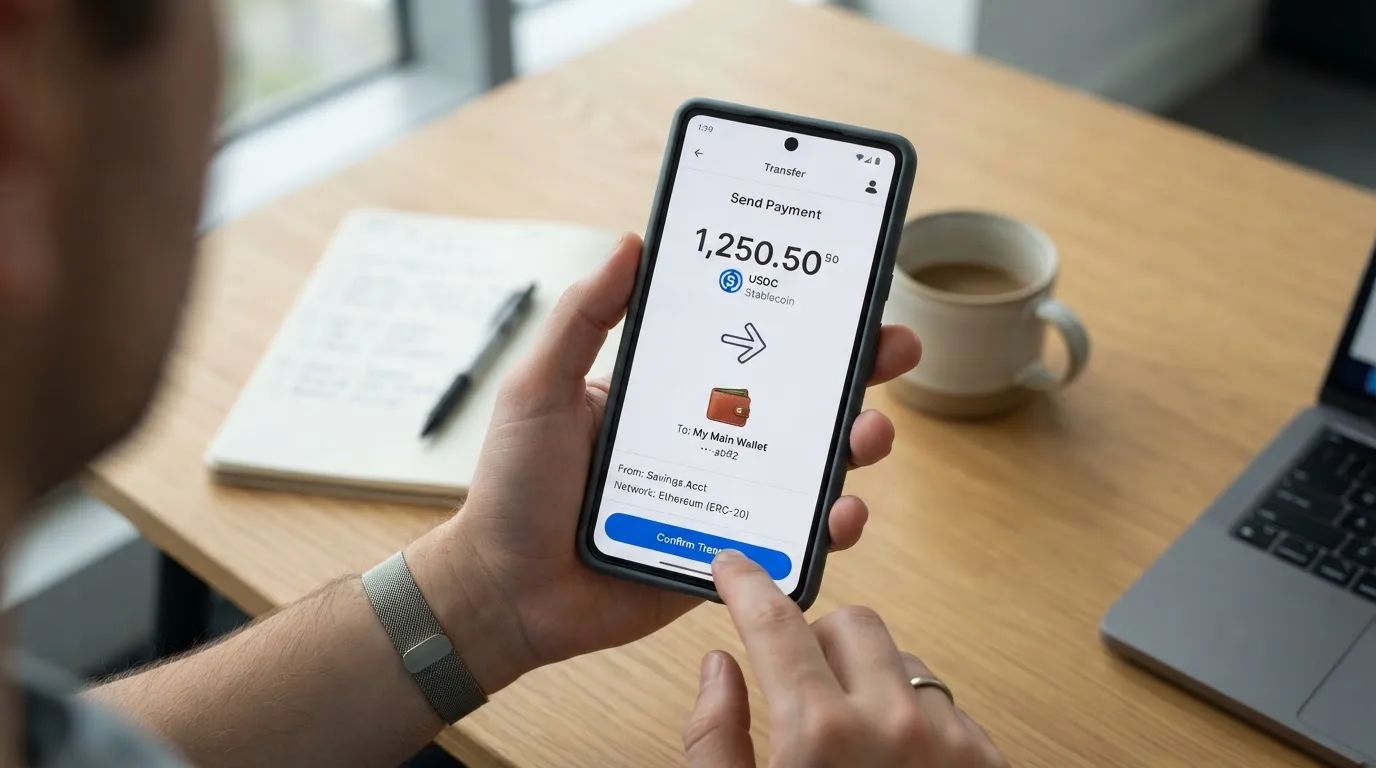
On-chain crypto deposit. This is the main event. The deposit fee to the card balance is free, and each asset is accepted only on the networks shown on the Deposit page — with RedotPay free to change those networks. USDT-TRC20 from 1 USDT after network fees is the stated example. The network fee itself is borne by the sender and counted before that minimum, so the 1 USDT floor is what actually arrives, not what you type.
Buying crypto with a credit card in the app. ETH, USDC, USDT, and it depends on the region. This is a convenience, not a bargain.
Transfers in from a mainstream credit or debit card. 3 % fee, minimum 1 USD. I would use this only for small top-ups where you want the balance in minutes.
The category rule that catches almost everyone: on-chain network fees are charged by the blockchain, not by the card. If you send USDT over Tron, the fee is paid in TRX. If you hold USDT on Ethereum and no ETH, you cannot send at all, because gas is paid only in ETH. Getting this wrong is the single most common expensive mistake with cards like this, and it is entirely avoidable — send only on a network the deposit page is currently showing.
How you get money *out* is not stated on the public pages, and if you need to withdraw regularly, treat that as a question to ask before you commit money.
Paying with it every day
You get a virtual card and a physical one, and the virtual card integrates with Apple Pay and Google Pay. Add it to your phone’s wallet and most of the friction of a crypto card disappears — this is, in practice, the argument for the virtual card.
There is no formal list of blocked merchant categories, and that is worth stating plainly rather than reading as good news. The card says only that “Some individual merchants may have its own internal policies regarding prepaid or crypto cards”. Illegal use is banned, and the card is not usable in sanctioned countries, but no formal category list is published. So you will find out at the till rather than in advance, and a refusal is usually about the merchant’s policy, not about anything you did.
The controls you do get are the ones that matter day to day: per-card limits, online / POS / ATM toggles, and currency toggles.
Rewards are thin and worth sizing up honestly. There is a 5 USD welcome reward, usable only on spending and valid for 30 days. The card page lists “Points & Rewards” and “RedotPay Pro” as separate programmes, and no card cashback rate is stated — so I would not build any spending maths around points.
The app itself looks well regarded on iOS: 4.75 from 4,312 ratings, updated 2026-09-28. The Android rating is not stated, which is a small but real gap for anyone not on an iPhone.
What can go wrong
This is where the card loses most of its points, and it deserves to be explained rather than hinted at.
The issuer is not named. The Singapore terms name “Redotpay Technology Pte. Ltd.” as programme manager and an unnamed “BIN Sponsor” as the actual issuer. Users must be “ordinarily resident outside of Singapore”. The App Store seller is “Red Dot Technology Limited”. The website footer cites “N° 144 en el Registro de PSAV de la CNV ( República Argentina)”. In plain terms: the brand you deal with is a front end over an issuing institution you are not told the name of. That is normal for this category and it is still an answer you deserve before you fund the account.
Freezes are the central complaint. Officially, the card acknowledges freezes linked to P2P orders and dispute handling. Users report the same pattern independently: KYC-related holds on funds, support escalations unanswered for days, limited daily payments. Trustpilot shows 778 reviews. A third-party review-analysis site says the most serious complaint is freezes triggered by source-of-funds reviews that can last weeks — I am passing that on as unofficial, not confirmed by the card, but it lines up with everything else.
The terms lean towards the company. The Singapore terms state that fees are non-refundable (cl. 16.3) and allow RedotPay to freeze accounts. Insurance or safeguarding arrangements and 2FA are not stated. Support response times are not stated. Dispute mechanics are not stated.
None of this makes the card a bad actor, and I want to be careful with the word. What it makes is a card where the downside case is not documented. Compare that with a bank deposit, where the terms are the other way round: the failure mode is somebody else’s problem and there is a scheme behind it. Here, the terms are written to protect the provider first.
Two more practical risks. Crypto transfers are irreversible, so a deposit sent on a network the provider does not support can be lost or need manual recovery with no guarantee. And a declined authorisation can leave a hold on your funds for several days — typically up to 7 — which looks, in a balance that is only ever a few hundred dollars, like money gone missing.
What to take instead
I looked at three comparable options. The scores are not mine to average into a ranking — they are given, and I would rather you saw them than a computed verdict.
Whop Cards — 5.2 / 10. Narrower and more predictable by design. Visa, works anywhere Visa is accepted, spends from a Whop balance, and the page says “No extra fees” without listing issuance or monthly amounts. Its catch is geography: consumers in 31 US states and businesses in 41 states, with a list of unsupported consumer countries including Belarus, China (Mainland), Cuba, Hong Kong, India, Iran, Iraq, Israel, Myanmar, Nepal, Nicaragua, North Korea, Russia, Syria, Turkey, Ukraine, Venezuela and Vietnam. It is not a general solution outside the US.
Stella — 6.5 / 10. Virtual and physical, VISA, works at “over 40 million VISA merchants globally”, crypto deposited into the account tops the card up automatically through an in-app custodial wallet. Its terms bar users under economic sanctions programmes and route US and European users through affiliates; the official site does not state which countries are covered, and no fees are stated officially.
UniFi Card — 4.7 / 10. A “Prepaid Debit Visa Card” issued by Lead Bank, USD, Apple Pay supported, funded by ACH, wire, SEPA or SPEI, with the app offering send-money routes to the Philippines, Mexico and the eurozone. Its availability is not confirmed from official pages — that comes from app-store routes and release notes — and fees are only “See UniFi website for more details”.
| Option | Score | Card | Where it fits | The catch |
|---|---|---|---|---|
| RedotPay | 6.9 / 10 | Visa debit, virtual and physical | Crypto holders outside the restricted list | Issuer unnamed; freeze complaints |
| Stella | 6.5 / 10 | VISA, virtual and physical | Deposit crypto, card tops up itself | Coverage and fees not officially stated |
| Whop Cards | 5.2 / 10 | Visa | US consumers and businesses | Only 31 consumer states, and country exclusions |
| UniFi Card | 4.7 / 10 | Prepaid debit Visa, Lead Bank | US plumbing: ACH, wire, SEPI, SPEI | Availability not confirmed from official pages |
If you are outside the US and your main problem is converting crypto to everyday spending, RedotPay remains the most concrete of these four. If you are in the US, the comparison gets less comfortable, because the option with the clearest published scope is the one built for US states.
Who I would recommend it to
I would recommend it to someone who already holds crypto, lives outside the restricted lists, has decided that a normal debit card is not an option for them, and is comfortable with a provider that can freeze a balance and that never names its issuer. Buy the 10.00 USD virtual card first. Use it for a month. See whether the 1.00 % fee bothers you and whether your everyday merchants accept it. Only then consider the 100.00 USD physical version.
I would not recommend it to anyone whose main worry is the safety of the balance itself, or who plans to move serious sums through it, or who needs a published withdrawal and dispute process. In those cases the missing pieces — safeguarding, 2FA, support times, disputes — are not details to fill in later; they are the reason to choose differently.
And if you are a reader whose difficulty with ordinary bank cards is that your address, your name or your country does not fit the form, that is worth naming plainly: this card’s country restrictions are long, its rules change between lists, and it will not fix that particular problem. It solves a different one.
Frequently asked questions
What is the RedotPay card?
It is a Visa debit card you fund with crypto. You transfer stablecoins or other supported assets to a wallet address, the balance converts to fiat, and the card spends that balance — virtual for online and mobile wallets, physical in plastic. It behaves like a prepaid card rather than a bank account: there is no overdraft, and no bank relationship behind it.
How does RedotPay card work?
You install the app, verify your identity, fund the account, then choose a virtual or physical card in the Card section. Each payment converts crypto to fiat at a 1.00 % fee, waived if you pay in the card’s own currency and 1.20 % if you pay in another. Add the virtual card to Apple Pay or Google Pay and most use feels ordinary.
Is RedotPay a bank?
No, and it does not present itself as one. The Singapore terms name Redotpay Technology Pte. Ltd. as programme manager and an unnamed “BIN Sponsor” as the issuer, and require users to be ordinarily resident outside Singapore. That means the money sits with an e-money arrangement, not a bank deposit.
Who owns RedotPay?
Several names surface and it is worth knowing which is which: Redotpay Technology Pte. Ltd. as programme manager, Red Dot Technology Limited as the App Store seller, and an unnamed BIN Sponsor as the actual issuer. The site also cites a registration on the Argentine CNV PSAV register and claims 9 Million+ Users.
Who can get a RedotPay card?
Most of the world, minus two overlapping lists. The KYC list bars citizens of many countries including the United States, Mainland China, Russia and Ukraine. The card-issuance list dated 28 August 2026 closes 47 places, adding residents of India, Indonesia, Morocco, Nepal, Singapore and Turkey — residents, not citizens. Georgia, Armenia, Kazakhstan and the UAE are on neither.
What does RedotPay card cost?
Virtual issuance is 10.00 USD and physical is 100.00 USD, non-refundable once paid. Maintenance is waived. The transaction fee is 1.00 %, 1.20 % for non-default currency, and 2 % at ATMs up to 10,000 USD a month. RedotPay Pro is 12.90 USD monthly or 129.00 USD annual.
Is RedotPay card safe?
Safety splits in two. Your crypto is not held when you pay — it is converted — but the balance is custodial, and the terms permit freezes. Safeguarding arrangements and 2FA are not stated. Users report KYC-related holds and unanswered support escalations, and Trustpilot shows 778 reviews.
Is RedotPay card free?
Nearly. There is no monthly or annual fee and no inactivity fee, and topping up the card balance from crypto is free. But the issuance fee is 10.00 USD virtual or 100.00 USD physical, every payment costs 1.00 %, and the 5 USD welcome reward cannot be used toward issuance.
How do I top up the RedotPay card?
Send crypto to the address on the Deposit page — USDT-TRC20 from 1 USDT after network fees is the stated example, with USDC and ETH also supported, free of any deposit fee. You can also buy ETH, USDC or USDT with a credit card in the app, or transfer in from a mainstream card for a 3 % fee with a 1 USD minimum.
Can I use the RedotPay card in my country?
That depends on two separate questions. You can only be issued the card if your citizenship and residence avoid the restricted lists above. Once you have it, it is a Visa card and works at ATMs worldwide, but no formal list of blocked merchant categories is published, so some shops will refuse it on their own policy — and as of 21 July 2026 delivery does not reach the restricted places plus Egypt, Palestine and Tunisia.
App and neobank cards: the entry point – cryptocardportal.com
Content created by the «cryptocardportal.com» team