
The only network it accepts is the one thing that matters
 Available in US
If you hold USDT on the Tron network and you cannot — or will not — go through a bank-style identity check, this card does something almost nothing else in this category does: it issues a Visa with no passport, no selfie, no verification. That is the pitch, and in fairness it is a real one.
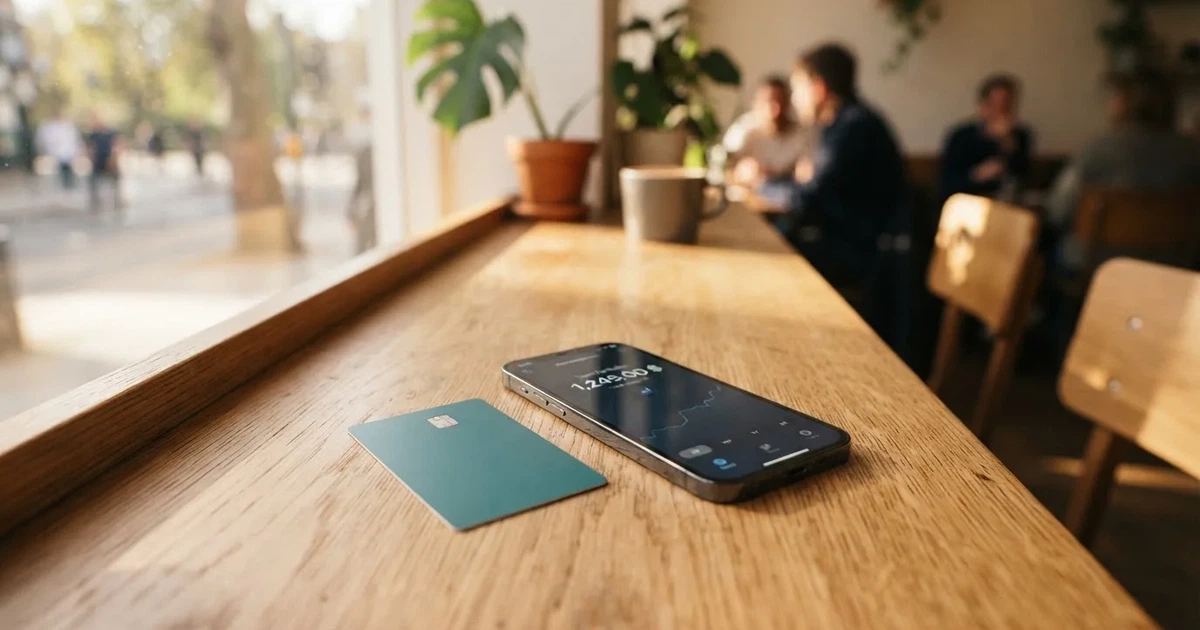
Everything after that pitch is thinner. The card is virtual only. It accepts exactly one asset on exactly one network. Its issuer is not named on the public pages, and the operator turns out to be an LLC whose terms page is titled something else entirely. The single customer review I could find is positive, which is nice, and also is not much of a safety record.
I scored it 4.7 out of 10. The conditions described here are current as of October 28, 2026.
Verdict: 4.7 / 10, and the split matters more than the total
A 4.7 sounds like a card nobody should touch. That is not quite what I found. The card is extremely good at one narrow thing and openly silent about almost everything around it, and those two facts pull in opposite directions.
Who it suits: someone who already holds USDT on TRC-20, who wants a Visa that spends from that balance, who does not want to send documents to anybody, and who treats the balance as spend money rather than savings. If that is you, the fit is genuinely better than the average score in this category suggests, because the fees are simple and there is no monthly drain.
Who it does not suit: anyone whose money is not already on Tron. Anyone who needs a physical card. Anyone who needs to draw cash. Anyone who wants to know, in advance and in writing, which bank stands behind the card. Anyone for whom a 4% top-up fee on a card you will load repeatedly is a real cost rather than a rounding error.
The score, criterion by criterion:
| Criterion | Mark | Why |
|---|---|---|
| Who can get it | 7 / 10 | Works wherever Visa is accepted; no country list published, and the terms exclude people from sanctioned countries |
| Cost | 3 / 10 | $13 once, no subscription or monthly fee, but a 4% top-up fee; $50 minimum, and a $50 card costs $65 |
| Top-up options | 4 / 10 | USDT on Tron (TRC-20) only — other networks must be converted to TRC-20 first |
| Reliability and complaints | 4 / 10 | Issuer bank not named, operator Libermall LLC, licences not disclosed; no complaints found, one positive review |
| Everyday use | 5 / 10 | Virtual Visa in a Telegram bot, Apple Pay and Google Pay supported, no plastic and no ATM |
That distribution tells the story better than the average. Access is generous, cost and flexibility are poor, and the everyday-use mark is limited by the format rather than by quality.
Will they give you the card?
Short answer: almost certainly, if you are 18 or over and not caught by sanctions. The eligibility rules are shorter than any card I have reviewed.
The terms ask you to confirm that you are 18+ and that you are not in a country under international sanctions. The service is not available to people from sanctioned countries or to people on sanctions lists. No country is named, and no country list is published anywhere on the public pages — so the honest position is that this is not stated.
On top of that, the card’s own claim is that it works “wherever Visa is accepted”. That is a statement about merchant acceptance, not about eligibility. It tells you where the card will work once you have it; it tells you nothing about which country’s residents can get one.
This is the one criterion where I scored the card generously, and here is why: the gate is genuinely low, but the low gate is not backed by a list of countries. If you are somewhere the issuing programme has decided to be cautious about, you may find out only at the point of loading money rather than at sign-up. There is no documented country restriction, but an undocumented one can exist.
How to get it
Three steps, and none of them involves a document. That is the whole process.
You open the Telegram bot, order a card, and send USDT on TRC-20 to the address the bot gives you. The card details arrive in the Telegram chat as a virtual card. There is no delivery step because there is no plastic.
On identity: the card says “zero KYC” and puts it plainly — an account on Telegram is enough, no documents. No passport, no selfie, no verification for the virtual card.
Two things are worth knowing before you assume that means nobody ever asks you anything. First, KYC is described as required for “part of the products” with extended features, and the data involved in that case would include name, date of birth, citizenship, address, ID document and selfie. Second, the terms say monitoring of unusual activity can trigger a request for more information. The card does not state the rejection reasons, so I cannot tell you what would get you declined.
The card itself: virtual, Visa. The site header also mentions Visa/Mastercard in places, which is the kind of small inconsistency I would want clarified before loading real money. Card amounts and limits are in USD; the card’s own currency is not stated.
Fees: what a Tegro payment really costs
The headline numbers are good and one of them is very bad. There is a $13 one-time issuance fee and then nothing recurring — no subscriptions, no monthly fee, no annual review. But every top-up costs 4% of the amount, and if you load the card regularly, that 4% is the number that decides whether this card is cheap or expensive for you.
The arithmetic the card itself gives: a $50 card costs $65. That is the $13 fee plus the 4% deposit fee on $50, in one number, and it is the clearest illustration of the shape of the pricing.
| Fee or limit | What the card states |
|---|---|
| Issuance | $13, one-time |
| Monthly fee | None — no subscriptions |
| Top-up (deposit) fee | 4% of the amount |
| FX fee / conversion spread | not stated |
| ATM withdrawal | not stated; no plastic, ATM not mentioned |
| Minimum balance | $50 |
| Starting card limit | $1,000 |
| Daily and monthly spend limits | not stated |
| Card currency | Amounts and limits in USD; card currency not stated |
| Tiers | One virtual Visa product, no tiers |
Three everyday payments, and which fees actually apply:
- A $30 subscription in USD. No top-up fee is triggered because you are not loading. The 4% does not apply at the moment of purchase. What you do not know is the conversion spread if your balance and the merchant do not share a currency, and that figure is not stated.
- Loading $100 to cover it. Here the 4% is charged on the deposit, so $4 goes to the fee, plus the $13 issuance if this is your first card. The Tron network fee is separate and comes from the blockchain, not from the card provider; the card does not state who pays it.
- Paying a merchant in euros. The card does not publish an FX fee or a conversion spread. You are being asked to accept an unknown number here, and I would want to see the rate on screen at the moment of payment before treating it as small.
A note on limits: the terms say limits depend on card type and may change, with no daily or monthly figures given. The starting card limit of $1,000 is the only number to plan around.
How to top up the card
One method. USDT, Tron network, TRC-20. If your USDT sits on Ethereum, Solana, Polygon or anything else, you must convert it to TRC-20 first — which is an extra step, an extra fee, and another thing that can go wrong.
The mechanics are simple and worth knowing precisely: the bot issues an address and a unique amount, and the deposit is credited automatically when that exact amount arrives. That means you send the exact figure shown, not a rounded one, or the automatic credit may not trigger.
What is not available: no fiat top-up. If you want to fund this card from a bank account, you are going through crypto yourself, which reintroduces the identity checks you were trying to avoid.
Two open items on funding. The card does not state who pays the Tron network fee. And on withdrawal, the card says only that “crypto transfers are irreversible” — that is about transfers, not about cashing out, and the withdrawal procedure is not stated.
The closure language is worth reading once. You may stop using the service at any time, and the operator may suspend or terminate access for violations, legal requirements or fraud prevention. What happens to the balance on closure is not stated, and that is the question I would ask before loading anything meaningful.
Paying with it every day
In everyday use it is a virtual Visa inside Telegram, with Apple Pay and Google Pay supported. That is the actual product: no app, no plastic.
Practical consequences you should plan around:
- No cash, anywhere. With no physical card there is no ATM withdrawal, and the card does not mention ATMs at all. If you need cash, this is not the tool.
- Apple Pay and Google Pay are the intended route. Tokenising the card into a phone wallet is how most people will actually use it, and it is the sensible setup.
- No app means no in-app controls. Freeze, limits, transaction review, everything happens in the bot or not at all.
- Blocked categories are not stated. The card does not publish a list of blocked merchant categories, so you cannot tell in advance whether gambling or another restricted category will be declined.
On rewards: no cashback is mentioned. If earning something back matters to you, that is not on offer here.
Disputes are the quiet weak point. The card says returns and disputes are handled under payment-system rules and our partners’ timelines — with no time frames given. The practical advice in the terms is to try the merchant first, then support. Governing law is Wyoming, USA. So: the process exists, the deadlines do not, and if a charge goes wrong you will be handling it across a border.
What can go wrong
I want to be direct about the two things that would make me hesitate to load a large balance.
You do not know who issues the card. The card is issued by an unnamed “partner bank under the Visa programme”. Tegro is the ordering and support interface. The company entity behind the brand is not stated, and no licences are disclosed. The terms page is titled “Libermall Card” and names Libermall LLC as the operator. So the legal entity you are contracting with is not the name on the product page. That is not automatically bad — many legitimate programmes are structured this way — but you are being asked to fund a prepaid balance with a card whose issuing bank you cannot name.
The model is custodial. Because the card is issued by a partner bank and Tegro is the interface, the balance sits with institutions rather than in a wallet you control. Custodial platforms have a track record: Mt. Gox (about US$350 million reported stolen, 2011–2014), Coincheck (about US$400 million, 2018), Ronin Network (US$625 million, 2022). The counterparty and hack risk is real and it is not offset by anything the card describes.
Sending on the wrong network is unrecoverable. Blockchain transfers are irreversible. A deposit sent on a network the provider does not support, or to an address belonging to a different network, can be lost or need manual support recovery with no guarantee. With one supported network this is a narrower risk than it sounds — but the mistake is easy to make, and the automatic-credit-by-exact-amount mechanism means a wrong network is also a deposit that never appears.
No safety features are described. No two-factor authentication, no in-app freeze, no insurance is mentioned. The terms say Tegro may pause an operation or restrict access on risk. The standard advice applies and is worth taking seriously: never share your PAN and CVV, and do not store the card details unencrypted.
The complaint record is empty, which cuts both ways. I found one 5-star Trustpilot review, dated June 2026, calling the card simple and noting that support and clear limits and fees will matter. No substantive complaints, and no Reddit threads. A Product Hunt-style listing on hunted.space shows 0 upvotes, 1 comment, no user feedback. A clean complaint record on a young product with almost no users is not the same as a good track record. Note also that the Trustpilot page is on tegro.cash, a possibly related brand, and the link to this card is unconfirmed — and that page is not an official source from the card itself.
Support is Telegram only: @Tegro_bot, with replies stated as coming “within a day”. The ordering bot is @TegroCardbot. The site is in Russian and English; support hours are not stated.
On sanctions and access: the terms state the service is not available to persons from sanctioned countries or on sanctions lists. One piece of general context worth knowing: Tether says it disables tokens in wallets on the OFAC sanctions list and has frozen funds tied to illicit activity, so stablecoins are not censorship-proof.
What to take instead
None of the alternatives below is a like-for-like replacement — none of them is a no-KYC card either. They are better on transparency, on top-up choice, or on being a real company, and worse on the thing Tegro does best.
| Tegro | Ape Wallet | MaxSwap | AnoCard | |
|---|---|---|---|---|
| Score | 4.7 / 10 | 5.5 / 10 | 5.2 / 10 | 5.9 / 10 |
| Card | Virtual Visa, virtual only | Virtual Visa: “service card” plus an Apple Pay / Google Pay card | Virtual only, Mastercard | Virtual cards (VCC), reloadable and one-time, several BINs |
| KYC posture | No KYC for the virtual card | Passport KYC uses a Russian passport | not stated | not stated on the page read |
| Issuance cost | $13 | not stated (promo codes change price) | 50 USD with 25 USD first deposit; total issuance listed 77.125 USD | not published; varies by BIN |
| Top-up | USDT TRC-20 only | Wallet balance in USDT | 4.5% + $1 | route depends on asset; shown before payment |
| Transaction fee | not stated | amounts not published; total shown before confirming | 0.25 USD + 0.4% | not published |
| Networks | Tron only | not stated | ADA, ALGO, AVAX, BCH, BNB, BTC, DOT, ETH, HBAR, HT, KRRX, LINK, LTC, MATIC, NEAR, SHIB, SUSHI, TON, TRX, UNI, USDC, USDT, XLM, XRP | starting data unverified: SOL, BTC, USDT, USDC, ETH and more |
| Cashback / rewards | none mentioned | none stated; two-level referral programme pays a share of purchases | not stated | none stated; $5 per referred card, 0.25% of referred top-ups |
How I read that table:
- Ape Wallet (5.5) is the closest in spirit and the better-documented one. It states a fee and total before you confirm any operation, which Tegro does not, and transfers to other users by Telegram username carry no fee. Its weak spot is Russian passport KYC, which is a real narrowing if that is not the document you hold.
- MaxSwap (5.2) has the most transparent price list of the three — 4.5% + $1 on top-up, 0.25 USD + 0.4% per transaction — and by far the widest network list. But it is Mastercard, not Visa, and its site claims no geographical restrictions without listing any.
- AnoCard (5.9) scores highest and has the least published information: the creation fee varies by BIN, some products carry a maintenance fee, and everything is shown in the SORN dashboard before payment. Its own site was down when checked on 2026-10-22. A high score built on unstated numbers deserves exactly as much scepticism as a low one.
One caution on the wider category, because it explains why these comparison tables are thin. Visa and Mastercard do not issue crypto cards to consumers themselves; they license issuers and can suspend a programme. Visa terminated its global agreements with FTX on 13 November 2022 and the FTX US debit card was wound down by its issuer. WaveCrest, a Visa issuer that supplied several crypto card brands, was suspended by Visa in Europe in 2018, closing all WaveCrest-issued Visa programmes. Programme closures typically give notice, then stop spending and loading, then ask users to withdraw remaining balances — one 2026 closure reported by a secondary source ended new loads on 8 July 2026 and spending on 8 August 2026, which is single-source and unconfirmed.
Who I would recommend it to
To the person who has USDT on TRC-20, has no access to an ordinary bank card for reasons of their own, and has decided that a Telegram bot is an acceptable counterparty for a small spending balance. For that person this is a real, functioning card at a fair price, and I would rather they had it than struggled on.
I would not recommend it as a primary card, as a place to hold money you cannot afford to lose, or to anyone who plans to travel with a lot of cash-like balance. The reasons are not the fee — $13 plus 4% is genuinely competitive — they are the unnamed issuer, the undisclosed entity, the absence of any described security features, and one supported network with no second option.
The practical line I would draw: keep the balance on this card at the level of a monthly spending float, not savings. If the balance goes up, the reasons to move it somewhere with a named issuer and a wider network list get stronger, not weaker.
And check three things before your first transfer, because none of them is answered publicly: what the conversion rate is when you pay in a currency other than USD, what happens to the balance if the service closes, and whether the issuer bank can be named. If those three get unsatisfactory answers, that is enough reason on its own.
Frequently asked questions
What is Tegro card?
Tegro is a virtual Visa card issued through a Telegram bot, aimed at people who hold USDT and want to spend it like ordinary card money. The card markets itself on “zero KYC” — an account is enough, with no passport, selfie or verification for the virtual card. It is virtual only: no plastic, no delivery, no ATM. The card is issued by an unnamed partner bank under the Visa programme, while Tegro acts as the interface.
How does Tegro card work?
You open the Telegram bot, order a card, and send USDT on Tron (TRC-20) to the address and exact amount the bot issues. The deposit is credited automatically when that precise amount arrives, and the card details appear in the Telegram chat. The balance then behaves like a stored balance: the card spends what is loaded and cannot overdraw it.
Is Tegro a bank?
No, and this is the point most worth being clear about. The card is issued by an unnamed “partner bank under the Visa programme”; Tegro is the ordering and support interface. The terms page is titled “Libermall Card” and names Libermall LLC as the operator, while the company entity and licences behind the Tegro brand are not stated. Treat this as a prepaid card product, not bank deposits.
Does Tegro card require KYC?
Not for the virtual card. The card states “zero KYC” and “no passport, no selfie, no verification” — a Telegram account is enough. KYC is described as required for “part of the products” with extended features, which would involve name, date of birth, citizenship, address, ID and selfie. Monitoring of unusual activity can also trigger a request for more information.
How do I top up Tegro card?
Only with USDT on the Tron network (TRC-20). The bot gives you an address and a unique amount; send exactly that amount so the credit triggers automatically. If your USDT is on another network you must convert it to TRC-20 first. There is no fiat top-up, and the deposit fee is 4% of the amount, with a $50 minimum balance.
What does a Tegro card cost to get started?
Issuance is $13 once, with no subscriptions and no monthly fee. The deposit fee is 4%. The card’s own example: a $50 card costs $65 in total. Card amounts and limits are in USD, the starting card limit is $1,000, and daily and monthly spend limits are not stated — the terms only say limits depend on card type and may change.
Can I use Tegro card in my country?
The card’s public pages do not publish a country list — this is not stated. Its own claim is that it works “wherever Visa is accepted”, which describes merchant acceptance rather than eligibility. The only eligibility rules given are 18+ and not being in a country under international sanctions or on a sanctions list.
Does Tegro card work in Apple Pay and Google Pay?
Yes, both are supported, and given that the product is virtual-only, adding it to a phone wallet is the intended way to pay. Your phone stores a device-specific token rather than your card number, and each payment uses a one-time code. That is the everyday-use path I would set up first, since there is no physical card to fall back on.
Is Tegro card safe?
Treat it as custodial and small. The balance sits with institutions rather than in a wallet you control, the issuing bank is not named, and no two-factor authentication, in-app freeze or insurance is described. Never share your PAN and CVV and do not store card details unencrypted. Blockchain transfers are irreversible, so a deposit on the wrong network can be lost.
Why should I not withdraw to cash with Tegro?
Because you cannot, and that is a design choice rather than a limitation of your account. Tegro issues virtual cards only — no plastic — and does not mention ATMs anywhere. If cash is part of how you spend, this card cannot cover it at all, and you would need a physical card from a provider that issues one.
Is Tegro card worth it?
Worth it if you already hold USDT on TRC-20, cannot get an ordinary card, and want a Visa without sending documents: $13 once and 4% per top-up is competitive. Not worth it if your USDT sits on another network, you need cash, you want a named issuer behind the card, or 4% per load adds up over repeated use.
Virtual cards: the entry point – cryptocardportal.com
Content created by the «cryptocardportal.com» team