
A no-bank-account USD Visa that promises a lot and charges nothing obvious — but says too little about how it works
 Available in US
A payment card that spends from a crypto balance sounds like a niche product, but for the people it actually targets, it can be the difference between paying online and not paying at all. The Kredete card is built for that audience. It is a USD Visa, virtual and physical, designed to be reachable from countries where a normal bank account is hard to get, and to be used wherever Visa is taken. On paper, that is a useful thing. The trouble is that the card’s own pages do not tell you very much about how it works underneath: who is issuing it, what it really costs to keep, or where the money comes from when you tap to pay. This review walks through what is stated, what is not, and what that means for someone deciding whether to rely on the card.

The card is reviewed in the conditions current as of October 28, 2026.
Verdict
Kredete scores 6.7 out of 10. That is a middling result, and the breakdown tells you why: the everyday mechanics are strong, but the basics of who you are dealing with, what you will pay, and how your money actually gets onto the card are thin on the official page.
| Criterion | Mark | Reason |
|---|---|---|
| Who can get it | 6 / 10 | The app says global accounts in 60+ countries and the card is said to work in 170+; the card page itself does not state where you can apply. Unofficial reporting places the launch in selected African markets with a 50-country African footprint and Gulf expansion planned. |
| Cost | 7 / 10 | 0% FX markup is a clean number; nothing is published about issuance, monthly or ATM fees. |
| Top-up options | 5 / 10 | The card spends from a Kredete account balance; the card page does not mention crypto. Unofficial reporting says settlement is in USDC. |
| Reliability and complaints | 6 / 10 | The seller name is Kredete, Inc.; the card issuer is not named on the official page. Unofficial reporting describes a 2023 Nigerian startup with a small seed round. No complaints found. The iOS app sits at 3.97 from 98 ratings. |
| Everyday use | 10 / 10 | A virtual card in about 10 seconds, a physical card on request, Apple Pay and Google Pay, ATM access, in-app freeze. |
| Total | 6.7 / 10 |
The card suits two people in particular: someone in an African market who wants a USD Visa with cashback and a quick on-ramp, and someone who has been turned away by ordinary banks and needs a Visa that works online and in stores without a traditional account. It does not suit someone who needs a clear, itemised fee schedule before they sign up, or anyone who wants a named, regulated issuer visible on the card’s own website. If you are in the second group, the “instead” section further down lists cards that publish more.
Will they give you the card
The first question with any card like this is whether you are allowed to have one at all, and Kredete is unusually quiet about it. The card’s own page does not state the list of supported countries. The app’s App Store listing says “global accounts in 60+ countries”, which is the closest thing to an official number, but it is a number, not a list. If you are reading this from a particular country and you need to know whether you can apply, you have to check the app directly.
Unofficial reporting gives you more shape, though it is not confirmed by the card itself. A piece in AppsAfrica from April 2026 says Kredete operates in selected African markets, with a footprint across 50 African countries, and plans to launch in the United Arab Emirates, Saudi Arabia and Oman. An earlier Disrupt Africa report from 4 June 2025 puts the African figure at “more than 40” countries. The 50-country figure is the more recent one, and the Gulf plans are forward-looking. None of this is on the official page, and the official page does not link to a country list, so treat both numbers as unofficial and unconfirmed.
What this means for you: there is a real chance you can get the card from where you are, but you will not know until you open the app. That is a meaningful difference from cards that publish a supported-country list, and it is the main reason “who can get it” only scored 6 out of 10 rather than higher.
The card is a USD Visa. It is sold as a virtual card, which the app says is issued in about 10 seconds, and as a physical card, which is delivered to 70+ countries. Delivery time and cost are not stated. The Kredete tier names — Basic, Flex and Premium — appear in the App Store release notes for version 4.4.0, dated 7 October 2026, but the page inviting you to “Compare Basic, Flex, and Premium side by side” does not say what each tier gives you or what it costs. So even after you find out you can apply, you do not know which tier you want, or why.
How to get it
The official Kredete pages do not publish a step-by-step signup walkthrough, and they do not spell out the identity checks you will be asked to pass. The closest official description is the App Store listing for the iOS app “Kredete Send Spend Save Credit”, which is free, at version 4.4.0 as of 7 October 2026, requires iOS 16.2 or later, and is rated 3.97 from 98 ratings. The Google Play listing was not read for this review. The app is the front door: account, card, freeze, all of it.
Because the card issuer is not named on the official page, you cannot go and read a single regulator’s register to see who is allowed to onboard you and what they will ask for. Unofficial reporting says Kredete was built with Visa, Stellar and Rain, and that it raised a US$2.25 million seed round in September 2024; again, none of that is on the card’s own site. So in practice, the KYC question is a question you answer in the app, not in advance: it is the app that tells you which documents to upload, in which order, and how long the review will take. If you are used to UK or EU bank onboarding, the experience will feel light on upfront detail. If you are used to African mobile-money onboarding, it will feel familiar.
The KYC levels themselves — what unlocks a higher spending cap, what unlocks the physical card, what triggers a manual review — are not stated on the official page. This is the part of the review where I would normally walk you through a list of “you will need a passport, a proof of address, a selfie video” and so on. I cannot, because the card has not published that list. The honest advice is: install the app first, see what it asks, and only commit to uploading documents once you have decided the card is right for you.
What it really costs: Fees
The fees section is where Kredete is at its most contradictory. The headline figure is good. The detail is missing.

| Fee or limit | Amount |
|---|---|
| Issuance fee | not stated |
| Monthly fee | not stated |
| FX markup | 0% |
| Conversion fee (crypto to fiat) | not stated |
| ATM fee | not stated |
| ATM allowance | not stated |
| Daily spending limit | not stated |
| Monthly spending limit | not stated |
0% FX markup is a clean number and a real selling point if you spend in a currency other than USD. The App Store release notes for version 4.4.0 (7 October 2026) say rates and fees are now grouped by currency — USD, EUR, GBP and NGN — and that each transfer method shows its fee before you confirm. That is a useful change if you can see it in the app. It is not the same as a published fee schedule on the website, and it does not tell you what the fee is for a card payment in a shop, only for a transfer inside the app.
To make the cost picture more concrete, here are three everyday situations and what the official page actually says about each:
- You buy a coffee in Paris with a USD card. The conversion is at 0% FX markup, which is the cleanest part of the pricing. Whether you pay any extra for the conversion itself is not stated; the App Store notes say each transfer method shows its fee, but a card payment at a terminal is not a transfer method in the usual sense. So you can be sure you are not paying an FX markup, and you cannot be sure you are not paying a conversion fee on top.
- You withdraw €200 from an ATM in Berlin. The card supports ATM access with the physical card. The fee, the daily allowance, and the per-transaction cap are all not stated. This is the single biggest gap in the published pricing for a traveller.
- You top up the card from a USDC balance in your own wallet. The card page does not mention crypto at all. Unofficial reporting says settlement happens in USDC, which implies a conversion step somewhere, but the cost of that conversion — and on which network — is not stated.
There is a US-dollar APY figure on the card page too, listed as “up to 5% APY on balance”. That is not a fee, it is a return, and it is worth noting only because the conditions for earning it are not stated either. Treat it as a marketing line, not a yield promise, until you can see the rate and the lock-up in the app.
The honest summary: the published fees are limited to “0% FX markup” and “see the app for the rest”. That is enough to keep the cost score at 7 out of 10, but it is not enough to budget with confidence.
How to top it up: Top up the Kredete card
The card is paid from the Kredete account balance. That is the entire official description of how money gets onto the card. The card page does not mention crypto, does not name a stablecoin, does not name a network, and does not list a minimum top-up. Unofficial reporting says the card “links to a user’s digital wallet”, with near-instant settlement in USDC and real-time FX conversion at the moment of purchase, but that comes from a single secondary source and is not stated by the card.
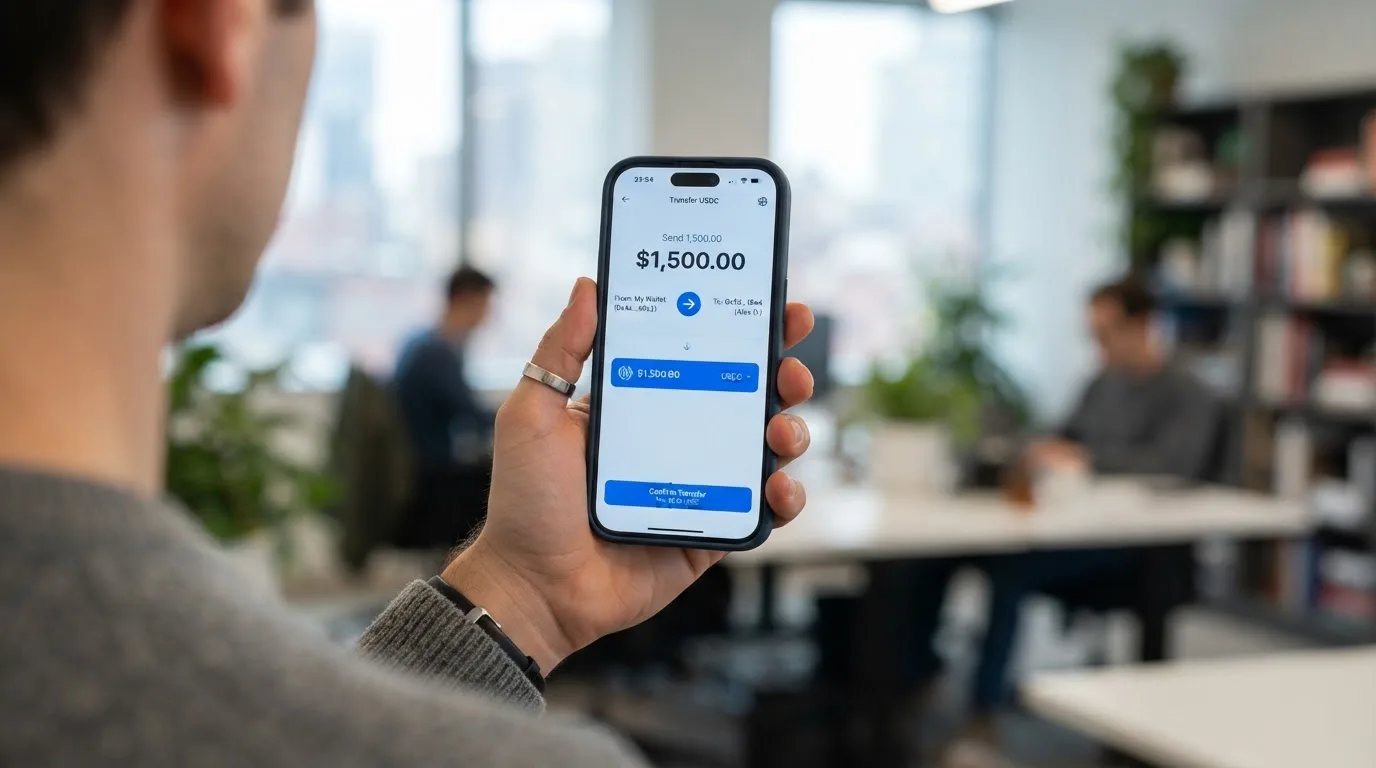
The practical question for someone reading this is: what do you actually do? You install the app, you create the account, and you look at the deposit or top-up screen. The App Store notes for version 4.4.0 mention grouped transfer methods by currency, which suggests a transfer-in experience similar to a wallet app rather than a card-on-top-of-a-bank-account experience. The exact on-ramp — bank transfer, card top-up, stablecoin transfer, mobile money — is not published on the card’s website. If the app offers a stablecoin deposit, the network it accepts is the network you need to use, and sending USDC on the wrong network to a USDC address is the single most common way to lose money in this category. The background section further down explains why that is irreversible.
What this means for you: the card’s top-up story is essentially “open the app and find out”. That is fine if you are comfortable discovering a product by using it, and not fine if you want to plan a budget in advance. It is also the main reason the top-up score is 5 out of 10, even though the card itself, once loaded, works in a very ordinary way.
There is no public mention of a withdrawal or payout flow. If you need to move money off the card back to a bank account or wallet, that is also something you find inside the app rather than on the website.
Paying with it every day
Once money is on the card, the everyday experience is the strongest part of Kredete. The virtual card is issued in about 10 seconds, which means you can use it for an online purchase almost as soon as you sign up. The physical card exists for places that need a card you can hand over, and it is delivered to 70+ countries. The card supports Apple Pay and Google Pay, which is the most reliable way to use a Visa on a phone in 2026, and the in-app freeze lives in the top bar of the app so it is one tap away.
The cashback offer is the second strong point. The card page lists “up to 6% cashback”, without specifying the payout currency or the conditions. Cashback is paid in something — the page does not say what — and the merchants that qualify are not listed. If you are evaluating the card on cashback alone, you have to assume the 6% is a ceiling, not a default, until you see your own rate in the app.
The iOS app is the only app reviewed here. At 3.97 out of 98 ratings, the rating is decent rather than glowing, and the review count is small enough that one or two grumpy users move the average. The app is free and at version 4.4.0 as of 7 October 2026, with iOS 16.2 as the minimum. The app is also where you freeze the card, where you confirm crypto sends and swaps with Face ID or passcode, and where the “privacy tools” mentioned in the release notes live. The Google Play listing was not read for this review; if you are on Android, that is the first thing to check yourself.
The official page does not say which merchant categories are blocked, so you will not know in advance whether the card works at a betting site, a crypto exchange, or an adult-content merchant. The background section explains why some issuers block whole merchant categories by policy. Treat any blocked-category question as a question for the app’s support chat, not for the website.
What can go wrong
The honest list of risks starts with the things the card does not tell you.
The card issuer is not named on the official page. Kredete, Inc. is the seller in the App Store, but the bank or e-money institution that actually issues the Visa is not stated on the official card page. Unofficial reporting says the card was built with Visa, Stellar and Rain, but Rain is a technology partner, not necessarily the issuer, and a card programme still needs a licensed issuer behind it. If you cannot find the issuer on the card’s own website, you cannot look up the issuer in a regulator’s register before you sign up, and you cannot read the issuer’s own terms. That is a real gap, and it is the main reason the reliability score sits at 6 out of 10 rather than higher.
The company is young and small. Unofficial reporting describes a Nigerian fintech startup founded in 2023, with a US$2.25 million seed round in September 2024. That is not a reason to distrust the company — many useful products come from small teams — but it is a reason to keep smaller balances than you would with a long-established bank, and to read the news around the company before you load a large amount.
No complaints were found in two passes of public sources on 21 and 22 October 2026. That is encouraging, and it is also a small sample: 98 iOS ratings is a small user base. The lack of complaints is not the same as a track record. The background section explains how programme closures have played out in this category in the past, and what to do if a programme winds down.
The security features that are stated are good. You can freeze the virtual and physical card from the app’s top bar, crypto sends and swaps confirm with Face ID or passcode, and the app lists “privacy tools”. Custody and safeguarding — where your money is held between top-up and spend — is not stated, which matters because if the underlying account holds stablecoin, the custodian of that stablecoin is the party you are really trusting with the funds.
News flow is positive so far. The card was launched on 4 June 2025 as a stablecoin-backed Visa, and on 20 April 2026 a partnership was announced at the Visa Africa Fintech Accelerator Cohort 5 Demo Day at GITEX Africa in Marrakech, with the 50-country African footprint and Gulf plans. A partnership announcement is not a guarantee, but it is a sign that Visa continues to back the programme.
Support and disputes are not stated. The official page does not describe how to contact support, what hours it operates, or how disputes and chargebacks are handled. If something goes wrong with a payment, the only thing the card page tells you is that the app exists.
The general background section further down explains, in neutral terms, how crypto cards have failed in the past and what protections you do and do not have. The short version: keep balances modest, use a unique email and a strong password, turn on the app’s freeze the moment the card is not in use, and assume the worst-case recovery is slow.
What to take instead
Kredete is not the only card that targets people who find ordinary banking hard. None of the alternatives below are identical to Kredete, and the differences matter. I have grouped them by the closest match to a reader who came to this page.
If you want a card with a published country list and US reach: Whop Cards
Whop Cards score 5.2 out of 10 in our comparison. The headline difference from Kredete is that Whop publishes a country list. Consumer cards are available in 31 US states, including California, Texas, New York and Florida; business cards are available in 41 states. The list of unsupported countries is also published: Belarus, Mainland China, Cuba, Hong Kong, India, Iran, Iraq, Israel, Myanmar, Nepal, Nicaragua, North Korea, Russia, Syria, Turkey, Ukraine, Venezuela and Vietnam. The corporate list includes Russia and Belarus. The basis — citizenship or residence — is not stated. If you need to know in advance whether you can apply, Whop gives you a yes-or-no answer, which is something Kredete does not.
Whop cards are Visa and work wherever Visa is taken. The card type and currency are not stated. The page says “No extra fees” without listing amounts, which is not a published schedule either, but it is at least a statement that there is no surcharge. The card spends from a Whop balance; pending balance is usable as soon as a payment arrives, settled funds are needed for withdrawals. The starting collateral is stablecoin from a linked wallet, and the coins and networks are not stated. Cashback is 5% at select merchants, currently Uber, with more planned; payout currency and conditions are not stated.
Whop is the alternative to look at if the Kredete country ambiguity is the deal-breaker for you, and if you are based in the United States.
If you want a card that explicitly mentions crypto: Stella
Stella scores 6.5 out of 10. The card is virtual and physical, Visa-branded, and accepted at “over 40 million VISA merchants globally”. The official site does not list supported countries, and the terms bar users under economic sanctions programmes and route US and European users through affiliates — a way of handling jurisdictional rules without naming a country list. Costs and fees are not stated officially, beyond being “described under this User Agreement and/or on the App”.
The top-up story is the relevant difference. You deposit crypto into the account, and the deposit automatically tops up the card; the in-app wallet is custodial. So Stella is honest in its public material about being a crypto-funded card, which Kredete is not. There is no cashback stated on the official card page; yield is a separate product. Stella is the alternative to look at if you specifically want a card that admits to being crypto-funded and a published wallet experience.
If you want a card issued by a named US bank: UniFi Card
UniFi scores 4.7 out of 10. The card is a “Prepaid Debit Visa Card” issued by Lead Bank, which is the part Kredete does not tell you. The card is USD and spends from the USD balance, with Apple Pay supported in the app. The supported-country list is not confirmed from official pages; the App Store lists send-money routes to the Philippines, Mexico, the eurozone, and recent release notes add Colombia, Brazil via PIX, and the UK in pounds.
The funding side is the cleanest of the three alternatives. You can receive funds via ACH, wire, SEPA via IBAN, or SPEI via CLABE, and you can also be paid into a USDC wallet; coins and networks beyond USDC are not stated on the listing. Cashback is “3% rewards on balances”, not on card spend, and that distinction matters if you are comparing reward rates. Fees and limits are not stated; the page refers users to the UniFi website.
UniFi is the alternative to look at if the missing issuer name on Kredete is your concern, and if you live in a country UniFi will actually serve.
Who I would recommend it to
The honest answer is short. I would recommend Kredete to two kinds of reader, and I would not recommend it to a third.
I would recommend it to a reader in an African market where the card already operates, who wants a USD Visa with cashback, and who is comfortable discovering the fee schedule in the app rather than on a website. The 0% FX markup, the in-app freeze, and the ten-second virtual card are all real benefits, and the cashback ceiling of 6% is high enough to matter if you spend a lot in the qualifying categories.
I would also recommend it to a reader who has been turned away by ordinary banks, who needs a Visa that works online and in stores without a traditional account, and who is willing to keep the balance modest while the product matures. The small user base, the unnamed issuer, and the lack of published fees are reasons to keep your exposure small until the company and the programme both have a longer track record.
I would not recommend it to a reader who needs to know in advance, on the card’s own website, what they will pay in fees each month, what the daily ATM allowance is, or which bank stands behind the card. Kredete does not publish any of that. If those are deal-breakers for you, Whop, Stella and UniFi each handle a different part of that gap, and the table above tells you which one to read first.
Frequently asked questions
What is the Kredete card?
The Kredete card is a USD Visa payment card, available as a virtual card issued in about 10 seconds inside the Kredete iOS app and as a physical card delivered to 70+ countries. The card is paid from a Kredete account balance, and the app supports Apple Pay, Google Pay, in-app freeze and cashback of up to 6%. The card’s own pages do not describe the underlying funding model; unofficial reporting says settlement happens in USDC.
How does the Kredete card work?
You install the Kredete app, create an account, top up the Kredete account balance, and spend from the card. The virtual card is generated in about 10 seconds; the physical card is delivered to your address. The card page does not say how the balance is funded; the app shows the available top-up methods. At payment time the card behaves like any other Visa, with 0% FX markup in 170+ countries.
Is Kredete a bank?
No. Kredete, Inc. is the company behind the app. The card issuer — the bank or e-money institution that actually issues the Visa — is not named on the official card page. Unofficial reporting says the card was built with Visa, Stellar and Rain, but a card programme still needs a licensed issuer, and Kredete does not name one publicly.
Who owns Kredete?
The official site does not say. Unofficial reporting describes Kredete as a Nigerian fintech startup founded in 2023, with a US$2.25 million seed round in September 2024. Treat that as unofficial and unconfirmed by the company.
Is the Kredete card available in my country?
The card’s own page does not publish a country list. The app’s App Store listing says “global accounts in 60+ countries”, and unofficial reporting places the launch in selected African markets with a 50-country African footprint and plans to expand to the UAE, Saudi Arabia and Oman. The honest answer is that you have to check the app from your phone to find out.
Does the Kredete card require KYC?
The card’s own pages do not describe the identity checks. Like any regulated card programme, Kredete is required by anti-money-laundering rules to verify its users, and the app will ask for documents during sign-up. The exact documents, the KYC levels, and the review time are not stated on the official page.
How do I top up the Kredete card?
You top up the Kredete account balance inside the app. The card page does not name the available top-up methods. The App Store release notes for version 4.4.0 (7 October 2026) say transfer methods are grouped by currency and each method shows its fee. If the app offers a stablecoin deposit, send the stablecoin on the network the app shows; sending on the wrong network to a USDC address is the most common way to lose money in this category.
How do I add the Kredete card to Apple Wallet or Google Pay?
The card supports Apple Pay and Google Pay. In the app, open the card and look for the “Add to Wallet” option; the standard Apple and Google prompts will guide you through the rest. Tokenised mobile wallets are also the most reliable way to use a Visa on a phone, because the device stores a token rather than your real card number.
Is the Kredete card safe?
The published safeguards are good: in-app freeze from the top bar, Face ID or passcode confirmation for crypto sends and swaps, and “privacy tools” in the app. The card’s own page does not describe custody or safeguarding of funds, and the issuer is not named. Keep balances modest while the product and the company are young, and assume the worst-case recovery is slow if something goes wrong.
Is the Kredete card worth it?
That depends on what you cannot get elsewhere. If you are in a supported market and a USD Visa with cashback is hard to find, the card is worth trying with a small balance. If you need a published fee schedule, a named issuer, or a confirmed country list before you sign up, the card does not provide those, and one of the alternatives above is a better fit.
App and neobank cards: the entry point – cryptocardportal.com
Content created by the «cryptocardportal.com» team