
A Visa card funded by stablecoins, with sensible fees and an unnamed issuing bank
 Available in US
HoneyCoin gives you a Visa card that spends a balance you have loaded, and you can fill that balance with stablecoins sent on-chain. There is no annual fee, spending in US dollars carries no fee on the card itself, and a virtual card arrives the moment you finish signing up. That is the shape of the product in one sentence, and it is genuinely useful for one particular person: someone in an African or emerging market who holds dollars in a stablecoin and wants to spend them at an ordinary shop without opening a foreign bank account.
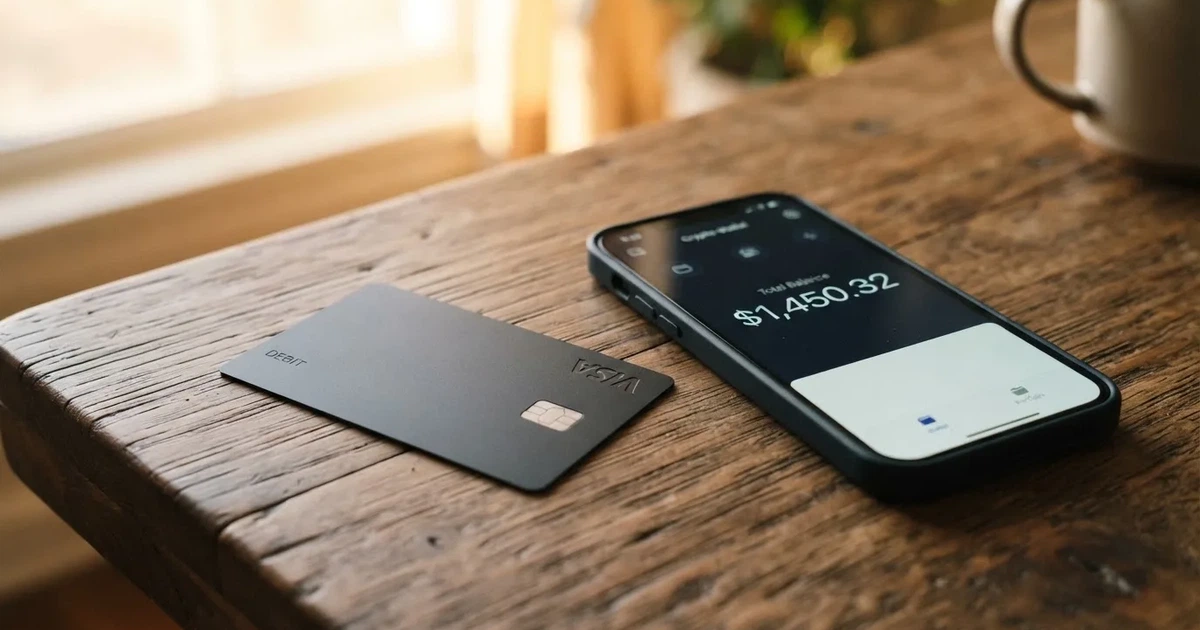
Against that, the card’s public pages leave several things unsaid that a careful buyer would want to know: the issuing bank is not named, the country list is not published, the crypto conversion fee is not disclosed, and no ATM or cash-withdrawal terms appear anywhere. Reliability is the weakest part of the picture too. Card payments in the consumer app were paused for months in 2025 because of card-testing attacks, and the company’s own App Store listing carries a single review.
I would rate it 6.7 out of 10. That is a middle score, and the middle is honest: the price is attractive, the mechanics are simple, and the risk is not exotic but ordinary — you are trusting a young Nairobi-based company with your money and with the card scheme’s willingness to keep working with it.
The conditions described here are current as of October 28, 2026.
What I scored and why
Here is the breakdown, criterion by criterion, with the reasoning I used rather than a marketing summary.
| Criterion | Mark | Why I gave it that mark |
|---|---|---|
| Who can get it | 8 / 10 | Accepted anywhere Visa is accepted, live in 45+ countries; but the card’s own pages warn that “some countries, merchants, and MCCs may be restricted” and publish no list |
| Cost | 7 / 10 | Issuance, monthly and yearly fees are all free; USD transactions at 0 %, FX spread up to 3 % on other currencies; the crypto conversion fee is not disclosed |
| Top-up options | 6 / 10 | Mobile money, bank transfer, card and on-chain stablecoins; the token table lists only USDC on Base, with USDT mentioned elsewhere |
| Reliability and complaints | 5 / 10 | HoneyCoin, Inc., Nairobi; issuing bank unnamed; card payments paused for months in August 2025 after card-testing attacks; App Store 1.0 from one rating |
| Everyday use | 7 / 10 | Virtual card instantly, physical card in 2–3 weeks; Apple Pay and Google Pay supported; ATM terms not disclosed |
| Total | 6.7 / 10 | Strong on price and reach, weak on transparency and track record |
Read that table as two stories. The left-hand half is the product: free, wide-reaching, ordinary to use. The right-hand half is the operation behind it, and it is young and lightly documented. Neither half cancels the other, but if you need the second half to be solid — because the money behind the card is money you cannot replace quickly — the first half stops being enough on its own.
Who gets the card
The card is accepted wherever Visa is accepted. HoneyCoin describes itself as live in 45+ countries, which is a wide reach for a card whose issuer is unnamed and whose headquarters is in Kenya. That reach is the reason to look at it if you are in a market where a normal debit card is awkward to obtain or expensive to keep.
The catch is that HoneyCoin’s own pages say “some countries, merchants, and MCCs may be restricted” and do not publish the list. There is no country table to consult before you apply. The MCC is the four-digit code that classifies a merchant by what it sells — for example, 7995 covers gambling, and issuers frequently block gambling on specific cards by policy rather than by law. HoneyCoin does not list which codes are blocked, so you cannot tell in advance whether the categories you actually buy from will work.
Two further points about eligibility. The card is open to anyone who passes identity verification, which the card states as a requirement before use — but it does not state which documents are needed, whether proof of address is required, what the minimum age is, or what verification tiers exist. So the honest answer to “who gets it” is: adults who can complete an identity check, in countries on a list the company has not published. If your country is uncertain, the only way to know is to find out during application, and that is worth weighing before you commit effort.
Getting the card
There are two forms of the card. The virtual Visa appears instantly once you have signed up; the physical card takes 2–3 weeks to arrive. The cost of the physical card is not stated. The card currency is USD, which is why USD transactions come through at 0 % — there is no conversion to do if you are already spending dollars.
Identity verification comes before use, and it is the gate that matters. Nothing on the public pages describes the documents required, whether proof of address is part of it, the minimum age, or how many verification levels exist. In practice, regulated businesses are required to verify customers under anti-money-laundering law and to keep monitoring transactions afterwards, so an ongoing check is normal rather than a one-off. In the EU that due diligence covers name, address, date of birth, nationality and identity documentation, a sanctions check, the purpose of the relationship, and whether you are a politically exposed person. In the US, the customer identification programme requires name, date of birth, address and an identification number, and electronic systems typically check proof-of-address documents against records.
One thing worth understanding before you apply: nationality is screened separately from where you live. Sanctions screening and issuer risk policy are often applied to citizenship and country of birth as well as to your address country. Two people living in the same city with different passports can get different answers from the same company, and nothing in HoneyCoin’s public material explains how it treats that distinction.
If the checks cannot be completed, EU rules require the institution to hold back from the transaction or relationship and, where necessary, close an existing one. That is why accounts get frozen pending documents, and it is worth expecting rather than being surprised by.
Fees and what they add up to in practice
The headline is good: issuance is free, and so are the monthly and yearly fees. Spending in US dollars is charged at 0 %. Spending in another currency carries an FX spread of up to 3 %. The crypto conversion fee is not stated, which is the single largest gap in this section — it is the number that determines what a non-dollar purchase really costs when your balance is denominated in USDC.

Here is the full set of figures the card publishes.
| Fee or limit | What the card says |
|---|---|
| Issuance | Free |
| Monthly fee | Free |
| Yearly fee | Free |
| Transactions in USD | 0 % |
| Other currencies | FX spread fee up to 3 % |
| Crypto conversion fee | Not stated |
| ATM / cash withdrawal | Not stated |
| Balance currency | USD balance (USDC) |
| Tiers | Single tier; limit increases with usage |
| Daily limit | 10,000 USD/day, “Increases with Usage” |
| Monthly limit | Default $10,000 daily applies to both spending and loading |
The default limit deserves a note, because it is stated in a slightly confusing way: 10,000 USD a day, described as the default for both spending and loading, which “increases with usage”. You can set lower custom limits in the app, and higher limits are possible after review. Practically that means a large monthly expense is not blocked by an arbitrary cap on day one, but it also means the ceiling you start with is not a promise — it is a starting point that a usage review can raise.
There is only one tier, so nothing in the product rewards you for volume or tenure.
Now, three ordinary payments, and what actually happens to each.
A $40 subscription in US dollars. This is the clean case. No card fee on the USD transaction, no FX spread, and if your balance is already in USDC on the account, nothing to convert. If you had to convert crypto into that balance first, the undisclosed conversion fee is what you pay — and it is what you cannot budget.
A €25 supermarket shop in Europe. Your balance is dollars, the till is in euros, so you eat the FX spread — up to 3 % on 25 euros. That is the case where the card is weakest, and it is also where the address verification wrinkle bites: AVS compares the numeric parts of the billing address a buyer typed with the issuer’s records, it is mainly offered in the US, Canada and the UK, and it is generally unavailable for foreign-issued cards, which can cause declines. A card issued in one country can also look “foreign” to a shop in another, because merchants can look up the BIN to see which institution and country issued the card and apply extra scrutiny if it differs from the billing address. Some merchants decline prepaid or foreign BINs outright.
A standard transfer home from abroad. Two currencies again — the spread up to 3 % — and then whatever your own sending or receiving arrangement costs, which is not a HoneyCoin fee and not something I can price for you. If you were converting into naira before the transfer, the undisclosed conversion fee sits on that step too.
None of these is a trap. It is simply a picture of a card that is cheapest for dollar spending, less cheap for anything else, and silent on one of the two numbers that set the real cost.
How to top it up
HoneyCoin lists four ways to load the balance: mobile money, bank transfer, card, and on-chain stablecoins. That list is the card’s real differentiator — mobile money in particular is not something most Western card products offer at all, and for a user in an African market it can be the only practical route.
The on-chain route is the one that needs care, because the card’s documentation is not consistent about which assets are supported. The token table lists only “USDC on Base”. The FAQ refers to USDC and “select other assets where enabled”, and the funding section additionally mentions USDT. So treat the token table as the reliable statement and the FAQ as the broader one — the safe assumption is USDC on Base, and anything else needs confirming in the app before you send.
The mechanics of a stablecoin deposit are worth understanding, because the mistakes are expensive. USDC is a dollar-pegged token; Tether’s USDT and Circle’s USDC are US-dollar-pegged, and the BIS put about 90 % of stablecoin market capitalisation in these two as of July 2025. Circle lists USDC as natively supported on 38 networks as of 16 September 2026, including Ethereum, Solana, Base, Polygon PoS, Avalanche, Arbitrum and Stellar. Circle stopped supporting USDC on Tron in February 2024, so “USDC over TRC20” is not a native option.
The rule that catches people: blockchain transfers are irreversible. A deposit sent on a network the provider does not support, or to an address belonging to a different network, can be lost or need manual support recovery with no guarantee. Sending Base tokens to an Ethereum address is not a slow transaction, it is a gone transaction. Two smaller snags: on Ethereum, gas fees are paid only in ETH, so a wallet holding USDT with no ETH cannot send at all; on Tron, fees are paid via bandwidth and energy resources, often burning TRX. And these network fees are charged by the blockchain, not by HoneyCoin.
What the card does not state is the fee, minimum, or who pays the network fee for a top-up. That is worth asking before your first transfer rather than after.
For withdrawal, the site says “Payout to local accounts or wallets on demand” at the platform level. Fees for withdrawing a card balance are not stated.
Paying with it day to day
The card works with Apple Pay and Google Pay, which is the practical route most people will use daily: add the virtual card to a phone wallet and pay contactless without handling the card. The security design behind that is not decorative — Apple Pay replaces the card number with a device-specific Device Account Number stored in the Secure Element, never on Apple servers, and each payment uses a one-time dynamic security code. The issuer can also restrict the tokenised number, for example blocking it on magnetic-stripe use.
Online payments may trigger 3-D Secure, an identity check on top of the payment: Visa’s brand is Visa Secure, Mastercard’s is Identity Check, and the 2016 version of the standard supports one-time passcodes and app-based authentication aligned with EU strong customer authentication. Under 3-D Secure, liability for fraudulent online payments can shift from merchant to your bank, though critics argue it can land on the cardholder.
Two absences are worth knowing. There is no cashback or rewards programme stated — no cashback at any rate, unlike several alternatives in this category. And no dispute process is described: what happens when a merchant takes the money and does not deliver is not spelled out on the public pages. A chargeback is a refund ordered by your issuer with a reason code such as fraud, duplicate billing or goods not received, and in the US those rights come from Regulation E for debit and Regulation Z for credit; prepaid-card coverage varies and should not be assumed. So if you are spending your emergency float on this card rather than your everyday float, the absence of a described dispute route matters more than the 0 % dollar fee.
The app itself is thin evidence. The US App Store listing reads “Peer – the everything app.” by HoneyCoin, Inc., with a rating of 1.0 from 1 rating when read on 21 October 2026. That is a single review — statistically meaningless in either direction, but not a foundation either. Google Play was not read.
Physical cards taking two to three weeks is normal for the category. Instant virtual issuance is the genuinely convenient part.
What can go wrong
Four things, in rough order of how much they should worry you.
The company behind it. HoneyCoin, Inc. / Quicknode Technologies Ltd as the starting data, with a Nairobi, Kenya address (The Cube, Riverside Drive), founded 2021. It says it is “licensed in key markets including the US, Canada, the EU, and several African jurisdictions”. It does not name its issuing bank, referring only to “licensed partners”. When you cannot see the bank that actually stands behind your card balance, you are relying on the programme manager’s word for it.
Card programme interruptions. This is not hypothetical for this company. On 12 August 2025 its own blog announced a $4.9M funding round and a footprint live in 45+ countries, and reported that card payments on the consumer app had been paused for months because of card-testing attacks — the practice where fraud rings use stolen card numbers to test whether they are live. Fraud rings do not distinguish between good customers and targets, and when a programme becomes attractive to them, spending can stop for everyone. It has happened across this category: Visa terminated its global agreements with FTX on 13 November 2022 and the FTX US debit card was wound down by its issuer; WaveCrest, a Visa issuer that supplied several crypto card brands, was suspended by Visa in Europe in 2018, closing all WaveCrest-issued Visa programmes.
Custody. Your balance is not in a wallet you hold the keys to. With a custodial wallet the provider holds the credentials, so you must trust the provider completely; a seed phrase is typically 12 to 24 words and anyone who obtains it can restore the wallet and spend its funds; and crypto transfers are typically irreversible with no built-in recovery, because the network cannot freeze or return them. Custodial platforms have a real record: Mt. Gox (about US$350 million reported stolen, 2011–2014), Coincheck (about US$400 million, 2018), Ronin Network (US$625 million, 2022). HoneyCoin states that “Client money is safeguarded and held completely separate from ours”, with 2FA on login and privileged actions and PCI DSS Level 1. Worth noting what that safeguarding is: EMIs must segregate customer funds in dedicated accounts or insure them, and such funds are not the same as bank deposits and are not covered by deposit guarantee schemes. An instant card freeze is a listed safeguard in this category, but no freeze function is mentioned on HoneyCoin’s security page.
Silent partial declines. Declined authorisations may leave a hold on your funds that can persist for several days, typically up to seven. Combined with an unnamed bank and an unpublished list of restricted countries and merchant categories, this is the everyday friction: not fraud, just a payment that does not go through and a balance you cannot spend for a week.
On the positive side, I looked for independent customer reviews and found nothing: no Trustpilot page for HoneyCoin, and no Reddit reviews found. Trustpilot results under that name belonged to an unrelated product. So there is no body of user experience either reassuring or damning — you would be among the early users, which cuts both ways.
What to take instead
Three comparable prepaid-crypto or crypto-funded cards, scored on the same basis. All three have their own gaps; I include them because the shape of each gap tells you something about where HoneyCoin stands.
| Card | Score | Where it draws its money from | What it does not tell you |
|---|---|---|---|
| HoneyCoin | 6.7 / 10 | Mobile money, bank transfer, card, on-chain stablecoins (token table: USDC on Base) | Issuing bank, country list, conversion fee, ATM terms |
| Stella | 6.5 / 10 | Deposit crypto into a custodial in-app wallet, which automatically tops up the card | Countries not stated on the official site; fees “described under this User Agreement and/or on the App” |
| Whop Cards | 5.2 / 10 | A Whop balance; pending balance usable as soon as a payment arrives, standard withdrawals use settled funds | Fee amounts; whether cards are virtual or physical; card currency |
| UniFi Card | 4.7 / 10 | ACH, wire, SEPA (IBAN) or SPEI (CLABE) in, or being paid to a USDC wallet | Fees; eligibility not confirmed from official pages; coins and networks beyond USDC |
Stella is the closest substitute. It offers virtual and physical cards on Visa, works at “over 40 million VISA merchants globally”, and funds the card by depositing crypto into a custodial wallet that tops it up automatically — no separate top-up ritual. Its terms bar users under economic sanctions programmes and route US and European users through affiliates, and its official site does not state which countries are served. No cashback is stated on the card page; its Earn product is separate yield.
Whop Cards is the most transparent about *where* it works and the least about price. It publishes a state list: 31 US states for consumers (Alabama, Alaska, Arkansas, California, Colorado, Connecticut, Florida, Hawaii, Illinois, Indiana, Iowa, Kansas, Kentucky, Maine, Massachusetts, Michigan, Minnesota, Montana, Nebraska, New Hampshire, New Jersey, New York, North Carolina, Oklahoma, Pennsylvania, South Carolina, Texas, Utah, Virginia, West Virginia, Wyoming) and 41 states for businesses, plus a list of countries where consumer cards are unsupported — Belarus, China (Mainland), Cuba, Hong Kong, India, Iran, Iraq, Israel, Myanmar, Nepal, Nicaragua, North Korea, Russia, Syria, Turkey, Ukraine, Venezuela, Vietnam — with Russia and Belarus also unsupported for corporate accounts. Whether eligibility turns on citizenship or residence is not stated. Its page says “No extra fees” without listing any amounts. It does offer 5 % cashback at select merchants, currently Uber, with more planned, though the payout currency and conditions are not stated. Spending comes from a Whop balance backed by stablecoin collateral from a linked wallet.
UniFi Card is the weakest of the four on the evidence available. Eligibility could not be confirmed from official pages; the App Store lists send-money routes to the Philippines (PHP), Mexico (MXN) and the eurozone (EUR), with recent release notes mentioning Colombia, Brazil (PIX) and the UK (GBP). It is a “Prepaid Debit Visa Card” issued by Lead Bank, supports Apple Pay, and spends from a USD balance. Its listing says only “Fees may apply. See UniFi website for more details.” A listing claim of “3% rewards on balances” is not the same as card cashback, which is not stated.
The pattern across all four is worth stating plainly: this category is young, and disclosure is uniformly thin. HoneyCoin’s advantage is not that it is the most transparent — it is not — but that it is the one of the four that explicitly supports mobile money, and that it publishes a real daily limit with a stated path to raising it.
Who I would recommend it to
I would recommend this card to someone who holds dollars in a stablecoin, is in a market where mobile money or a dollar-denominated balance is the practical way to move value, and who wants a free Visa to spend it through — accepting that the balance is custodial, that the issuing bank is unnamed, and that the 0 % dollar rate does not carry over to other currencies.
I would not recommend it as your only card. It has no rewards, no described dispute process, no disclosed ATM terms, an undisclosed conversion fee, and a 2025 history of spending being paused for months. If this were the only way you could spend anything at all, it would still be a reasonable choice — but it should be a choice you made with those facts in front of you, not one made because a page showed 0 %.
Two things to check before your first transfer, in this order: confirm the exact network and asset against the token table in the app, since the FAQ and the funding section disagree with it; and confirm what conversion fee applies when your balance is not already in the currency you are spending. Both are answerable in the app in a minute, and both are the difference between a pleasant surprise and an expensive one.
And if your situation is one where a tax question follows the spending — note that the IRS treats digital assets as property, so exchanging them for goods, services or dollars generally produces a taxable gain or loss, measured in local fiat currency at fair market value on the date of the transaction, which can make each card payment funded from crypto a separate disposal. I am not giving tax or legal advice here; I am flagging that the consequence exists, and that how it applies to your own holdings is a question for a professional in your jurisdiction.
Frequently asked questions
What is the HoneyCoin card?
HoneyCoin is a prepaid Visa card funded from a balance you load yourself. It works at any merchant that accepts Visa, in a virtual form issued instantly and a physical form that arrives in 2–3 weeks. It is aimed at users in Africa and other emerging markets who want to spend a stablecoin balance through an ordinary payment card, with mobile money among its listed top-up methods.
How does the HoneyCoin card work in practice?
You load a balance first, then the card spends only that balance, so it cannot overdraw. The balance is US dollar denominated, held as USDC, and spending in US dollars carries no card fee. Spending in another currency picks up an FX spread of up to 3 %. The card also works with Apple Pay and Google Pay, and the default daily limit is 10,000 USD for both spending and loading.
Is HoneyCoin a bank?
No — not as far as its public material shows. It is a fintech company, HoneyCoin, Inc. / Quicknode Technologies Ltd as the starting data, based at The Cube, Riverside Drive, Nairobi, Kenya, founded 2021, saying it is licensed in key markets including the US, Canada, the EU and several African jurisdictions. It does not name its issuing bank, referring only to “licensed partners”. In EU terms an electronic money institution can issue payment cards but cannot lend.
Who owns HoneyCoin?
The card’s own disclosure points to HoneyCoin, Inc., also referenced as Quicknode Technologies Ltd, a Nairobi-based company founded in 2021. It announced a $4.9M funding round on 12 August 2025. Ownership beyond the company structure is not broken out publicly, so if the specific shareholder behind the company matters to your decision, that is a question to put to them directly.
Which countries can I use the HoneyCoin card in?
The card says it is live in 45+ countries and accepted wherever Visa is accepted. It also warns that “some countries, merchants, and MCCs may be restricted” without publishing the list, and does not state which documents, proof of address or minimum age it requires. So the reliable answer is that eligibility is checked case by case during application rather than looked up in advance.
Does the HoneyCoin card require KYC?
Yes — identity verification is required before use, and the card does not state which documents are needed, what verification tiers exist, or whether proof of address is required. Regulated providers are obliged to verify customers and monitor transactions under anti-money-laundering rules, and nationality is screened separately from residence, since sanctions and issuer risk policy often apply to citizenship and country of birth as well as address.
How do I top up the HoneyCoin card?
Four methods are listed: mobile money, bank transfer, card, and on-chain stablecoins. For the crypto route the token table lists only USDC on Base, while the FAQ mentions “select other assets where enabled” and the funding section also mentions USDT — so confirm in the app before sending. Network choice matters more than anything else, because transfers are irreversible and a deposit to the wrong network can be lost.
Is the HoneyCoin card free?
Issuance, the monthly fee and the yearly fee are all free, and transactions in US dollars are charged at 0 %. The gap is that the crypto conversion fee is not stated, and other currencies carry an FX spread of up to 3 %. The cost of a physical card is also not stated, and there is a single tier with no rewards of any kind.
Is HoneyCoin card safe to use?
It publishes sensible safeguards: client money “safeguarded and held completely separate from ours”, 2FA on login and privileged actions, and PCI DSS Level 1. Counterparty risk remains, because such safeguarded funds are not the same as bank deposits and are not covered by deposit guarantee schemes. The card’s own record includes card payments on the consumer app paused for months in 2025 after card-testing attacks, so treat it as one tool among several.
Where can I use the HoneyCoin card, and what about cash withdrawals?
Anywhere Visa is accepted, with Apple Pay and Google Pay supported, and virtual cards activating instantly while physical cards take two to three weeks. The merchant-category restrictions are not listed despite the card warning some MCCs may be blocked, and ATM and cash-withdrawal terms are not stated at all. Cash availability is therefore the first thing to ask about if you need it.
App and neobank cards: the entry point – cryptocardportal.com
Content created by the «cryptocardportal.com» team