
TXBFI review: a crypto Visa priced like a luxury product
 Available in US
I keep coming back to TXBFI because the shape of it is unusual. It is a Visa card that spends straight from a crypto balance, sold in four tiers that climb from $25 all the way to $10,000, with no monthly fee anywhere in between. Most cards in this category are cheap to open and cheap to keep. This one is cheap to open only if you never leave the cheapest tier, and the ladder above you is steep. That single fact colours almost everything below.
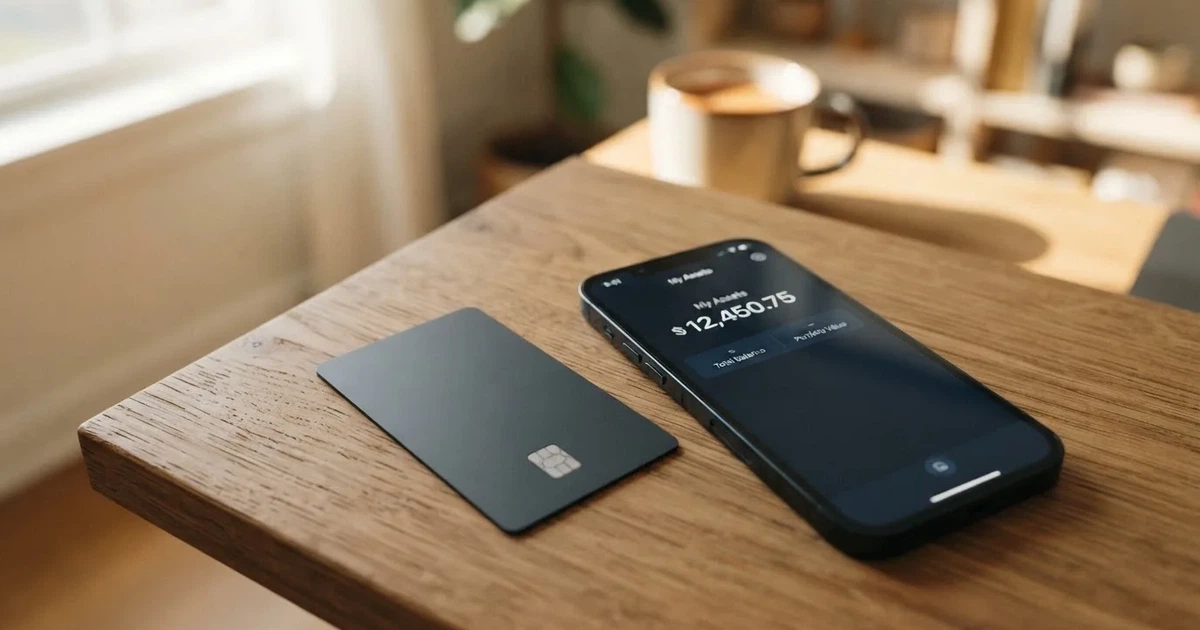
The conditions described here are current as of October 28, 2026.
Verdict: 5.8 out of 10
I score TXBFI 5.8 out of 10. The card does several things well — the range of coins you can hold, the four tiers, the cashback ladder, the fact that there is no monthly fee. But the card also has gaps that matter more to a prospective user than the good parts: nobody will tell you which countries are eligible, the card issuer is not named, the app is in beta, and I could not find a single independent review of it anywhere. A card you cannot check is a card you have to take on faith, and that is what you are being asked to do here.
Who it suits: crypto holders who want a Visa that runs from virtual through to a gold metal tier, who already hold the assets and just need somewhere to spend them, and who read terms pages for fun. Who it does not suit: anyone who needs a predictable country list, a visible regulator with a licence number, a phone app that has graduated from beta, or a card they can complain to when something goes wrong.
| Criterion | Mark | Why |
|---|---|---|
| Who can get it | 7 / 10 | Country list not disclosed; Russia and Belarus not mentioned; the only wording is that availability is subject to jurisdiction, eligibility, applicable law and provider requirements |
| Cost | 3 / 10 | One-time Virtual $25 (promo, from $200), Plastic $300 (promo, from $500), Metal $1,000, Gold $10,000; top-up 2.6%, forex 0.6%, no monthly fee |
| Top-up options | 7 / 10 | Top up with BTC, SOL, SUI, XRP, XLM, USDT, USDC; networks not disclosed |
| Reliability and complaints | 5 / 10 | TheXBanky s.r.o., Prague, Czechia; card issuer and VASP licence number unnamed, app in beta, no reviews found |
| Everyday use | 8 / 10 | Virtual is virtual, Plastic / Metal / Gold are physical; Apple Pay and Google Pay on the virtual card, physical cards Google Pay only; ATM: Plastic $1,000 a day, Virtual none |
| Total | 5.8 / 10 | A capable card on paper, an untested one in practice |
The headline number is not a punishment. It is a description of a product I could not verify. Everything below tells you what I could and could not confirm.
Will they give you the card?
Here is the honest answer: I cannot tell you, and neither can TXBFI’s public pages.
There is no list of eligible countries and no list of excluded ones. Not on the card page, not in the help articles, not anywhere I looked. The card states only that “Service availability is subject to jurisdiction, eligibility, applicable law and provider requirements.” That sentence is doing an enormous amount of work. It means, in effect, that the decision rests with the company and with the issuer behind it, and that the rules can change without your being told in advance. It also means you cannot read the eligibility criteria before you apply, because they are not written down.
That matters enormously for the reader this review is for. If you are in a country with its own rules about crypto, or a country under sanctions, or simply a country where a Prague-issued card will not settle with local merchants, you are the one who discovers the answer, not the marketing page. You would be starting a KYC process, handing over a passport and a proof of address, and only then finding out whether you are eligible.
A useful piece of background, though it is not about TXBFI specifically: nationality is recorded and screened separately from residence, because sanctions screening and issuer risk policy are often applied to citizenship and country of birth as well as to the country you live in. So even a card that did publish a country list might have exclusions based on your passport rather than your address. Getting an answer before you upload anything is worth an email to the support addresses listed further down.
A note on what “eligible” usually means here
In the wider card world, prepaid and debit cards are generally available to adults, 18 and over, and some issuers set higher limits. That is the general pattern. TXBFI does not state a minimum age on the pages I read, which is its own small silence. Do not treat the general pattern as permission; treat it as a reason to ask.
How to get it
The process itself is short, which is a point in its favour. You register on the web platform, pass KYC, choose a tier, pay the one-time price, and top up.
The KYC asks for a government photo ID — a passport, a national ID or a driver’s licence — plus proof of address dated within the last 3 months, meaning a utility bill or a bank statement. There is a biometric or liveness check, and screening against sanctions, PEP lists and wallets happens per the terms. Most accounts are approved within 24 hours. One account per person.
There is a single KYC path, described in one place: ID, proof of address, liveness, approval mostly within 24 hours. What is not described is which tiers need which extra checks, or what the rejection reasons would be. So if you are holding yourself back because you suspect your documentation will not pass, you will not find that out from the documentation.
The card itself is a Visa. The Virtual tier is virtual; Plastic, Metal and Gold are physical. The card’s currency is not stated, which becomes important the moment you use it abroad, and I will come back to it in the costs section.
One thing the card’s public pages do not state at all: delivery. There is no stated delivery time, no stated delivery cost, no stated destination countries. If you order a Metal card at $1,000, you are buying a physical object and the public pages do not tell you how or when it arrives.
What it really costs: the Fees
This is where I would start if I were you, because the answer is more complicated than the headline suggests.

There is no monthly fee and no annual fee — both are $0. What there is instead is a one-time price per tier, which is not a fee but which behaves like one, because you pay it once and never get it back. Upgrading costs the difference between tiers.
| Fee or limit | Value |
|---|---|
| Virtual issuance (promo) | $25, from $200 |
| Plastic issuance (promo) | $300, from $500 |
| Metal issuance | $1,000 |
| Gold issuance | $10,000 |
| Monthly fee | $0 |
| Annual fee | $0 |
| Forex, per international transaction | 0.6%, described as a fixed spread over mid-market |
| Deposit fee, top-up | 2.6% Virtual and Plastic, 2.4% Metal, 1.8% Gold |
| Internal crypto-to-crypto exchange | 0.2% |
| Cross-chain swap | 0.2% |
| ATM fee | $2.50 domestic, $3.50 international |
| ATM daily withdrawal | Virtual none, Plastic $1,000, Metal $1,500, Gold $3,000 |
| Single tap limit | $15,000 (Virtual, Plastic), $40,000 (Metal), $100,000 (Gold) |
| Monthly limits | not stated |
The card tiers page also says “from 2%” for ATM, which does not line up with the FAQ’s $2.50 and $3.50. And here is something you should know before you read the table above as settled: the site also carries a heading “Why 2.7% upfront” and a header showing 3% for top-up. Those numbers contradict the FAQ’s 2.6%. I have put the FAQ figures in the table because they are the ones stated most precisely, but the inconsistency is itself a fact, and it is the kind of thing that makes me hesitant about every other number on the page.
The free ATM allowance, if there is one, is not stated. The monthly limits, for spending or for anything else, are not stated.
What this means for three ordinary payments
Take a Tuesday: you buy a coffee, a sandwich and a book.
- Coffee, $4, home city. No forex fee, because it is not international. No ATM fee, because you are not at a machine. The cost is whatever the card’s conversion does at the moment of payment, which is the conversion the card handles rather than a fee on the card. The coffee is cheap. This is the easy case.
- Sandwich, $9, abroad, in euro. This is where the 0.6% forex fee applies, on an international transaction, described as a fixed spread over mid-market. On $9 that is a fraction of a cent, and you will never notice it. On a $200 purchase abroad it is $1.20, and you will notice it more at that size than at this one.
- A $300 hotel abroad, on the Metal tier. The forex fee is $1.80. The deposit fee is not involved here — you have already funded the balance. But this is the payment where the single tap limit matters: Metal’s limit is $40,000, so $300 is nowhere near it, and on the Virtual tier’s $15,000 it would also be fine. The limit only starts to bind on the big payments, and that is where the tier ladder pays for itself.
Two other charges lurk in the same category and you should know them even if you never touch them. Converting crypto to crypto inside the app costs 0.2%. A cross-chain swap costs 0.2%. Both are small; both are things a beginner does without realising they are spending twice.
The fees that are not on the card’s list
Two charges you may pay that the card does not name. First, on-chain network fees — gas, or bandwidth on Tron — are charged by the blockchain for your deposit, not by the card provider, and they vary by network and by congestion. The card does not say who pays them or when. Second, and more awkwardly, the card does not state its card currency, though the home page mentions 20+ currencies. If your balance is denominated in something other than the currency a shop wants, a conversion happens somewhere, and the terms of that conversion are not published.
How to Top up
Top up with BTC, SOL, SUI, XRP, XLM, USDT or USDC. That is the list of assets, and it is a decent one — it covers the two major stablecoins and a spread of majors including two you will not have heard of.
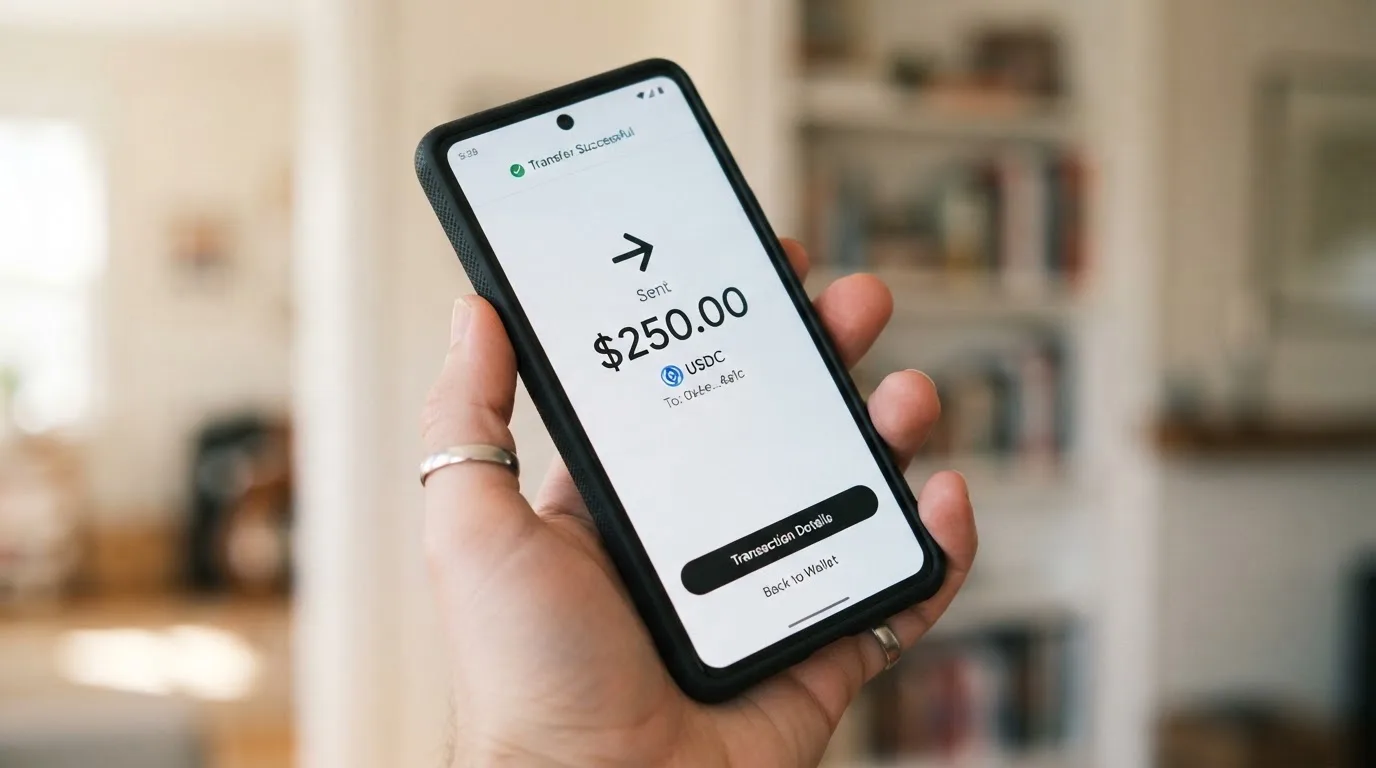
The networks are not stated, and this is the single most consequential gap in the whole product for anyone actually trying to use it. Here is why, in general terms rather than card-specific terms. A stablecoin is not one thing; it exists in separate versions on separate blockchains, and the versions are not interchangeable. USDT has been issued on networks including Ethereum, Tron, Solana, Polygon and Avalanche. Circle stopped supporting USDC on Tron in February 2024, so “USDC over TRC20” is not a native option. And blockchain transfers are irreversible: a deposit sent on a network the provider does not support, or to an address belonging to another network, can be lost or need manual support recovery with no guarantee.
There are further details the card leaves open. The minimum top-up is not stated. Whether you or the provider pays the network fee is not stated. For fiat, the home page mentions local bank transfers and SEPA, with no fees stated.
The deposit fee is the one number that is clear: 2.6% on Virtual and Plastic, 2.4% on Metal, 1.8% on Gold. Exchange deposits are 0%.
Here is what that fee does to a small top-up. Put $100 in on a Virtual card and the fee takes $2.60 before a single cent is spendable. The same $100 on a Gold card costs $1.80, a difference of 80 cents — which is the entire reason a Gold card costs $10,000. That fee is not a rounding error on the deposit; on smaller amounts it is a real percentage of what you put in, and it is worth doing the arithmetic on your own typical top-up before you pick a tier.
Two things the card does not state that you will need if you ever want out: how to withdraw crypto or money from the account, and what happens to any balance left when you close. The account is deletable in the app under Profile, Delete Account, or by email. That is stated. What you get back, if anything, is not.
Paying with it every day
This is the section where TXBFI is at its most convincing, and also where the public pages contradict themselves.
Virtual cards support Apple Pay and Google Pay, per the FAQ. Physical cards support Google Pay only. That is the FAQ’s position. But a trust badge on the home page says both are available for all tiers. One of those is wrong. If Apple Pay on the Metal card matters to you, you have a fifty-fifty and no way to resolve it from the outside.
Merchants: the categories that are blocked are not stated. A merchant category code is a four-digit number that classifies a business by goods or services, assigned under ISO 18245 when a business starts accepting a card. MCC 7995, for instance, covers gambling, and many issuers block it on specific cards by policy rather than by law — the blocked list varies by issuer, and TXBFI publishes none. So gambling is the example everyone asks about and, in this case, it is genuinely unknown.
Cashback is the tidiest thing about the card, and it is uncapped: BTC cashback at 0.05% on Virtual, 0.1% on Plastic, 0.2% on Metal, 0.4% on Gold, credited within 24 hours. Brand discounts run 1% / 2% / 4% / 7–9% across the same tiers. Set against the 2.6% deposit fee on the cheapest tier, cashback is not what makes the card pay for itself.
The app is iOS beta via TestFlight and Android beta via Google Play testing, with “V2 launching soon”. No store rating is published, and no review score exists for an app most people cannot find in a normal app store search. This is also the app you would use for the one thing that matters most in an emergency: freezing the card. Two-factor authentication and an in-app freeze are not stated.
Disputes. No chargeback process is described. For context, a chargeback is a refund ordered by the card issuer to settle a dispute, with reason codes such as fraud, duplicate billing or goods not received; in the US, debit card reversal rights come from Regulation E and credit card rights from Regulation Z, and prepaid-card coverage varies and should not be assumed. So the category’s protections may or may not apply to you depending on how TXBFI’s card is set up — and TXBFI does not tell you. The terms point to Czech law and Czech courts, and link a Complaints Policy whose text is not available.
That is the pattern I keep noticing on this card: where the good news is specific, the bad news is a link to a document you cannot read.
What can go wrong
The card issuer is not named. This is the one that should make you pause. A card network routes messages and sets rules, an issuer holds the actual card programme under that network’s licence, and the brand you have signed up with is often only a programme manager or a front end. When a card brand and an issuer are the same visible company, you can at least see who to write to. Here the site calls TXBFI a technology platform, and the issuer and programme manager are not named. If something goes wrong with your money at the card level, you do not yet know whose name is on it.
The company is real and Czech. TXBFI’s operator is TheXBanky s.r.o., IČO 21932506, Děčínská 552/1, Střížkov, 180 00 Prague 8, Czech Republic. That is a registered, searchable legal entity, which is more than many cards in this category offer. The FAQ claims a VASP licence and EU and Czech AML compliance, with no licence number given. The home page displays an “Offshore Banking Sublicense” badge with no details behind it.
For context on what that badge might mean in the wider market: MiCA, the EU’s markets-in-crypto-assets regulation, took legal effect in June 2023; its rules on asset-referenced tokens and e-money tokens applied from 30 June 2024, and the remaining provisions including crypto-asset service provider rules from 30 December 2024. Under it, e-money tokens may be issued only by a credit institution or an electronic money institution. The transitional period for existing providers runs only until 1 July 2026 or until they receive or are refused authorisation, whichever comes first. ESMA maintains an interim register of authorised CASPs, white papers and non-compliant entities — a register you can consult yourself. Note also that the card itself is a payment service regulated separately from the crypto side, so a card like this commonly depends on two licences rather than one.
No track record, and no bad history either. I found no official incidents. I also found no Trustpilot page and no Reddit threads — the search I ran was “TXBFI card reviews trustpilot reddit”. Absence of complaints here means absence of users, not absence of problems. A brand with no reviews has not been reviewed because it has not been around long enough, or because nobody has written about it yet, and both of those are young-company symptoms rather than quality signals.
Custody. The FAQ says TXBFI does not take custody of your assets or control your private keys, and that assets are held by third-party providers. Read that carefully: the second clause is the load-bearing one. Non-custodial in the sense that your keys stay with you, but the balance the card spends is in someone else’s hands by the time it is a card balance. Custodial platforms have a record of failures — Mt. Gox at about US$350 million reported stolen across 2011–2014, Coincheck at about US$400 million in 2018, Ronin Network at US$625 million in 2022. Holding funds with a custodian carries counterparty and hack risk. Two-factor authentication and instant card freeze, the everyday safeguards that limit the damage of a compromised app or a lost phone, are not stated.
Programmes end. Visa and Mastercard do not themselves issue crypto cards to consumers; they license issuers, and they can suspend a programme. Visa terminated its global agreements with FTX in November 2022 and the FTX US debit card was wound down by its issuer. WaveCrest, a Visa card issuer that supplied crypto card brands, was suspended by Visa in Europe in 2018, closing all WaveCrest-issued Visa programmes. Closures typically give a notice period, then stop spending and loading, then ask users to withdraw remaining balances. With TXBFI’s withdrawal terms unstated, a closure notice would leave you without a published route out.
Declines and holds. Some merchants decline prepaid or foreign card numbers, because the issuer identification number in the card number tells the merchant both the institution and the country of issue, and a mismatch with your billing address invites extra scrutiny. Address verification, which compares the numeric parts of the billing address against issuer records, is mainly offered in the US, Canada and the UK and is generally unavailable for foreign-issued cards — a common cause of declines. And a declined authorisation may leave a hold on your funds for several days, typically up to seven.
3-D Secure. Most online payments will involve an extra identity step: the issuer assesses risk and either approves frictionlessly or challenges you, for example with a one-time code or a biometric. Visa’s brand is Visa Secure. This can also cut both ways, because under 3-D Secure liability for fraudulent online payments can shift from merchant to your bank — or, per its critics, to you.
Taxes. I am not going to advise you here, but you should not be surprised. The IRS treats digital assets as property, so exchanging them for goods, services, dollars or other digital assets generally produces a taxable gain or loss. For personal holdings that result is a capital gain or loss, short-term if held a year or less, measured in local fiat currency at the fair market value on the date of the transaction. Which means every card payment funded from crypto may be its own separate disposal. Read this as a prompt to ask a professional in your own jurisdiction, not as an opinion.
What to take instead
I looked at three other cards in this category. None of them is clearly better; they are differently unfinished.
Cardex — 5.6 out of 10. A debit card on VERVE, Visa, Mastercard and UnionPay, virtual and physical, which is the widest network list on the comparison. Its App Store listing is Naira-focused — you pay in Naira — and its card currency is Naira per that listing, which narrows who it actually suits. Funding with USDT, USDC and BTC, networks not stated. Conversion happens at the moment of payment, and the site says an AI-powered conversion rate scans global exchange rates and picks the best one when you spend, but no fee percentage is stated anywhere. Pricing and rewards are not stated. It claims one card for 200+ countries without a country list or exclusions.
TakeCard — 5.5 out of 10. The most transparent pricing of the three, and the narrowest reach. A Visa, issued in the United States, prepaid, with card currency USD paid 1:1. One percent commission per purchase. Virtual card USD 5; physical USD 20 issuance plus USD 20 shipping, Bolivia only — though another article in the same help centre says USD 10 for the physical card in Bolivia, so even here the pages disagree. The physical card is available only to Bolivian users for now, while the Takenos site says the wallet can receive payments from any country. You can top up from the Takenos balance. No rewards mentioned.
OkiCard — 6.0 out of 10, the highest of the three. A virtual card, USD/EUR pegged, claiming 150+ countries with some pages saying 200+, and stating there is no geo-blocking based on your passport, though you must confirm you are not in a sanctioned jurisdiction. Its cost pages disagree with each other: issuance $0 and monthly $0 on the pricing page, a starting price of $15 for the virtual card, and an FAQ that mentions a one-time issuance fee. Initial deposit 100 USDT. Load fee 3%, USD transaction fee 0%, no hidden exchange spreads claimed — though the FX fee itself is not stated. Funding is USDT on BSC, Ethereum, Tron and Solana, with USDC “soon” and BTC and altcoins “coming soon”; deposits go to a generated address and are converted to fiat at the moment of spending. No cashback mentioned.
| TXBFI | Cardex | TakeCard | OkiCard | |
|---|---|---|---|---|
| Score | 5.8 | 5.6 | 5.5 | 6.0 |
| Card currency | not stated | Naira per listing | USD | USD/EUR pegged |
| Networks | Visa | VERVE, Visa, Mastercard, UnionPay | Visa | not specified |
| Physical card | yes, three tiers | yes | Bolivia only | mentioned, no details |
| Purchase fee | not stated per payment | not stated | 1% | 0% in USD |
| Funding | BTC, SOL, SUI, XRP, XLM, USDT, USDC | USDT, USDC, BTC | Takenos balance | USDT mainly |
| Rewards | BTC cashback 0.05–0.4% | not stated | not stated | none mentioned |
| Issuer named | no | not stated | United States | not stated |
The pattern across all four is the same one TXBFI shares: the pages state features confidently and stay silent on licences, issuer identity and networks. If TXBFI’s absence of a country list is the problem that matters to you, note that Cardex and OkiCard do not publish real lists either. What TXBFI has that the others do not is a physical ladder up to gold, and a discount structure that scales with it.
Who I would recommend it to
I would recommend this card to one specific person: someone who already holds crypto they intend to spend, who is comfortable being an early adopter of a beta app, who does not need to know the issuer’s name because they have read the terms and accepted the risk, and who lives in a jurisdiction where they are reasonably confident a Czech-issued Visa will work. That person gets a real Visa, a genuine choice of seven assets, cashback at up to 0.4% with no monthly fee, ATM access up to $3,000 a day on Gold, and single tap limits up to $100,000. That is a good card, on paper, for a person the card is actually for.
I would not recommend it as a first crypto card. I would not recommend it to anyone who needs to answer a bank, an employer or a landlord’s question about where their money came from this week. I would not recommend it to anyone in a hurry — 24 hours is fast, but beta software in two app stores is beta software, and the V2 that is “launching soon” may not be the app you are using on the day you need it. And I would not recommend it to anyone whose country is not on a published list, because there is no published list, and an application that ends in a refusal after you have handed over your passport and your bank statement is a worse experience than an email that says no.
The card’s own positioning is crypto holders who want a Visa from virtual to gold. I would keep that. Just hold it a little more loosely than the marketing suggests.
Frequently asked questions
What is TXBFI card?
TXBFI is a Visa payment card that spends from a crypto balance, sold in four tiers: Virtual, Plastic, Metal and Gold. The operator is TheXBanky s.r.o., a company registered in Prague, Czech Republic. The site describes TXBFI as a technology platform. Top up with BTC, SOL, SUI, XRP, XLM, USDT or USDC, and the card converts and spends that balance. Which countries can get one is not stated anywhere on its public pages.
How does TXBFI card work?
You register on the web platform, pass KYC, choose a tier, pay the one-time price and top up. The balance is converted to fiat and the card spends it. In practice this is a prepaid model: you convert or top up a fiat or stablecoin-denominated balance first, and the card spends only that, so it cannot overdraw. A card payment involves several parties — the network routes it, an issuer holds the programme, and the brand is often only a front end.
Is TXBFI a bank?
Not on the evidence available. The operator is a Czech company, TheXBanky s.r.o., and the site calls TXBFI a technology platform rather than a bank. The card issuer and programme manager are not named, and while the FAQ claims a VASP licence and EU and Czech AML compliance, no licence number is given. The home page shows an “Offshore Banking Sublicense” badge with no details. I could not confirm any banking licence.
How do I get TXBFI card?
Register on the web platform, then complete KYC: a government photo ID (passport, national ID or driver’s licence) plus proof of address dated within the last 3 months, a biometric or liveness check, and sanctions, PEP and wallet screening per the terms. Most accounts are approved within 24 hours, one account per person, minimum age not stated. Then choose a tier, pay the one-time price and top up. Delivery is not stated.
Does TXBFI card require KYC?
Yes. It requires government photo ID, proof of address dated within the last 3 months (a utility bill or bank statement), and a biometric or liveness check, with sanctions, PEP and wallet screening per the terms. There is a single KYC path — no tiered levels — and rejection reasons are not stated. The minimum age is also not stated, though prepaid and debit cards are generally aimed at adults 18 and over.
How much does TXBFI cost?
There is no monthly fee and no annual fee, both $0. But issuance is one-time and steep by tier: Virtual $25 (launch promo, from $200), Plastic $300 (promo, from $500), Metal $1,000, Gold $10,000. Upgrades cost the difference between tiers. Ongoing costs: 0.6% forex per international transaction, top-up fees of 2.6%, 2.4% and 1.8% by tier, 0.2% internal exchange, 0.2% cross-chain swap, and ATM fees of $2.50 domestic or $3.50 international.
How do I top up the TXBFI card?
With BTC, SOL, SUI, XRP, XLM, USDT or USDC, deposited to an address the app gives you. The networks are not stated, which matters: sending on the wrong network can be lost or need manual recovery with no guarantee, and USDC over TRC20 is not a native option since February 2024. Deposit fees are 2.6% Virtual and Plastic, 2.4% Metal, 1.8% Gold; exchange deposits are 0%. Minimum top-up and network-fee responsibility are not stated.
Can I add TXBFI card to Apple Wallet?
The FAQ says virtual cards support Apple Pay and Google Pay, and physical cards support Google Pay only. But a trust badge on the home page says both are available for all tiers, so the two sources conflict. How Apple Pay stores your card is worth knowing: it replaces the number with a device-specific one kept in the Secure Element, never on Apple servers, and each payment uses a one-time dynamic code.
Is TXBFI card safe?
It depends on what you mean. Non-custodial per the FAQ — TXBFI says it does not take custody of assets or control private keys — though assets are held by third-party providers. Two-factor authentication and an in-app freeze are not stated. I found no Trustpilot page and no Reddit threads, no official incidents, and no published store rating. The app is in beta on TestFlight and Google Play testing.
Can I withdraw money or delete my TXBFI account?
The account is deletable in the app under Profile, Delete Account, or by email. How to withdraw crypto or bank money is not stated on the public pages, and neither is what happens to any balance left when you close. That gap is worth asking about support before you ever fund it, since it is the question that matters most if the programme ever winds down.
Virtual cards: the entry point – cryptocardportal.com
Content created by the «cryptocardportal.com» team