
A genuinely free virtual Mastercard that spends straight from your crypto — with no ATM, no plastic yet, and a 3.1 TrustScore behind it
 Available in US
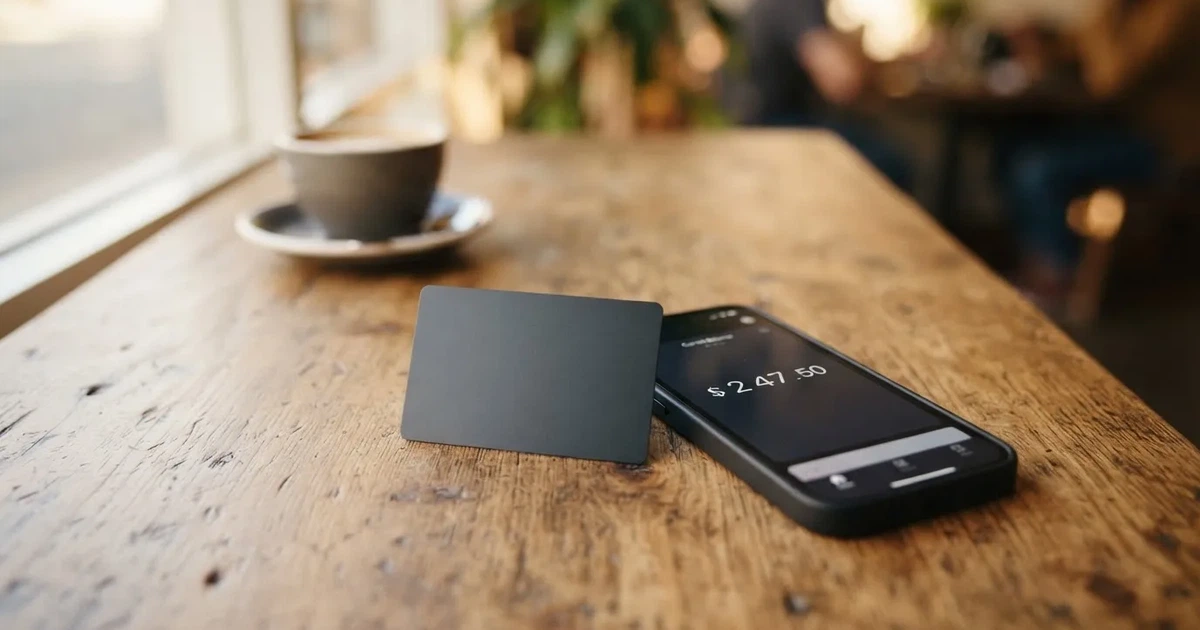
The SwissBorg Card is a Mastercard debit card that converts and spends crypto held in the SwissBorg app, with no issuance fee and no monthly fee. That part is genuinely unusual, and it is why the card scores well on cost. Everything around it is more complicated than the headline suggests: the card exists only as a virtual card for now, there is no ATM, cash balances in the app cannot be used to pay with it, the everyday conversion cost is 0.99% of every purchase, and the platform’s user reviews sit at a TrustScore of 3.1 out of 5 with recurring reports of frozen accounts. My score is 6.2 out of 10.
Conditions are current as of October 28, 2026.
Who this suits, in one line: if you live in the EEA, Switzerland or the United Kingdom, already hold crypto you want to spend day to day, and you would rather not pay a monthly card fee, this is a reasonable free option. Who it does not suit: anyone who needs physical plastic in the post this year, anyone who needs to take money out at a cash machine, anyone who wants to pay from a fiat balance, and anyone who cannot afford to wait out an account review — because that last risk is the one I keep coming back to.
Score breakdown
| Criterion | Mark | Why |
|---|---|---|
| Who can get it | 5 / 10 | Residents of the EEA (30 countries), Switzerland and the United Kingdom — one large region, but residence-based and with a restricted-country list |
| Cost | 9 / 10 | Issuance and servicing are free, 0.99% crypto conversion on every purchase, no separate FX fee from SwissBorg; no ATM available |
| Top-up options | 6 / 10 | Spends directly from crypto balances in the app: BTC, ETH, SOL, BORG, USDC, USDG, EUROP, TGBP; USDT and Tron are not named, and fiat balances do not work on the card |
| Reliability and complaints | 5 / 10 | Issuer UAB Monavate is supervised by the Bank of Lithuania but was fined €270,000 on 2025-11-25; Trustpilot 3.1, with complaints about account freezes and slow support |
| Everyday use | 5 / 10 | Virtual card instant, Apple Pay and Google Pay available; plastic only planned, no ATM |
| Total | 6.2 / 10 | Free and well-licensed, but immature, narrow in use, and with a live complaints problem |
The cost mark is the standout. Two marks of nine for cost in this category is unusual, and the reason is specific: there is no issuance fee, no service fee, no annual fee, and no additional foreign-exchange fee charged by SwissBorg. What you pay is the 0.99% conversion on each transaction. Everything else that pulls the average down is availability and reliability rather than price.
Who they will give the card to
Eligibility is by residence, not citizenship. The card is available to residents of the EEA — 30 countries, namely Austria, Belgium, Croatia, Cyprus, Czechia, Denmark, Estonia, Finland, France, Germany, Greece, Iceland, Ireland, Italy, Latvia, Liechtenstein, Lithuania, Luxembourg, Malta, Netherlands, Norway, Poland, Portugal, Romania, Slovakia, Slovenia, Spain and Sweden — plus Switzerland and the United Kingdom. The card’s own wording is simply “Reside in one of the following countries”.
Two things follow from that. First, if you are one of the roughly half a billion people inside that region, the country question is settled and you can read past this section. Second, if you are outside it, this card is not for you no matter how your finances are arranged, and the workaround people speculate about online is not something I will be exploring here.
There is also a restricted-countries list. Russia and Belarus are both on it, alongside Afghanistan. The card states plainly that it cannot be used in those countries.
One nuance worth holding on to, because it catches people out: nationality is not the test, residence is. That is the card’s rule as published. Whether a given individual’s citizenship affects how a payment is processed elsewhere is a separate matter from eligibility, and I am not in a position to tell you how any particular bank or merchant will behave.
How to get it
The route is short and entirely inside the app. There is no branch, no postal application and no waiting period for the virtual card itself.
The order is:
- Download the SwissBorg app (iOS or Android) and open a personal account.
- Complete KYC Level 2 — that means a verified photo ID and a verified proof of address. You must be at least 18.
- In the app, tap Card on the Portfolio screen and accept the terms.
- Choose a primary cryptocurrency. The virtual card is then ready instantly.
KYC Level 2 is not a formality here; it is the gate. The platform has three levels, and the card needs the second one. Level 1 carries a cumulative deposit and withdrawal limit of EUR 5,000. Level 2 allows EUR 50,000 in and EUR 1,000,000 out. Level 3 is unlimited. Card spending also counts against the total account withdrawal limits tied to your KYC level, which is a detail that surprises people who assume the card is separate from the platform. How long verification takes, and on what grounds an application is rejected, are not stated on the card’s public pages.
One third-party line I will flag as unofficial rather than pass on as fact: a Card Pilled review, last verified 2026-10-16, lists the same Level 1 EUR 5,000 in/out, Level 2 EUR 50,000 in and EUR 1,000,000 out, Level 3 unlimited. That matches the official figures above for Levels 2 and 3 in direction, but treat the third-party rendering as unofficial — it is not confirmed by the card.
What you get is a virtual Mastercard debit card, delivered instantly in the app on activation, with nothing to ship. Physical cards are planned for a later phase, and the card’s own words are that “depending on community demand, physical cards may become available with an additional issuance and shipping fee”. Delivery time, cost and replacement cost for physical cards are not stated.
Your card’s base currency is fixed: EUR for EEA residents, CHF for Switzerland, GBP for the United Kingdom. It cannot be changed after issuance. That single fact quietly shapes a lot of your day-to-day experience, so I would check it before you commit.
Fees: what it really costs
Here is the honest picture. Free to hold; not free to spend, because the conversion is charged per transaction.

| Item | Fee |
|---|---|
| Issuance (virtual card) | None |
| Monthly / service / annual fee | None |
| Crypto-to-fiat conversion on each card transaction | 0.99% exchange fee |
| Market-liquidity adjustment | May be applied in real time |
| Additional FX fee from SwissBorg | None |
| Non-base-currency conversion | Mastercard exchange rate |
| Cash machine withdrawals | Not available |
| Fiat withdrawal from the app | 0.10% execution fee, with per-currency min/max |
| Crypto withdrawal from the app | 0.10% execution fee plus real-time network gas |
Three everyday payments, so you can see what this means in practice:
A €40 grocery shop. The exchange fee is 0.99% of €40, so about €0.40 on top of the price. It is converted from whichever crypto balance you selected. There is no monthly fee sitting on top, and no separate FX charge from SwissBorg if you pay in euros.
A £28 train ticket, on a EUR-based card. The Mastercard exchange rate applies, since £ is not your base currency. SwissBorg adds no extra FX fee of its own, but you are still exposed to whatever the rate does on the day. This is the case that makes people who live and travel on several currencies wince.
A €12 coffee with Apple Pay. Same 0.99% conversion, roughly €0.12. Small enough not to notice until you look at a month of them.
What is deliberately absent matters as much as what is there. There are no cash machine withdrawals at all — “this feature might be considered in a future iteration” — and ATM balance checks are not available either. There are also daily, monthly and annual spending limits, limits on single transactions, and limits on the number of transactions per day and per month. The exact figures are not stated publicly; they are “subject to regulatory requirements and risk assessments and may be adjusted at any time”. If precise limits matter to you, that is a question to put to support before you rely on the card.
The loyalty structure is worth knowing because it changes the numbers, though it does not change the fee. Seven ranks run on locked BORG: Standard at 0 BORG, Bronze at 1,000, Silver at 3,000, Gold at 10,000, Platinum at 30,000, Diamond at 60,000 and Elite at 100,000. Higher ranks raise the cashback percentage, apply a yield multiplier rising from 1x to 2x, unlock priority access to Alpha Deals, add governance voting weight (10 BORG = 1 vote), boost ecosystem rewards and improve referral terms. The cashback rate on the card purchase itself runs from 5% at Standard to 90% at Elite — but read that carefully, because it is a percentage of the exchange fee, not of your spend.
Top up: there is no separate top-up
This is the part that trips up most people, and it is the opposite of how prepaid cards usually work. There is no SwissBorg card balance to load. The card spends directly from crypto held in the SwissBorg wallet, so “topping up the card” means topping up the crypto balance, or simply holding enough already.
Supported for card spending: BTC, ETH, SOL, BORG, USDC, USDG, EUROP and TGBP. You pick one primary cryptocurrency and can nominate backup currencies; if the primary balance is not enough, the system dynamically switches to a backup. USDT and Tron are not named among the supported assets, and I would treat that as something to confirm rather than assume.
Fiat balances cannot be used with the card. This is worth sitting with. You can hold multi-currency fiat balances in the app — EUR, CHF, GBP and others — but they are separate from card spending. If you were hoping to keep euros in the app and spend them, that does not work.
Deposits into the app:
| Deposit route | Cost |
|---|---|
| Crypto deposit | Free; you pay the sending platform’s network gas |
| Bank transfer deposit | Free; your sending bank may charge |
| Fiat top-up to the app via bank transfer | Free |
| Card / Apple Pay / Google Pay deposit, Standard countries (most of the EU) | 2.25%–1.5% by rank |
| Card / Apple Pay / Google Pay deposit, International (e.g. UK, Switzerland) | 4.5%–3.75% by rank |
| Minimum deposit | €10 |
| Minimum card-deposit fee | €5 (Standard, Bronze); €3 (Silver–Elite) |
So the cheapest way in is a bank transfer, then crypto from your own wallet. Depositing by card is the expensive way, and it is the one users complain about most, because those funds then sit in a security holding period — I come back to that in the risks section.
Getting money back out is where the app’s balances diverge again. Refunds from purchases are credited to your fiat account in the card’s base currency, not back to crypto. Withdrawing fiat from the app costs 0.10% execution fee with per-currency minimums and maximums — for example EUR min 1.50 / max 100, CHF min 5 / max 110, GBP min 1.50 / max 85. Withdrawing crypto costs 0.10% execution fee plus real-time network gas, with minimums and maximums per asset and network. If you close the account, funds held on the card are redeemable for up to six years; after twelve months from the end of the agreement a monthly maintenance fee is deducted, and if the agreement is ended within six months a closure fee may apply.
That six-year redemption window and the maintenance fee are the terms I would want you to notice. They only bite if you leave, but they are a reminder that leaving is not instant.
Paying with it every day
Apple Pay and Google Pay are supported, and Curve too. Apple Pay was initially available in Switzerland and France, and requires the latest app version plus KYC Level 2 — the same verification you need for the card anyway. If you pay mostly by phone, that is the realistic path, and it works.
Online payments use 3-D Secure with in-app biometric approval. You can freeze and unfreeze the card instantly in the app, which is the single most useful safety feature on a card that lives in a phone.
A category list you should read before you rely on the card: gambling and betting, adult content and services, cryptocurrency purchases, financial services such as money transfers, illegal goods including drugs and weapons, cash advances, and certain government services. If any of that is a normal part of your spending, this card is not a fit.
Cashback is paid in BORG tokens, calculated as a percentage of the exchange fee on each purchase, and it depends on your rank: Standard 5%, Bronze 15%, Silver 30%, Gold 50%, Platinum 65%, Diamond 80%, Elite 90%. Two caveats sit directly under that. The BORG rewards are locked for a period under the “Paid to Trade” programme, so they are not spendable on demand. And cashback is not guaranteed — SwissBorg reserves the right to modify, suspend or discontinue it at any time. Treat it as a small perk, not a reason to choose the card.
The apps are rated decently. Google Play (en_GB) shows 4.6 from about 15.2K reviews and the App Store (Ireland) 4.4 from 88 ratings, both read 2026-10-21. The official SwissBorg website footer shows slightly different numbers — Google Play 4.2 and App Store 4.6 — which is normal, since store ratings move daily and the footer lags.
One thing worth knowing about how a declined payment feels. A declined authorisation can leave a hold on your funds that stays for several days, typically up to seven. That is a category-wide behaviour, not a SwissBorg quirk, but it means a failed hotel booking can quietly tie up money you were counting on.
What can go wrong
I want to split this into two halves: things that are structurally true of this kind of card, and things users actually report.
Structurally true. The card is custodial. Your crypto sits in the SwissBorg wallet and you are trusting the platform with it, so you carry counterparty and hack risk in a way you would not with a self-custody card. Funds held on the card are not protected by the Financial Services Compensation Scheme; Monavate follows Electronic Money Regulations 2011 for safeguarding. And blockchain transfers are irreversible, so a deposit sent on a network the provider does not support, or to an address belonging to a different network, can be lost or need manual recovery with no guarantee. That is the practical reason to send a small test amount before sending a large one — not as a trick, just as ordinary care.
What users report. Trustpilot shows a TrustScore of 3.1 out of 5 across approximately 1,900 reviews, per NeoBase aggregation read 2026-09-15. The recurring themes across Trustpilot, Reddit and Google Play reviews through 2025–2026 are consistent enough to take seriously:
- Accounts restricted or frozen without a clear explanation or warning, sometimes after a deposit, with resolution taking weeks.
- Customer support slow or unresponsive — tickets unanswered for days or weeks, with silence after an initial reply.
- Card and Apple Pay / Google Pay deposit cooldown periods, where funds are locked during mandatory security holding periods and users cannot access or withdraw them.
Then there is the regulatory fact that sits behind the trust problem. The card issuer is UAB Monavate, incorporated in Lithuania (entity code 305628001, Konstitucijos pr. 21a, LT-08130 Vilnius), authorised by the Bank of Lithuania under authorisation code LB002139901097 to issue electronic money and provide payment services. On 2025-11-25 the Bank of Lithuania fined Monavate €270,000 with a warning for breaches related to AML, management and reporting obligations. To be clear about what that does and does not mean: it is a supervisory action against the issuer, not a finding that your funds are unsafe, and it does not affect your contractual rights. But it is a real, dated, public event involving the entity that issues your card, and I would not read it as neutral.
The company side is more reassuring. The app is owned by SBorg SA, Rue du Grand-Chêne 8, 1003 Lausanne, Switzerland. BlockNodes SAS (29 rue Blanche, 75009 Paris, France) holds MiCA authorisation number A2026-011 from France’s AMF. The card does not come from a company that has never heard of a regulator.
Support is reachable in-app by chat, by email at [email protected] and through a help centre. The card issuer Monavate is also reachable by phone on +37069870638 and at [email protected]. Communication is in English, per the card terms: “We will communicate with you in English.”
How much of this is risk and how much is complaint volume is genuinely hard to separate from the outside. Complaints are not proof of wrongdoing, and long review counts are not proof of fraud. What I can say is that a 3.1 TrustScore alongside frozen-funds reports is a pattern a cautious person would plan around — by not treating the card as the only place their money lives, and by not keeping large balances on it between transactions.
For completeness, disputes have a clock. Contact SwissBorg via the app (Profile > Support) or by email within eight weeks of the transaction date. SwissBorg will assist with resolving the dispute or forward it to the card network. Where a refund applies because the merchant did not specify the exact amount and it exceeded reasonable expectations, it comes within ten business days of receiving the claim or the further information needed. Unauthorised transactions: liability is limited to EUR 50 if the card is lost, stolen or misappropriated, except in cases of fraud or gross negligence, and you must report without undue delay and no later than 13 months. One catch to note — reversals and refunds are credited to your fiat account in the card’s base currency, and the original crypto-to-fiat conversion fee is not refunded. So a €40 grocery shop that gets refunded returns €40, minus the roughly €0.40 you already paid.
What to take instead
If any of the problems above is disqualifying, there are three other cards in this category I would look at. None is a clean sweep, and the honest summary is that this category is young.
| Card | Score | Card type | Where available | Stated costs |
|---|---|---|---|---|
| SwissBorg | 6.2 / 10 | Mastercard debit, virtual | EEA, Switzerland, UK | No issuance or monthly fee; 0.99% per transaction conversion |
| Stella | 6.5 / 10 | Visa, virtual and physical | Not stated on the official site | Not stated; fees “described under this User Agreement and/or on the App” |
| Whop Cards | 5.2 / 10 | Visa | 31 US states for consumers; 41 for businesses | “No extra fees”; no amounts listed |
| UniFi Card | 4.7 / 10 | Prepaid debit Visa, issued by Lead Bank | Not confirmed from official pages | Not stated; “Fees may apply” |
A few observations rather than a ranking. Stella scores slightly higher and offers both virtual and physical Visa cards, but the countries it serves are not stated on the official site, and its fees are not stated either — that is a lot of unknowns for someone whose main concern is practicality. Its terms bar users under economic sanctions programmes and route US and European users through affiliates.
Whop Cards is a different model: a US-facing Visa that spends from a Whop balance, pending balance usable as soon as a payment arrives. Its cashback is 5% at select merchants, currently Uber. It does not support consumers in a long list of countries including Russia, Belarus, China (Mainland), India, Turkey and Ukraine, and the basis for eligibility — citizenship or residence — is not stated.
UniFi Card is a USD prepaid Visa aimed squarely at sending money abroad: receive funds via ACH, wire, SEPA (IBAN) or SPEI (CLABE), or get paid to a USDC wallet. Its app store routes cover the Philippines, Mexico, the eurozone and more recently Colombia, Brazil (PIX) and the UK. Eligibility is not confirmed from official pages, fees are not stated, and the listing claims “3% rewards on balances” rather than card cashback.
The pattern across all four: virtual-only products score better on cost and worse on practicality; the ones that state their fees plainly are the ones that let you budget.
Who I would recommend it to
I would recommend the SwissBorg Card to someone in the EEA, Switzerland or the UK who already holds crypto they want to spend, who pays mostly by phone through Apple Pay or Google Pay, who has no use for a cash machine, and who is comfortable paying 0.99% per transaction in exchange for no issuance fee, no monthly fee and no separate FX charge. For that person it is a good deal, and the free tier alone is harder to find than it sounds.
I would not recommend it to someone who needs a physical card this year, who needs cash, who wants to spend from a euro balance sitting in the app, or who cannot absorb a frozen account with a slow support response. That last group is not hypothetical — it is the most common complaint theme across 1,900 reviews, and it is the reason this card sits at 6.2 rather than higher despite a genuinely excellent cost profile.
The card’s own timeline is short and recent: the “Paid to Trade” loyalty programme launched 2025-09-23, the Mastercard partnership was announced 2026-02-18, the virtual card launched 2026-02-25 in a phased rollout to the EEA (29 countries) and Switzerland, MiCA authorisation followed in around March 2026, the Card Rulebook v0.1 was published 2026-07-22, and the United Kingdom was added 2026-08-27. A product that new will change. Rulebook v0.1 is the kind of document that gets rewritten.
My actual advice: treat this as a second card rather than your only one. Keep the balance you need on it modest, use the free card for what it is good at, and check the rulebook when it settles.
Frequently asked questions
What is the SwissBorg Card?
It is a Mastercard debit card that spends crypto held in your SwissBorg app wallet. The crypto is converted to fiat at the moment of purchase and the card pays out as an ordinary Mastercard would, in stores and online. There is no issuance fee and no monthly fee. It launched as a virtual card in February 2026, and a physical version is planned but not yet available.
Is SwissBorg a bank?
No. The app is run by SBorg SA in Lausanne, Switzerland, and the card itself is issued by UAB Monavate, a Lithuanian electronic money institution authorised by the Bank of Lithuania to issue electronic money and payment services. It is an e-money and payments business, not a bank, which is why funds on the card are not covered by the Financial Services Compensation Scheme.
Which countries can use it?
Residents of the EEA (30 countries), Switzerland and the United Kingdom. Eligibility is based on residence, not citizenship — the card’s wording is “Reside in one of the following countries”. The card cannot be used in Russia or Belarus, both of which are on its restricted-countries list alongside Afghanistan.
Does the SwissBorg Card require KYC?
Yes, KYC Level 2, which means a verified photo ID and a verified proof of address, and you must be at least 18. Level 1 carries a EUR 5,000 cumulative deposit and withdrawal limit; Level 2 allows EUR 50,000 in and EUR 1,000,000 out; Level 3 is unlimited. Card spending counts toward those account-level withdrawal limits.
What does the SwissBorg Card cost to use?
There is no issuance fee, no service fee and no annual fee. Each card transaction carries a 0.99% crypto-to-fiat conversion fee, and a real-time market-liquidity adjustment may apply. SwissBorg charges no additional FX fee, but transactions in a currency other than your card’s base currency of EUR, CHF or GBP use the Mastercard exchange rate.
How do I top up the SwissBorg Card?
You do not, in the usual sense — there is no card balance to load. The card spends directly from crypto held in the app, so you top up the crypto balance. Supported assets are BTC, ETH, SOL, BORG, USDC, USDG, EUROP and TGBP, with one primary and optional backups. Fiat balances in the app cannot be used to pay with the card at all.
Can I use the SwissBorg Card at a cash machine?
No. Cash withdrawals at ATMs are not currently available, and ATM balance checks are not either. The card’s own wording is that the feature “might be considered in a future iteration”. Cash advances are also a prohibited merchant category. Plan on spending the card, not withdrawing with it.
Is the SwissBorg Card safe?
It has real safeguards: 3-D Secure with in-app biometric approval, instant freeze and unfreeze in the app, spending limits, and Apple Pay and Google Pay. But it is custodial, so you are trusting the platform with your crypto, and funds on the card are not covered by a deposit guarantee scheme. Trustpilot shows 3.1 out of 5, with recurring reports of frozen accounts and slow support.
Why was SwissBorg’s card issuer fined?
UAB Monavate, the Lithuanian entity that issues the card, was fined €270,000 with a warning by the Bank of Lithuania on 2025-11-25 for breaches related to anti-money-laundering, management and reporting obligations. This is a supervisory action against the issuer, not a finding about your funds, and it does not change your contractual rights — but it is a dated public event involving the entity behind your card.
When is a physical SwissBorg Card coming?
It is planned for a later phase, not available now. The card states that “depending on community demand, physical cards may become available with an additional issuance and shipping fee”. Delivery time, cost and replacement cost are not stated, so if physical plastic matters to you, this card is not the one to build your spending around yet.
App and neobank cards: the entry point – cryptocardportal.com
Content created by the «cryptocardportal.com» team