
A Visa card from a company that tells you very little about itself
 Available in US
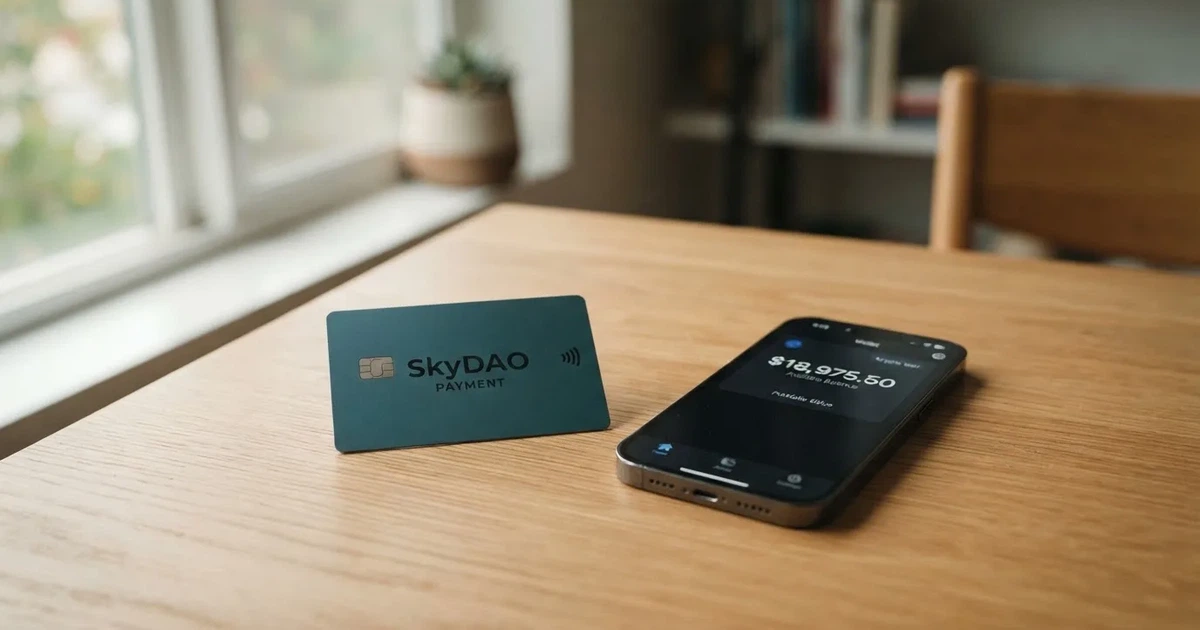
The SkyDAO card is a Visa payment card tied to a crypto wallet: you move value from the wallet to the card, then spend it in shops, at ATMs, or through Apple Pay and Google Pay. That much is on the card’s own pages. Almost everything around it — who can have one, what it costs, which coins and networks it accepts, who issues it and under which licence — is not stated anywhere I could read. My score is 5.3 out of 10, and the reasoning below is deliberately unsentimental about that.
The conditions described on this page are current as of October 28, 2026.
Verdict: 5.3 / 10, a decent card wrapped in silence
SkyDAO scores well on one axis and neutrally on the rest. The physical Visa is genuinely usable: you order it in the app, add it to Apple Pay or Google Pay, and withdraw at ATMs. That is more than a lot of crypto projects promise. But a payment card is a trust product before it is a technology product, and trust is exactly what you cannot assess here. No fee schedule, no issuer, no licence name, no country of registration, and — the detail that would settle most of the questions — no list of the countries it will actually issue to.
| Criterion | Mark | Why |
|---|---|---|
| Who can get it | 5 / 10 | Countries are not named on the pages that could be read; earlier material suggested worldwide except 49 restricted countries, but that is not confirmed here |
| Cost | 5 / 10 | Issuance, fees and servicing are not disclosed |
| Top-up options | 5 / 10 | Transfer from wallet to card, multichain — but the coins and networks are not named |
| Reliability and complaints | 4 / 10 | SKYDAO TRUST LTD, country of registration, issuer and licences not named; no complaints or reviews found, and too few App Store ratings for a rating to display |
| Everyday use | 8 / 10 | A physical Visa ordered in the app, Apple Pay and Google Pay, ATM withdrawals; the virtual card is not described |
| Total | 5.3 / 10 | — |
Who this suits: someone who already holds crypto, already uses a wallet happily, and wants a physical Visa with ATM access — a crypto user who has decided the wallet is the right home for their money and just wants a card bolted to it. The audience note is that simple.
Who this does not suit: anyone choosing a card for the first time, anyone whose priority is knowing what a payment costs before they make it, and anyone who needs to answer one specific question honestly: is this card coming from a licensed institution in a country I can name? You cannot answer that from the public pages today. That is not me being cautious out of habit; the answer genuinely is not written down.
Who will they give you the card
The honest answer is that the pages I could read do not say. The card’s own material, in the starting data behind this review, describes availability as worldwide except 49 restricted countries — but that claim is not confirmed by what the card publishes now, so I would not plan around it.
That is an uncomfortable position to be in, and it is worth being precise about why. “Not available in your country” and “eligible subject to review” feel similar from the outside, but they are different products. The first you can check in thirty seconds. The second means you sign up, upload documents, and wait for a decision you cannot predict. If your reason for wanting a crypto card at all is that ordinary banking is difficult where you live — being blocked from a mainstream account, or living in a place where the paperwork is the obstacle — then eligibility uncertainty is not a minor detail. It is the whole question.
So the practical order is this. Before you install anything, look for a country list or an eligibility check inside the app or the site’s help pages, and if you find none, send support one plain question: which countries can apply, and what is the basis for the test — citizenship, residence, or both? The distinction between citizenship and residence matters more than it sounds. Sanctions screening and issuer risk policy are routinely applied to citizenship and country of birth as well as to the country you live in, so a resident of an eligible country can still be declined on nationality, and vice versa.
One more thing worth knowing as you read claims like “available worldwide”: a card is issued by somebody, and that somebody has a home country. The card number itself starts with a six- or eight-digit issuer identification number that merchants can look up, and it reveals which institution issued it and from which country. That is not a trick and not a loophole — it is the ordinary design of card numbering. It means a card issued in one country can look foreign to a shop in another, and it means a claim of global availability tells you nothing on its own about who is actually on the other side.
How to get it
The stated path is short: download the SkyDAO app and complete identity verification to apply for a physical card online. That is the card’s own wording. What is not stated is the important half of the sentence — which documents count, how long review takes, whether it is manual or automated, and what happens if it is refused.
Once verification is through, the physical card is ordered online in the app, it is a Visa card linked to the SkyDAO wallet, and “once your order is placed, the card will be shipped to your specified address”. Delivery time and delivery cost are not stated. So the honest picture is: you can see the shape of the process, and you cannot see its duration. If you need the card for a specific date — a trip, a subscription renewal, a payroll that lands once a month — an unknown shipping window is itself a reason to start early and a reason not to depend on it.
Where the money goes is straightforward in principle: value moves from the wallet to the card. The card currency is not stated, which quietly colours everything downstream. If the card holds dollars and you are paying a euro invoice, someone is converting at some moment, at some rate, and charging something for it. Without a stated card currency and a stated conversion fee, that “something” is unknown, and so is its sign.
Fees and what a payment actually costs
Here is the blunt version: the card’s public pages state no fees at all — not the cost of issuing the card, not a monthly servicing fee, not a conversion rate, not an FX margin, not what an ATM withdrawal costs, and not any spending limits. The costs table below is therefore mostly a record of what is missing, which is the only honest way to present it. Values come from what the card states, so where it says nothing, the cell says so.
| Item | What the card states |
|---|---|
| Issuance | not stated |
| Monthly fee | not stated |
| Conversion fee | not stated |
| FX / foreign-currency fee | not stated |
| ATM withdrawal | available; fee and allowance not stated |
| Daily limits | not stated |
| Monthly limits | not stated |
Beyond limits, the only thing in writing is a “VIP service” pitched at high-value users — priority access, dedicated support and higher limits. Those are the developer’s claims, and a tier whose selling point is higher limits is most interesting precisely for people with high limits, which is not you if you are still checking whether the card works at all.
Let me show you what that silence costs in practice, with three ordinary payments. I am not going to invent numbers for you — inventing them is exactly the trap this card sets — so each one ends in the same place: an unknown.
A coffee in Lisbon, if your balance is in a different currency from the card. The purchase clears as a card transaction, then becomes a conversion between two amounts. You do not know what rate the conversion used, and you do not know whether a percentage was added on top of it. The exchange-rate movement alone can move the final figure by a few percent, which means your effective price can differ from the shelf price even before any fee is counted.
A supermarket at home, in your own currency, if that is the card’s currency too. This is the cleanest case: no conversion, no FX layer, and the amount should equal the price. But even here I cannot tell you the daily or monthly ceiling, so I cannot tell you whether a week’s shopping fits inside it. If the card silently caps you, the transaction is declined at the till with no explanation, which is the most common way people discover a limit they never read.
A withdrawal from a cash machine abroad. The card says ATM withdrawals are available. It does not say what they cost, whether a daily allowance exists, or whether the machine’s own surcharge is passed to you on top. Out-of-network machines add a fee the ATM operator sets, the issuer may add its own, and the currency conversion on a cash withdrawal typically happens at a worse rate than the card-network rate. Three layers, none of them documented for this card.
The pattern is the thing to take away, not the individual examples. A fee you do not know about does not disappear because nobody mentioned it — it shows up in your balance. The only reliable defence is to send the balance in tiny amounts first, watch one full cycle, and compare what left the card against what you actually spent. That is a habit, not a figure, and it is the only one available when there is no schedule.
How to top it up
Top-up is a transfer from your wallet to the card. The card is described as multichain, and the App Store listing calls it a unified account for fiat and digital assets. Fees and minimums are not stated.
Multichain is a genuinely good word for a user and a genuinely dangerous one when it is unqualified. It means the transfer could run on more than one blockchain, which means the network matters absolutely. Blockchain transfers are irreversible: send on a network the provider does not support, or to an address belonging to a different network, and the money is not merely delayed — it may be gone, or recoverable only by a support agent making an exception, with no guarantee of outcome. So the phrase “multichain” without a list of accepted networks is not flexibility, it is an unanswered question.
This matters even more than it sounds, because of how stablecoin transfers behave in practice. Ethereum-compatible tokens need gas, paid only in ETH — a wallet holding USDT and no ETH cannot send it, and the transfer fails for a reason that is invisible on the card’s side. Tron prices fees through bandwidth and energy rather than gas, commonly burning TRX. Circle stopped supporting USDC on Tron in February 2024, so “USDC over TRC20” is not a native option at all. If you send a token on the wrong network, the receiving side may simply not recognise it.
One quiet fact worth keeping in mind: on-chain network fees for your deposit are charged by the blockchain, not by the card provider. That means they are outside anything SkyDAO controls and outside anything it would refund. It also means the cheapest network for the user is not automatically the one the card accepts.
So: before your first transfer, find the list of accepted coins and networks inside the app. If it is not there, that is the answer. And send a small test amount first — small enough that losing it would annoy you, not ruin your week.
Withdrawals from the balance are not described either, which matters if the card is where your money actually sits. Money that can leave by spending but not, on any documented route, by withdrawal is money you can use but not recover on your own timetable.
Paying with it every day
This is where SkyDAO scores best, and it deserves a fair hearing. The physical Visa is ordered in the app and works through the terminals people use every day. Apple Pay and Google Pay are both supported. ATM withdrawals are available. For the user described above — crypto in hand, a phone, a shop — that is a working everyday card.
The mobile wallets are not a small addition, and the reason is structural rather than cosmetic. Apple Pay does not transmit your card number: it substitutes a device-specific Device Account Number held in the Secure Element on the phone, never on Apple’s servers, and each payment carries a one-time dynamic security code. You are not typing your card number into a café’s terminal or a website. Your phone is genuinely better at this than the plastic is.
Two things about everyday use are still unstated and both can stop a payment. The first is blocked categories. Some issuers restrict gambling, and the relevant merchant category is a four-digit code covering casinos, betting and lotteries; blocking it is a policy choice rather than a legal requirement, and the list is issuer-specific. Nobody has told you what SkyDAO’s list is, so you do not know which category codes your card will refuse.
The second is online authorisation friction. For online payments, Visa’s 3-D Secure system — Visa Secure — asks the issuer to assess risk and either wave the payment through or challenge you with a one-time code or a biometric check. Address verification can also apply, comparing the numeric parts of the billing address you type against the issuer’s records. That check is mainly offered in the US, Canada and the UK, and is generally unavailable for foreign-issued cards, which produces declines. Read the other way: a card whose issuer country differs from yours is more likely to hit a verification path that some merchants handle badly.
Rewards are not stated. There is no cashback figure, no partner list, no rate. If a card review quotes you a percentage for this product, check where it came from: it cannot be found on the card’s pages.
The app itself: iPhone and iPad, free, rated 18+, version 2.4.8 as of October 10. The App Store notes that it “hasn’t received enough ratings or reviews to display an overview”, as I read on 2026-10-21 in the Canadian storefront; Google Play was not checked. That is worth pausing on. Every crypto project has a long tail of complaints, and a complaint-free app is usually a sign of a small user base rather than a clean record. It also means the App Store overview cannot warn you about anything.
Dispute handling is not described — no stated procedure if a merchant takes the money and does not deliver, no stated route for a refund.
What can go wrong
Start with the company, because it is the least documented part. The site mentions Hong Kong for regional access, the United States for global standards, and the word “License” without naming anything. The App Store seller is SKYDAO TRUST LTD, developer name SkydaoTrust. The registered country, the issuer of the card, and the names of the licences are all not stated. So the question you probably came with — is SkyDAO a bank? — has no published answer. It is not a bank on the evidence; it is an entity of unstated type with a brand name that ends in Trust.
That is not a rhetorical flourish. Who you are trusting determines what happens when something goes wrong. If a partner bank or electronic money institution stands behind the card, customer funds must be safeguarded in dedicated accounts or insured — and even then, safeguarded funds are not bank deposits and may not sit under a deposit guarantee scheme. If the answer is nobody, your recourse is different and weaker. Both structures exist in this category; you cannot tell which one you are in.
The complaints picture is honestly thin, which cuts both ways. No official incidents were found, no Reddit threads, and no Trustpilot page for SkyDAO itself. One Trustpilot page for sky.money carries two one-star reviews; whether that is the same business is unclear, so I have not used it as evidence either way. The mark of 4 out of 10 here is not because of a scandal — it is because the record is absent, and absence of evidence is not evidence of absence.
Check any limits and use patterns against what a programme shutdown looks like, because the category has done this before. Programme closures typically run in stages: a notice period, then spending and loading stop, then users are asked to withdraw remaining balances. One 2026 closure reported by a secondary source ended new loads on 8 July 2026 and spending on 8 August 2026 — a single unconfirmed source, offered here only as the shape such an event takes. The precedents are better documented than that: Visa terminated its global agreements with FTX on 13 November 2022 and the FTX US debit card was wound down by its issuer. WaveCrest, a Visa issuer that supplied crypto card brands, was suspended by Visa in Europe in 2018, closing all WaveCrest-issued Visa programmes. In both cases the network, not the crypto brand, ended the product. Visa and Mastercard do not issue crypto cards to consumers themselves; they license issuers and can suspend a programme.
Security claims sit in the same category as the VIP claims: the developer says the app uses encryption and multi-layer risk controls. Typical safeguards in this category do include app-based two-factor authentication, instant card freeze, spending limits, 3-D Secure confirmation and tokenised mobile wallets. None of that has been verified for this card, and encryption of data in transit is a normal expectation, not a differentiator.
Support is thin too. “Dedicated support” is claimed for VIP only. The App Store lists the app in English plus Bengali, French, German, Hindi, Indonesian, Italian, Japanese, Korean, Portuguese, Russian, Simplified Chinese, Spanish, Thai, Traditional Chinese, Ukrainian and Vietnamese — a wide range, which says something about who it is built for. Support channels and hours are not stated, and the help centre at skydao.zendesk.com is closed. An unanswered help centre is a cost you should price in.
Then the risks that belong to the category rather than to this card, because they will apply to you whichever way you decide. A crypto card usually behaves like a prepaid card: your crypto is converted and loaded as a fiat balance, and the card spends only that balance, so it cannot overdraw. But if that balance is custodial, you have trusted the provider with the credentials — and control of crypto belongs to whoever holds the key. A seed phrase, typically twelve to twenty-four words, is an unencrypted form of the private key, and anyone who obtains it can restore the wallet and spend it. Transfers are typically irreversible, and a stolen key has no built-in recovery: the network cannot freeze or return funds. The category’s record of custodial failure is long — Mt. Gox at roughly US$350 million reported stolen across 2011 to 2014, Coincheck at about US$400 million in 2018, Ronin Network at US$625 million in 2022. With a self-custody-linked card, the funds stay in your own wallet until the moment of payment, but the responsibility for key loss, phishing and clipboard-hijacking malware that swaps copied addresses is entirely yours. Neither model removes the need to know where your keys are.
The stablecoin side carries its own risks. A stablecoin aims to hold a stable value, but despite the name they are not necessarily stable: TerraUSD collapsed in May 2022, and USDC temporarily lost its peg in March 2023 during the US banking crisis. If your balance is dollar-pegged, its dollar value is the variable. Tether’s USDT and Circle’s USDC are the two that dominate, with the BIS in July 2025 putting about 90 per cent of stablecoin market capitalisation in them; Circle says USDC is redeemable one-for-one for dollars and fully backed by cash and cash equivalents, mostly in an SEC-registered government money market fund, with monthly reserve attestations by a Big Four firm, and lists USDC as natively supported on 38 networks as of 16 September 2026, including Ethereum, Solana, Base, Polygon PoS, Avalanche, Arbitrum and Stellar. Tether describes USDT as a token built on multiple blockchains with reserves intended to back it one-to-one, issued on networks including Ethereum, Tron, Solana, Polygon and Avalanche. And these balances are not censorship-proof: Tether says it disables tokens in wallets on the OFAC sanctions list and has frozen funds tied to illicit activity.
Two smaller things to keep in view. A declined authorisation may leave a hold on your funds that can remain for several days, typically up to seven — so a failed payment can quietly reduce what is available to you for a week. And some merchants decline prepaid or foreign-issued card numbers outright, because the lookup shows the issuer country; that is a policy at the till, not a rule you can argue with.
On the legal and tax side, I am deliberately not advising you — but I would rather flag it than let you be surprised. KYC is not optional here: regulated businesses must verify customers and assess risk under anti-money-laundering and counter-terrorism-financing law, with ongoing monitoring and suspicious-activity reporting. In the EU, due diligence covers name, address, date of birth, nationality and identity documents, a sanctions check, the purpose of the relationship, and whether you are a politically exposed person. If due diligence cannot be completed, EU rules require the institution to refrain from the transaction, and where necessary end the relationship — which is why accounts close or freeze pending documents. In the US, the customer identification programme requires name, date of birth, address and an identification number, and electronic KYC also validates proof-of-address documents. Nationality is screened separately from residence, as noted earlier. Cards are generally for adults 18 and over.
Regulation is worth a line because it explains the shape of the product. MiCA, the EU’s markets-in-crypto-assets regulation, took legal effect in June 2023; its rules on asset-referenced and e-money tokens applied from 30 June 2024, and the remaining provisions including crypto-asset service provider rules from 30 December 2024. Under MiCA, e-money tokens may be issued only by a credit institution or an electronic money institution. The transitional period lets providers already operating under national law continue only until 1 July 2026 or until they receive or are refused a MiCA authorisation, whichever comes first. ESMA keeps an interim register of authorised providers, white papers and non-compliant entities, and you can check a provider there. A card is a payment service regulated separately under e-money and payment-services law, so a crypto card often rests on two licences. In the US, FinCEN guidance treats administrators and exchangers of convertible virtual currency as money transmitters, while ordinary users buying things are not. Consult a qualified adviser about your own position.
What to take instead
I am comparing these on published detail, not on enthusiasm. If what stops you with SkyDAO is that nobody will tell you the fee, the issuer or the country, then the useful question is which of these publishes more of that.
| Score | Card | Who | Fees | |
|---|---|---|---|---|
| SkyDAO | 5.3 / 10 | Physical Visa; currency not stated | Countries not stated | Not stated |
| Stella | 6.5 / 10 | Virtual and physical VISA, works at over 40 million VISA merchants globally | Countries not stated on the official site; terms bar users under economic sanctions programmes and route US and European users through affiliates | Not stated officially; “described under this User Agreement and/or on the App” |
| Whop Cards | 5.2 / 10 | Visa, works anywhere Visa is accepted; virtual/physical type and card currency not stated | 31 US states for consumers (Alabama, Alaska, Arkansas, California, Colorado, Connecticut, Florida, Hawaii, Illinois, Indiana, Iowa, Kansas, Kentucky, Maine, Massachusetts, Michigan, Minnesota, Montana, Nebraska, New Hampshire, New Jersey, New York, North Carolina, Oklahoma, Pennsylvania, South Carolina, Texas, Utah, Virginia, West Virginia, Wyoming); 41 states for businesses | Page says “No extra fees”; no issuance or monthly amounts listed |
| UniFi Card | 4.7 / 10 | Prepaid Debit Visa Card issued by Lead Bank; card currency USD | Not confirmed from official pages | “Fees may apply. See UniFi website for more details.” |
Stella is the strongest of the four on the evidence here, at 6.5 out of 10, and the reason is structural rather than cosmetic: it states the issuer country situation honestly, even if bluntly — its terms bar users under economic sanctions programmes and route US and European users through affiliates. A product that tells you it will not serve people under sanctions has made a decision you can evaluate. Funding is simple, too: you deposit crypto into the account and the card tops up automatically, with an in-app custodial wallet. Its weaknesses are the same shape as SkyDAO’s — fees are not stated officially, only described under the agreement or in the app, and the official card page states no cashback, with the Earn product being separate yield. For someone in Europe or the US who wants both crypto funding and a clear compliance stance, it is worth reading the user agreement properly.
Whop Cards is the most transparent on geography, and the least transparent on almost everything else. It names its US states outright, for consumers and for businesses, and it names the countries it will not support for consumers — Belarus, China (Mainland), Cuba, Hong Kong, India, Iran, Iraq, Israel, Myanmar, Nepal, Nicaragua, North Korea, Russia, Syria, Turkey, Ukraine, Venezuela and Vietnam, with Russia and Belarus also unsupported for corporate customers. That is a real service to a reader doing eligibility checks. But the basis for eligibility — citizenship or residence — is not stated, the card type and currency are not stated, and the page says “No extra fees” without listing any issuance or monthly amount. Its spending model is a Whop balance: pending balance becomes usable as soon as a payment arrives, while standard withdrawals use settled funds, and it is backed by stablecoin collateral from a linked wallet with coins and networks not stated. The 5% cashback at select merchants, currently Uber, with more planned, has no stated payout currency or conditions.
UniFi Card scores lowest here at 4.7 out of 10, but it is the only one of the four that names its issuing bank: a prepaid debit Visa from Lead Bank, spending from a USD balance, with Apple Pay support. Naming an issuer is worth more than it should be. The weakness is that it is built around sending money rather than around a crypto wallet. The App Store lists routes to the Philippines (PHP), Mexico (MXN) and the eurozone (EUR), with recent release notes mentioning Colombia, Brazil (PIX) and the UK (GBP) — useful, but not what this comparison is about. Funding arrives via ACH, wire, SEPA (IBAN) or SPEI (CLABE), with USDC payouts to a wallet; other coins and networks are not stated on the listing. Fees are deferred to the website, and the listing’s “3% rewards on balances” is a claim about balances, not card cashback.
Set against those, SkyDAO’s honest advantage is the physical Visa with ATM access and a genuine mobile-wallet experience, and its honest weakness is that it is the least forthcoming of the four about who issues it and what it charges.
| For | Against |
|---|---|
| Physical Visa ordered in the app, plus Apple Pay and Google Pay | No fee schedule: issuance, monthly, conversion, FX or ATM all not stated |
| ATM withdrawals available | Issuer, registered country and licence names not stated |
| Multichain wallet-to-card funding | Countries eligible not named |
| Fifteen-plus app languages, including Ukrainian and Russian | App Store shows too few ratings to display an overview |
| VIP tier with priority access, dedicated support, higher limits | Support channels and hours not stated; help centre closed |
| No card block on a normal purchase — Apple Pay uses a device token, not your number | No stated dispute procedure, no stated limits, no stated rewards |
Who I would recommend it to
To the person who already has a wallet full of stablecoins, already accepts that a custodial partner holds the keys, and wants a physical Visa to spend from it this month. If that is you — and for many readers reading this, it is — then the gaps I have listed are things you can work around with discipline: test with small amounts, verify the eligible-country list inside the app before you upload anything, and send support one blunt question about the issuer before you put real balance behind the card.
I would not recommend it to you if any of these are true. You are opening your first card and need a published price for spending. You need to know today whether you are eligible, in a country with strict documentation requirements. You plan to hold a large balance on it, or to use it as your only access to money. Or you want to know, in plain words, who is legally responsible for your funds — because that is the one question this card leaves unanswered, and it is the question that matters when something goes wrong.
The pattern I would suggest: treat any crypto card whose fee schedule, issuer and licence are not published as a convenience tool with a small balance, not as financial infrastructure. That is not a criticism of SkyDAO alone — most of this category is like that. It is a description of what the published information lets you responsibly conclude.
Frequently asked questions
What is the SkyDAO card?
The SkyDAO card is a Visa payment card linked to the SkyDAO crypto wallet. You move value from the wallet to the card, then spend it. A physical Visa is ordered online in the app after identity verification and shipped to your specified address, and the app supports Apple Pay and Google Pay and ATM withdrawals. The card currency is not stated, which matters whenever you spend in a different currency from your balance.
Is SkyDAO a bank?
Not on the published evidence. The App Store seller is SKYDAO TRUST LTD and the site mentions Hong Kong for regional access and the United States for global standards, using the word “License” without naming anything. The registered country, the card issuer and the licence names are not stated, so I cannot tell you what kind of company stands behind it or which regulator supervises it.
Which countries can apply for the SkyDAO card?
The card’s pages that could be read do not name eligible countries. Earlier material described availability as worldwide except 49 restricted countries, but that is not confirmed by what the card publishes now. Check for a country list in the app, and ask support whether the test is citizenship, residence or both — those are screened separately.
How much does the SkyDAO card cost to use?
Nobody will say, as far as the published pages go. Issuance, monthly servicing, conversion, FX and ATM fees are all not stated, as are daily and monthly limits. The only pricing-adjacent claim is a “VIP service” offering priority access, dedicated support and higher limits, described by the developer without figures. You would need to discover the costs by spending small amounts and watching your balance.
How do I top up the SkyDAO card?
By transferring from your wallet to the card, and the card is described as multichain. Which coins and which networks are not listed, and network fees are charged by the blockchain rather than by SkyDAO. Because transfers are generally irreversible, sending on an unsupported network or to another network’s address can mean lost funds, so confirm the accepted list in the app and make a small test transfer first.
Does the SkyDAO card require KYC, and what documents?
Yes, identity verification is part of applying, per the card’s own wording: download the SkyDAO app and complete identity verification to apply for a physical card online. Which documents are accepted, how long review takes and the grounds for refusal are not stated. Verification levels and what additional checks higher tiers trigger are also not described.
Is the SkyDAO card safe to use?
Safety here rests on things that are not published. The developer claims encryption and multi-layer risk controls, but that is unverified. Support channels and hours are not stated and the help centre is closed, so your practical recourse if a payment goes wrong is unknown. No complaints or reviews were found either way, and no Trustpilot page for SkyDAO itself — which means the record is absent, not clean.
Can I use the SkyDAO card in Apple Pay and Google Pay?
Both are supported, and this is the strongest part of the offer. Tokenised mobile wallets replace your card number with a device-specific number stored in the phone’s Secure Element, with a fresh security code per payment, so you are not typing your card details into terminals or websites. What is not stated is which merchant categories the card blocks, so gambling or other restricted purchases may simply be refused.
Are there rewards or cashback on the SkyDAO card?
None are stated. No cashback rate, no partner list, no payout terms appear on the card’s pages, and the only tier mentioned is a VIP service with priority access, dedicated support and higher limits. If you have seen a percentage quoted for this card, it is not something the card itself publishes, so check where it came from before you value it.
Is the SkyDAO card worth it?
Worth it if you already hold crypto, use a wallet comfortably, and want a physical Visa with ATM access plus mobile wallets — that combination is genuinely useful and hard to find elsewhere. Worth less if you need a published fee schedule, a named issuer, an eligibility answer before you sign up, or a clear dispute process. My score for it is 5.3 out of 10, and the reason is documentation rather than function.
App and neobank cards: the entry point – cryptocardportal.com
Content created by the «cryptocardportal.com» team