
A virtual-only crypto card with a wide reach, a short track record and no published prices
 Available in US
Coinepay is a crypto payment card: you hold crypto or stablecoins, the platform converts them into a card balance, and you spend that balance through a virtual Visa or Mastercard. On paper it is a straightforward idea, and the brand describes itself as usable in over 30 regions with registration open to users worldwide. In practice the public pages tell you remarkably little about the things that decide whether a card is any use to you: what it costs, how you fund it, what the limits are, and who is actually behind it. I scored it 5.2 out of 10, and the reason is not that anything looked bad — it is that almost everything a buyer needs is either shown inside the app or simply not stated.
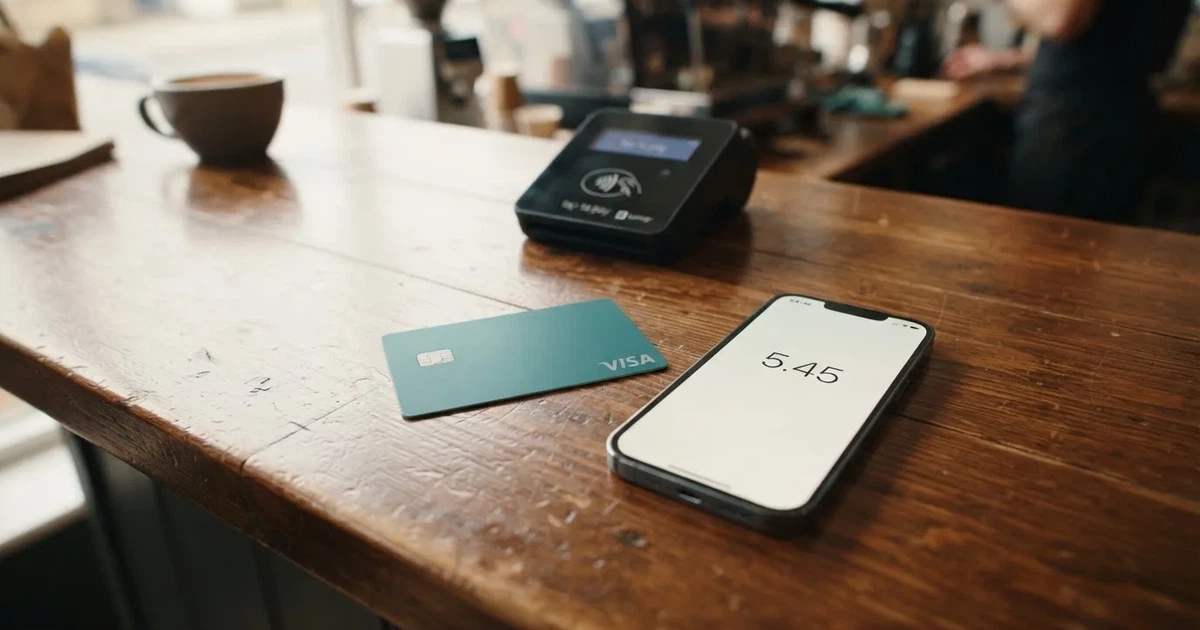
The conditions described below are current as of October 28, 2026.
| Criterion | Mark | Why |
|---|---|---|
| Who can get it | 6 / 10 | Over 30 regions and users worldwide can register; non-residents of restricted jurisdictions and of mainland China are excluded |
| Cost | 5 / 10 | Fees, exchange rates and limits are shown in the app before you confirm; no figures published |
| Top-up options | 5 / 10 | Unofficial: topping up with USDT on TRC20 and BSC |
| Reliability and complaints | 6 / 10 | Green Banking Services Ltd (FINTRAC MSB), World Card Ltd (FinCEN MSB) per the site; no complaints found; iOS 5 from 5 across 5 ratings |
| Everyday use | 3 / 10 | Virtual Visa and Mastercard only; wallets and ATM not stated |
| Total | 5.2 / 10 |
Who this card suits, and who it does not
The honest reading of the evidence: Coinepay suits someone who already lives in crypto, pays mostly online, and treats the card as a spending interface rather than as money — teams paying for AI subscriptions and advertising abroad are the use cases the site itself names. It does not suit anyone who needs a physical card in the post, who wants a published fee schedule before committing, who needs a wide ATM network, or who is uneasy about handing a company in a group of four legal entities their money.
There is a version of this card that is genuinely useful, and a version that is a hassle. Which one you get depends almost entirely on whether the app shows you an acceptable number at the moment you confirm something. That is an unusual design for a financial product, and it is the single most important thing to understand before you start.
What the brand says about eligibility is short and specific. The User Agreement sets four conditions: you must be 18 or older, not sanctioned, not resident in or located in jurisdictions where services are restricted under the AML/CTF Policy, and — because virtual-asset services are not available to residents of mainland China — not a mainland China resident. The home page adds that it serves over 30 regions and that users worldwide can register. Nowhere does the site publish the list of those 30-plus regions, which means the question “can I use Coinepay card in my country” cannot be answered from the public pages. The agreement tells you the rule; only the app tells you the verdict.
How to get the card
You register by email or phone, or with a Google or Apple login. Before certain services are available, identity verification (KYC) or business verification (KYB) is required, and the agreement says more information may be requested at any time — not just at sign-up, but later. The tier structure of verification is not stated anywhere in the public material, so I cannot tell you what unlocks at which level, or whether limits rise as you verify more.
The card itself is virtual: a virtual Visa and a virtual Mastercard, issued via banks the App Store description calls “compliant banks”. Several cards can live under one account. The card currency is not stated; the starting data on the listing shows a USD card balance. Physical delivery is not offered according to the App Store description — the app lists virtual cards only, and no physical card is mentioned. If your mental picture of a card includes something in an envelope, that picture is wrong here.
Two structural points before you apply. First, “issued via compliant banks” is a phrase that hides the identity of the actual issuer on your statement, and the issuer is the party that ultimately decides whether a payment is approved. Second, when you pay, the card is looked up the way any card is looked up: the first six or eight digits of the number identify the issuing institution and country. If that country does not match the billing address you type, some merchants apply extra scrutiny or decline. This is ordinary card mechanics, not a quirk of crypto, and it is worth remembering before you blame the card for a failed checkout.
Fees: what it really costs
Here is the difficulty in one sentence: Coinepay states the price, but not in public. The User Agreement says that “fees, exchange rates and limits applicable to each Service are shown in the application or communicated to you before you confirm a transaction”. The home page advertises “ultra-low transaction fees” and mentions negotiable pricing for higher volumes. Issuance cost is not stated, a monthly fee is not stated, ATM use is not applicable in the usual sense because the cards are virtual, and no tier structure is published.

| Item | What is published |
|---|---|
| Issuance fee | Not stated |
| Monthly fee | Not stated |
| Conversion fee | Not stated; the app shows the rate before you confirm |
| Exchange rate | Not published; shown in the app per transaction |
| FX / foreign-currency fee | Not stated |
| ATM | Not applicable — virtual cards only |
| Daily limits | Not published; shown in the app, subject to review and approval |
| Monthly limits | Not published; shown in the app |
Three everyday payments, and which fees actually bite:
- An AI subscription billed in USD. You pay the displayed rate on a USD balance; what you lose is the spread inside that rate, and the subscription itself may or may not accept a card that its issuer’s country does not match.
- An advertising platform charging in a currency other than USD. Here a second layer can appear — merchants, card networks and banks may add their own fees on top of whatever Coinepay shows you. That sentence is in the agreement; it is the reason a price shown in an app is not necessarily the price on your statement.
- A split across several cards for business use. The site mentions custom spending limits per card for business, but no pricing for that; if you are paying for volume, the “negotiable pricing” line is the lever, and you would have to ask.
So: work out your own worst case. Before you confirm anything, look at the rate and any fee the app displays and compare it against what a mainstream exchange would give you for the same conversion on the same day. That comparison is the only fee audit available to you, and it is the one that matters.
How to top up the card
This is the section where I have the least, and I want to be straight about that rather than dress it up. Officially, the funding method is not stated. The card’s own public pages do not say which assets you can send, on which networks, from which wallets, or how long a top-up takes.
What circulates outside the company’s pages is this: a Coinepay promotional Substack post from 2026 describes depositing USDT over TRC20 or BSC through the Wallet > Deposit path in the app. Treat that as unofficial and unconfirmed by the card — but note that it is at least consistent with how cards of this type usually work, and that the network it names is the one that matters.
If you do top up, three things deserve attention before you send anything:
- The network must match the one the app asks for. Blockchain transfers are irreversible. A deposit sent on a network the provider does not support, or to an address belonging to a different network, can be lost or need manual support recovery with no guarantee. Check the network character by character.
- The chain charges its own fee. Network fees for your deposit are charged by the blockchain, not by the card provider — so they are a real cost of topping up even though they appear on no fee schedule.
- Choosing the asset is not a free choice. USDT is issued on many chains; USDC is not natively available on Tron, because the issuer stopped supporting it there in 2024. Sending the “wrong” stablecoin on the “right” chain is a common and expensive error.
Paying with it every day
Day to day, Coinepay behaves like a prepaid card: crypto is converted and loaded as a balance, and the card spends only that balance, so it cannot overdraw. That is a genuinely useful property. What you spend is what you loaded.
The app side looks thin rather than broken. The iOS app is Coinepay (Coinepay Limited), version 2.2.2 as of 28 September 2026, rated 5 out of 5 across 5 ratings — a small sample, but clean. On Android, Google Play lists Coinepay (io.coinepay.app) with 5K+ downloads, updated 24 September 2026, plus an APK. If you want to add the card to a phone wallet, the mechanics are the standard ones: Apple Pay replaces the card number with a device-specific number stored in the phone’s secure hardware, never on Apple’s servers, with a fresh one-time code per payment. Whether Coinepay’s virtual cards are actually provisioned into Apple Pay or Google Pay is not something the public pages confirm, so check in the app.
Two gaps you will notice. Rewards or cashback are not stated — no loyalty layer is advertised at all, so assume there is none. And the wallet picture is not stated: whether the platform gives you a withdrawal address, whether you can move funds back out to your own wallet, and on what terms, is not in the public material. For a card aimed at spending rather than saving, that may not matter. If you want a bridge rather than a wallet, it matters a great deal.
When something goes wrong with a payment, the route is the standard one, and it is worth reading before you need it. You are asked to report unauthorised or incorrect transactions without undue delay. Disputes with merchants go to the merchant first; Coinepay then helps you submit a chargeback under the card network’s rules, and the outcome is decided by the issuer and the network, not by the brand. Refunds are credited according to the merchant’s and the network’s timescales. The governing law named in the agreement is Ontario, Canada — which matters, because it tells you whose rules you would be arguing under.
What can go wrong
Let me separate what I verified from what I could not.
Verified, and mildly reassuring. I found no complaints. There are no official incident notices to read, and searches on 21 and 22 October 2026 turned up no Trustpilot or Reddit presence for this brand — the results were about CoinPayments, a different company, or generic guides to virtual cards. No dated incidents exist to report. That is a clean record in the sense that a young product has nothing to hide yet.
Also verified, and worth reading twice. The company behind the card is a group, not one entity. The User Agreement says World Card Ltd (Wyoming, headquarters New York) is the parent. Green Banking Services Ltd (Ontario, Canada, FINTRAC MSB #N300000924) is the operating entity that contracts with you. Coinepay Pte. Ltd (Singapore) and Coinepay Limited (Hong Kong) are liaison offices, and a second FinCEN MSB registration, number 31000321315556, appears in the name Coinepay Limited. These are registrations as claimed by the site — I did not check them against the registries. Note the App Store listing is published under Coinepay Limited, which is the Hong Kong liaison office rather than the Ontario entity you contract with.
Not stated, and therefore yours to worry about. The App Store listing claims “advanced encryption technology” for user data. The custody model is not stated. Two-factor authentication is not stated. Whether you can freeze the card instantly is not stated. Whether your funds are safeguarded in a way comparable to a bank deposit is not stated. No deposit guarantee scheme is mentioned — and for an electronic money balance, one should not be assumed.
The honest risk picture. Everything above is the generic risk profile of a custodial card, with a young company on top of it. A custodial provider holds your credentials, so you must trust it completely. Crypto transfers are irreversible and a stolen key has no recovery path. The category has a documented history of catastrophic failure — Mt. Gox, Coincheck, Ronin Network — and holding funds with a custodian carries counterparty and hack risk by definition. On top of that sits a schedule risk specific to cards: programmes close. Visa terminated its global agreements with FTX in November 2022 and the US debit card was wound down. WaveCrest, a Visa issuer supplying crypto card brands, was suspended by Visa in Europe in 2018 and all its programmes closed. When that happens, the sequence is always the same — a notice period, then spending stops, then you are asked to withdraw what is left. If you keep a working balance on a card from a young provider, that is the scenario to hold in mind.
One more practical warning, from the card mechanics rather than the company: a declined authorisation can leave a hold on your funds for several days, typically up to seven. A payment that fails is not always instantly neutral.
What to take instead
Three comparable options, from the same category. The scores are the same scale as the one above.
| Coinepay | Cardex | TakeCard | OkiCard | |
|---|---|---|---|---|
| Score | 5.2 | 5.6 | 5.5 | 6.0 |
| Reach | Over 30 regions, worldwide registration | “One crypto card, 200+ countries”; no country list | Physical card Bolivia only; other countries not listed in help articles | “150+ countries” (some pages “200+”) |
| Card form | Virtual Visa and Mastercard | Virtual and physical; VERVE, Visa, Mastercard, UnionPay | Virtual immediately; physical Bolivia only | Virtual; physical mentioned without detail |
| Published pricing | None | No fee percentage stated | USD 5 virtual; USD 20 issuance plus USD 20 shipping for Bolivia | Issuance $0 monthly $0, starting price $15 — pages disagree; load fee 3%; USD transaction fee 0% |
| Funding | Unofficial: USDT on TRC20 or BSC | USDT, USDC and BTC wallets, networks not stated | Top up from the Takenos balance; coins not named in the article | USDT on BSC, Ethereum, Tron, Solana; USDC “soon” |
Cardex (5.6) covers more ground on paper — 200-plus countries and four networks including UnionPay — and offers a physical card, but it publishes no fee percentage either, and its app listing is Naira-focused, which tells you who it actually serves.
TakeCard (5.5) is the only one here with a published price list: USD 5 for the virtual card, USD 20 plus USD 20 shipping for the physical card in Bolivia (another article in the same help centre says USD 10 for the physical card in Bolivia, so the site contradicts itself). It charges 1% per purchase and pays USD 1:1 with no currency adjustment, other currencies at the official Visa rate of the day. The trade-off is geography: the physical card is Bolivian-only for now.
OkiCard (6.0) is the most transparent of the four. Its pricing page lists issuance $0, monthly $0, a starting price of $15 for the virtual card, a 3% load fee and 0% transaction fee on USD — though its FAQ mentions a one-time issuance fee, so the pages disagree there too. It says “no hidden exchange spreads” and takes USDT on four chains. An initial deposit of 100 USDT is required.
The pattern across all four is the one you should take away: in this category, published pricing is the exception, not the rule, and the card that publishes its numbers even partially is easier to judge than one that publishes none.
Who I would recommend it to
I would recommend Coinepay to someone who already holds stablecoins, spends online, does not need a physical card, and is comfortable opening an app to read the rate and fee before each payment. If you fall into that group, the wide stated reach and the clean complaints record make it a reasonable card to try with small sums.
I would not be the person to recommend it to if any of these are true of you:
- You need a physical card, or you rely on cash and ATMs.
- You want a fee schedule you can read before you sign up, in a document, not in a screen that changes.
- You are sending money to a country whose merchants are known to decline prepaid or foreign-issued cards — extra scrutiny follows from the BIN lookup, not from anything you did.
- You intend to hold a balance on the card for weeks, or you want to move funds back to your own wallet on your own terms. The withdrawal side is not stated.
- Your decision hinges on knowing exactly which legal entity holds your money and how your funds are safeguarded. Both are answerable only by asking.
If you are still considering it, my one suggestion is this: put a small amount on it, do three or four ordinary payments of different sizes in different currencies, and read every figure the app shows you each time. You will learn more in an afternoon than from anything published, and it costs you little to find out.
Frequently asked questions
What is Coinepay card?
Coinepay is a crypto payment card that converts crypto or stablecoin into a card balance you spend through a virtual Visa or Mastercard. You top up, the platform converts at a rate it shows you, and the card draws on that stored balance like a prepaid card. The cards are issued through partner banks described as “compliant banks”, and the company is a group rather than a single issuer.
Is Coinepay a bank?
No — it is not a bank. Its User Agreement names Green Banking Services Ltd (Ontario, Canada, FINTRAC MSB #N300000924) as the operating entity you contract with, under a parent, World Card Ltd (Wyoming, HQ New York). Two further entities, Coinepay Pte. Ltd (Singapore) and Coinepay Limited (Hong Kong), act as liaison offices. That is a payments and crypto structure, not a deposit-taking bank.
Who owns Coinepay?
The stated parent is World Card Ltd, incorporated in Wyoming with headquarters in New York, according to the User Agreement. A second FinCEN money services business registration, number 31000321315556, appears under the name Coinepay Limited, the Hong Kong liaison office. These registrations are claimed by the company’s own site; I did not verify them against any registry.
Does Coinepay card require KYC?
Yes for certain services. The User Agreement requires identity verification (KYC) or business verification (KYB) before certain services are available, and warns that more information may be requested at any time. You register by email, phone, or Google or Apple login. The verification tiers themselves are not stated publicly, so what each level unlocks is something only the app will show you.
How do I get a Coinepay card?
Register an account, complete identity or business verification, then request a virtual Visa or Mastercard from inside the app — several cards can exist under one account. Cards are virtual only, per the App Store description; no physical delivery is offered. The card currency is not stated, though the listing shows a USD card balance as the starting point.
How much does a Coinepay card cost?
The public pages give no figures. Issuance fee, monthly fee, conversion fee, exchange rate and FX fee are all not stated; Coinepay says fees, rates and limits appear in the app before you confirm a transaction. The home page advertises “ultra-low transaction fees” and negotiable pricing for higher volumes, and the agreement notes that merchants, card networks and banks may add fees of their own.
How do I top up the Coinepay card?
Officially, the funding method is not stated on the company’s public pages. What circulates unofficially, in a 2026 Coinepay promotional Substack post, is depositing USDT over the TRC20 or BSC networks through Wallet > Deposit. Make sure the network you send on is the one the app asks for — blockchain transfers cannot be reversed, and a wrong network can mean lost funds.
Where can I use the Coinepay card?
Anywhere a virtual Visa or Mastercard is accepted online, subject to the merchant’s own rules. The site names AI subscriptions, advertising and purchases abroad as use cases, but the public material does not list supported or blocked merchant categories. Be aware that merchants can look up the card’s issuing country and decline prepaid or foreign-issued cards, and that some online services check billing addresses.
Is Coinepay card safe?
There is no track record of harm that I could find: no official incident notices, and no Trustpilot or Reddit presence for this brand in searches on 21 and 22 October 2026. But the app claims “advanced encryption technology” while stating nothing about the custody model, two-factor authentication or card freeze, and no deposit guarantee is mentioned. You are trusting a young group of entities with a prepaid balance.
How do I withdraw money from Coinepay, and can I delete my account?
Withdrawal and account closure procedures are not detailed on the public pages, so the specific process for moving funds back to your wallet or closing your account remains unclear. Before depositing funds, it is best to ask support directly via the app or at [email protected] and request the answer in writing.
Virtual cards: the entry point – cryptocardportal.com
Content created by the «cryptocardportal.com» team