
Brighty card, written for someone who wants a real answer
 Available in US
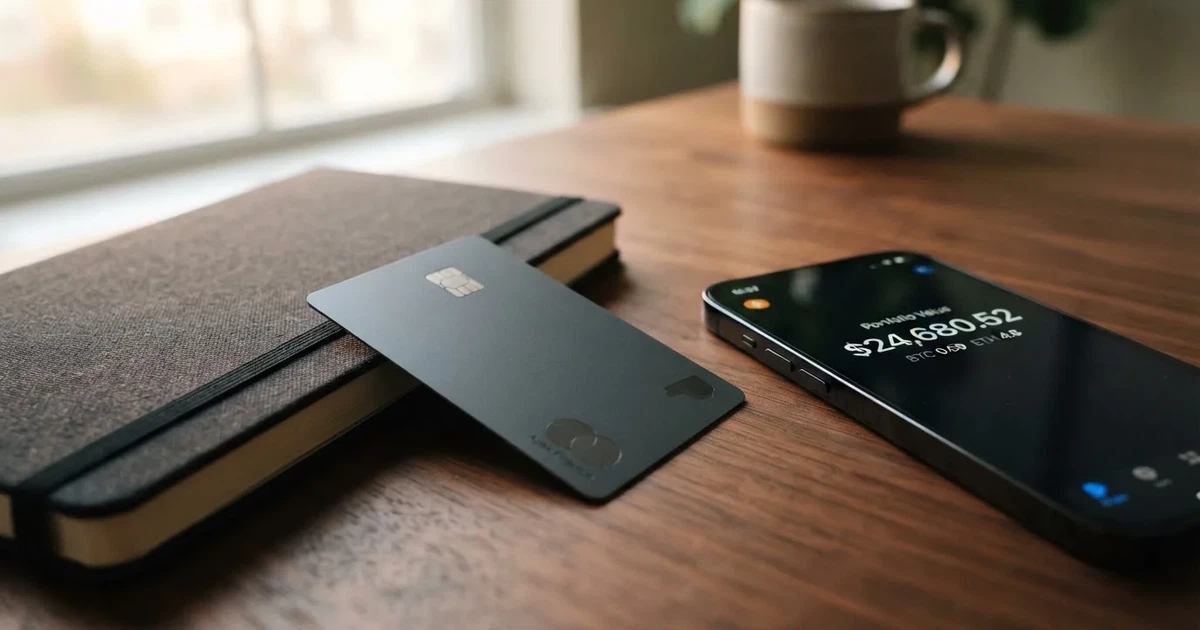
Brighty is a financial technology company — not a bank — that combines a crypto wallet, a euro IBAN account and a payment card. The product is aimed at people inside the European Economic Area who already hold crypto and want a single app to hold it, convert it and spend it. The card exists as a virtual Mastercard (or Visa, depending on the help article you read), and the experience sits somewhere between a neobank and a crypto exchange. In this review I go through who can actually get one, what the fees look like in practice, how the top-up flow works, what daily use feels like, and the parts of Brighty that I think warrant caution. The score at the end is 5.6 out of 10, and the reason it is not higher is mostly the everyday-use and reliability side, not the cost.
Conditions in this review are current as of October 28, 2026.
Verdict
Brighty sits in a narrow lane. It is built for residents of the European Economic Area, plus Montenegro and Andorra, who already keep some of their money in crypto and who want a euro IBAN and a card from the same provider. If that is your situation, Brighty does what it sets out to do: it gives you an IBAN, lets you hold Bitcoin, Ethereum, USDC and a few other coins in-app, converts them with a small markup, and hands you a card you can use wherever Mastercard is taken. If that is not your situation — if you live outside the EEA, or you do not hold any crypto, or you specifically want a metal Visa with a long track record — then there are better-known products elsewhere.
The numbers behind the 5.6 reflect that mixed picture. The cost side is reasonable: the virtual card is EUR 2.99 to issue and the monthly service is free, and the in-app conversion fee is 0.6%, 0.5% or 0.4% depending on the plan after a free monthly allowance. The top-up side is generous: incoming crypto is free on every plan, with no monthly cap, and incoming fiat via SEPA and Faster Payments is a percentage with a minimum. The two scores that pull the total down are everyday use (5 out of 10) and reliability (4 out of 10). The reliability score is the one I find harder to ignore. Brighty does not publicly name its card-issuing partner, its help center is not very deep, and the user reviews I have seen cluster around account closures that arrive without an explanation. That is a meaningful risk for any product that holds your balance and your card.
| Criterion | Mark | Why |
|---|---|---|
| Who can get it | 5 / 10 | EEA-only on the card page; app also live in Montenegro and Andorra; not all combinations of residence and nationality are eligible |
| Cost | 7 / 10 | Virtual card EUR 2.99, no monthly fee, conversion 0.6% / 0.5% / 0.4% above a free monthly allowance |
| Top-up options | 7 / 10 | BTC, ETH and USDC in the app, with IBAN top-up; incoming crypto is free on all plans |
| Reliability and complaints | 4 / 10 | Issuing partner not officially named; Trustpilot 3.2 / 5 across a small number of reviews; recurring complaint theme is unexplained account closures |
| Everyday use | 5 / 10 | Virtual Mastercard, no Apple Pay for Mastercard, Google Pay works; physical card ordering is reported as not currently fulfilled |
| Total | 5.6 / 10 | A reasonable choice if the EEA + IBAN + crypto card combination is what you need, less convincing if you do not need all three |
Who can get the Brighty card
The card page is labelled “EEA only” and the app has since expanded to Montenegro and Andorra, with availability that “may vary by jurisdiction”. A full country list is not published on the main site, so the practical rule is: you should expect to be eligible if you live in an EU or EEA country, Switzerland, Montenegro or Andorra, and you are over 18, and you have the documents Brighty asks for at sign-up. There is one nationality carve-out that is worth reading carefully: due to regulatory restrictions, Brighty is unable to onboard Russian nationals residing in Montenegro or Andorra. Even if you live in an eligible country, your citizenship can affect the outcome.
A third-party site (cryptocardhub, August 2026) lists 36 countries that include the EU, the EEA, Switzerland, Montenegro, Andorra, San Marino, Monaco and Moldova. That figure is unofficial, not confirmed by Brighty itself, and I would not plan around it. Treat the official answer — EEA plus Montenegro and Andorra — as the floor and the unofficial list as an indication of where the app is known to work.
The rules above are about the onboarding side, but you also need documents. Brighty uses Sumsub, named in a help article, to run verification inside the app during sign-up. The exact tiers are not spelled out on the pages I read, and processing time is not stated. If something goes wrong, the help center tells you to email [email protected]. The documents the help articles call out are the usual ones: a clear photo of your ID with your full name, date of birth, place of birth and citizenship, plus a proof of address that can be a utility bill or a bank statement PDF no older than three months. Screenshots of bills are not accepted; you need a PDF or a photo of the document. An official registration confirmation, or a second official ID that shows your address, is also accepted. Documents get rejected if anything is ambiguous, if the address does not match what you typed at sign-up, if the document is damaged or expired, or if fields including the signature are blank.
So in plain language: if you are an EU/EEA resident, or a resident of Montenegro or Andorra, and you have a passport or national ID and a recent utility bill in your name, you should be able to get through the door. If you hold Russian citizenship and live in Montenegro or Andorra, you cannot. The rest of the picture is the everyday-usability and reliability questions I get to in a moment.
How to sign up for Brighty
The flow itself is what you would expect from a crypto card product. You download the app, enter your details, complete verification through Sumsub with an ID and proof of address, and then either request a virtual card or order a physical one. The help center confirms you can choose a virtual card or a physical card inside the app, but it does not give a country list, a delivery time or a cost for the physical card, and it does not give a replacement price. A third-party source (cryptocardhub, August 2026) says physical Mastercard orders are currently not being fulfilled, and that this is acknowledged in the help center with wording along the lines of “will not be fulfilled”. That claim is unofficial, so I would not treat it as final, but the practical effect is the same: if you want a Brighty card in your hand today, you should assume only the virtual card is reliably available.
The card itself is virtual. The NPC page describes a virtual card, and a help article on cards references a physical Visa, a virtual Visa with no PIN and a virtual Mastercard. The card currency is not stated on the pages I read. A third-party source (cryptocardhub, August 2026) reports that the Mastercard is issued by UAB Monavate, that the card balance is held in EUR, USD, GBP and AED, and that the in-app wallet supports USDC, EURC, BTC, ETH, ADA, XTZ, TON and SOL. None of that is confirmed on Brighty’s own pages, so I am reporting it as unofficial.
What I would actually check before signing up:
- That your country is in the EEA, Switzerland, Montenegro or Andorra, and that your citizenship is not on any restricted list for your country of residence.
- That you have a PDF utility bill or bank statement in your name, dated within the last three months, before you start the verification, so the in-app KYC does not stall.
- That you are happy with a virtual card only. If you need a physical card for ATM use or contactless tap-to-pay, you should not assume one is currently being sent.
What Brighty costs: fees, limits and the everyday math
The headline numbers for the Brighty card are reasonable. The virtual card costs EUR 2.99 to issue on every plan, and the monthly card service fee is free. The balance inquiry fee is free. You can issue up to 10 cards per month. The physical card price, if you can get one, is not stated on Brighty’s own pages.

The fee that actually shapes your day is the in-app conversion fee. When you convert crypto to euro (or between supported currencies) inside the app, the first part of your monthly volume is free, and the part above that is charged at 0.6% on the One plan, 0.5% on the Plus plan and 0.4% on the Pro plan. So a casual user who converts a few hundred euro a month will pay nothing in conversion. A heavier user pays a small percentage, lower than what many exchanges charge on a small retail conversion, but higher than what a major broker would charge on a wire. The fee for paying in a foreign currency with the card is not stated on the pages I read.
The subscription prices for the Plus and Pro plans are not stated on Brighty’s own pages. A third-party source (cryptocardhub, August 2026) says Plus is EUR 9 per month and Pro is EUR 18 per month, with One being free. That is unofficial. The same source quotes card purchase limits of EUR 15,000, EUR 25,000 and EUR 50,000 by plan, which contradicts the official help article I read that says EUR 50,000, EUR 75,000 and EUR 100,000. When official and unofficial numbers disagree, the official number is the one to plan around, which is what the table below uses.
A few of the everyday costs in the table come from third-party sources. The ATM figures especially are unofficial and relate to legacy Visa rates, so I would not plan around them. Where the official help center has nothing, the line is left blank rather than guessed.
| Fee or limit | One | Plus | Pro | Notes |
|---|---|---|---|---|
| Virtual card issue | EUR 2.99 | EUR 2.99 | EUR 2.99 | Same on all plans; up to 10 cards per month |
| Monthly card service | Free | Free | Free | Same on all plans |
| Card purchase limit, daily | EUR 50,000 | EUR 75,000 | EUR 100,000 | Official help article |
| Card purchase limit, monthly | EUR 50,000 | EUR 75,000 | EUR 100,000 | Official help article |
| In-app FX above free allowance | 0.6% | 0.5% | 0.4% | After a free monthly allowance (not stated) |
| Free FX per month | EUR 0 | EUR 2,000 | EUR 5,000 | Official help article |
| SEPA out | EUR 3 + 0.3% (min EUR 10) | EUR 0.5 + 0.3% | EUR 0.5 + 0.3% | Min fee EUR 0.5 on Plus/Pro |
| Faster Payments out | EUR 3 + 0.3% (min EUR 10) | EUR 0.5 + 0.3% | EUR 0.5 + 0.3% | Min fee EUR 0.5 on Plus/Pro |
| SWIFT out | 0.9% (min EUR 50) | 0.9% (min EUR 50) | 0.9% (min EUR 30) | Pro has a lower SWIFT minimum |
| Outgoing fiat limit, daily | EUR 30,000 | — | — | Plus/Pro not separated in this row in the article I read |
| Outgoing fiat limit, monthly | EUR 250,000 | — | — | Plus/Pro not separated in this row in the article I read |
| Fiat account max balance | EUR 100,000 | EUR 250,000 | EUR 500,000 | Across all three plans |
| ATM fee, EEA | — | — | — | Not stated officially; unofficial: Plus EUR 3.50, Pro EUR 3 |
| ATM fee, outside EEA | — | — | — | Not stated officially; unofficial: Plus EUR 3.50 + 3.5%, Pro EUR 3 + 3% |
| Physical card price | — | — | — | Not stated officially |
| Cashback | — | — | — | Official page does not state a rate; unofficial: 0.5% in USDC base, 1.25%–1.75% in selected categories |
To make that table less abstract, three everyday payments and how they would work on the One plan look like this.
- A EUR 40 grocery shop with a euro balance. You have already converted some crypto to euro in the app. You tap the virtual card details into Apple Pay or Google Pay (subject to the network caveats in the next section), the merchant is charged in euro, Brighty does not apply an FX fee because both sides are euro, and your euro balance is debited EUR 40. No fee on this side. The cost of getting to a euro balance was the in-app conversion fee: 0.6% on this plan above the (un-stated) free allowance, so EUR 0.24 on a EUR 40 conversion, paid at the moment of conversion, not at the moment of payment.
- A EUR 25 subscription to a US-based streaming service, paid in dollars. Your euro balance is converted to dollars by the card network at the wholesale rate, and Brighty charges an FX fee (not stated) on top. I would budget EUR 0.25 on a EUR 25 payment and treat the official fee as “not stated”, because Brighty’s pages do not give a number I can quote.
- A EUR 100 ATM withdrawal with a physical card. The card page claims acceptance at ATMs worldwide, but Brighty does not publish a fee or allowance. The unofficial Visa numbers from cryptocardhub (August 2026) suggest EUR 3.50 inside the EEA or EUR 3.50 + 3.5% outside. None of that is official, and the physical card itself is reported as not being currently fulfilled. If you need a card that works at an ATM today, Brighty is not the one to plan around.
Top up: how to add money to your Brighty account
The top-up flow is the part of Brighty that I find least controversial. You can put money in by transferring crypto into the in-app wallet, or by sending fiat to the IBAN account. Incoming crypto is free on every plan, with no monthly cap. That is more generous than most crypto card products, which typically charge a flat fee for the on-chain transfer you cover, plus a percentage on top.
The specific tokens Brighty supports on the funding side, as listed on the NPC page, are Bitcoin, Ethereum and USDC. The outgoing networks (the chains you can withdraw to from Brighty) are Ethereum, Tron, Bitcoin, Cardano, Tezos, Islamic Coin, TON, Arbitrum, Solana, Polygon and BEP20. The withdrawal fees on those networks are: ERC20 EUR 3, TRC20 EUR 3, BTC EUR 20, ADA EUR 1, XTZ EUR 1, HAQQ EUR 1, TON EUR 3, ARB EUR 3, Solana EUR 3, Polygon EUR 3, BEP20 EUR 3. Those fees are the same on every plan and have no monthly limit. So a withdrawal of 0.01 BTC from Brighty costs you EUR 20 regardless of plan. In practice that means Brighty is a card-and-balance product, not a place to move large amounts of crypto around cheaply: it is cheaper to load it and spend it than it is to withdraw it to your own wallet.
The fiat top-up side uses the IBAN. Incoming SEPA costs 0.3% with a EUR 10 minimum, Faster Payments costs 0.3% with a EUR 10 minimum, and SWIFT costs 0.7% with a EUR 50 minimum. Incoming fiat is capped at EUR 100,000 per month across all plans. The card top-up fee, the minimum top-up, and the time it takes for funds to clear are not stated. So the most you can assume is that a SEPA transfer from your regular bank account will arrive, you will be charged at least EUR 10 for the privilege, and the rest is not promised.
A small operational point that I think is worth raising: blockchain transfers are irreversible. If you send USDC on a network Brighty does not support for that token, or to a Brighty deposit address for a different network, the funds are very hard to recover. Brighty has help articles on “Refund Policy for Unsupported Crypto Deposits” and “Wrong Network and Unsupported Cryptocurrency”, which is a polite way of saying this happens often enough to need a written policy. The same is true for every custodial wallet, but the larger the network list, the easier it is to make a mistake.
If you are topping Brighty up from a self-custody wallet or an exchange, the steps I would take are:
- Check which networks Brighty supports for the token you are sending, in the help center, before you start the transfer. The list above is what I found on the funding page; the help center may have a more current one.
- Send a small test amount first, on a network with a low fee like Polygon or Solana, before sending the bulk of your deposit.
- Keep the transaction hash of every deposit until the balance shows in the app. Without it, support has nothing to look up.
Paying with Brighty day to day
The card side of Brighty is where I started running out of clean answers. The headline shape is: virtual Mastercard (or Visa, depending on which help article you read), in-app, with mobile wallet support that depends on the network.
For mobile wallets, the help article on “Apple Pay & Google Pay” (as of 26 May 2026) says Apple Pay is currently unavailable for Mastercard cards because of technical updates, while Apple Pay is available for Visa. Google Pay works for Mastercard. So if you specifically want Apple Pay, the card network matters: ask for the Visa variant. If you are happy with Google Pay, the Mastercard should work. None of this is about the card itself being worse on one network than another; it is about which tokenised wallet each network has integrated.
The merchant category blocklist — which kinds of shops the card will refuse — is not stated. A few crypto cards block gambling or high-risk MCCs by policy, but Brighty does not publish the list. If you have a specific use case in mind, that is the kind of question to ask [email protected] before you fund the card.
The rewards side is also thin in official terms. The NPC page says “Keep earning on your crypto while using it”, which is a way of saying that the crypto balance continues to be held (and the company may lend or stake it behind the scenes) while you spend from it. A cashback rate is not stated on Brighty’s own pages. A third-party source (cryptocardhub, August 2026) reports 0.5% in USDC as a base rate on every tier, 1.25% to 1.75% in selected categories, with monthly caps of 20, 60 and 100 USDC by plan, paid the following month into a Reward Box. That is unofficial, so I would not commit to it in writing.
The app itself is available on the App Store (Turkish storefront, rated 4.9 from 9 ratings on the page I read) and on Google Play. The Google Play rating was not found. The app’s job is to show your balance, convert between currencies, freeze or terminate the card, and reach support. A 4.9 from 9 ratings is a very small sample, so I would not treat it as a strong signal of quality in either direction.
What I would actually check on the everyday-use side:
- Which card network the app issues you, and whether you need Apple Pay specifically.
- Whether your typical merchants (subscriptions, in-app purchases, transit) fall inside the blocklist, if you can find a list.
- Whether the EUR 50,000 / 75,000 / 100,000 daily and monthly purchase limits on the One / Plus / Pro plans cover what you intend to do. For most people they are very high, but a small-business use case is closer to those limits.
What can go wrong with Brighty
The reliability score is the one I want to spend the most time on, because it is the score that touches the rest of the product. There are three pieces to it: complaints, the company structure, and the support experience.
The user reviews I have seen cluster on Trustpilot’s nl-be page, with 3.2 out of 5 from 78 reviews. That is a small sample, and review dates were not visible to me, so the average is a snapshot rather than a trend. The themes that come up repeatedly are: accounts closed without explanation, with the company citing policy or regulation; referral bonuses not paid, with the company citing suspected referral abuse; and “instant” transfers that take hours. Some users praise the cashback. I did not find a Brighty subreddit or card-specific complaint thread, so the Trustpilot set is the main public signal. A 3.2 from 78 reviews is a middling score, and the fact that the dominant complaint is “closed without explanation” is a serious flag for a custodial product.
The company structure is the second concern. Brighty describes itself as a financial technology company, not a bank. Accounts, cards, custody and on/off-ramp are run through unnamed licensed partners. There are no licence numbers on the pages I read. A 2024 press release on StreetInsider says Brighty is based in Switzerland and holds crypto-exchange and digital-asset custodian licences; that is from a third-party press release, not from Brighty’s own pages, so I would not plan around it. The card-issuing partner is not officially named. A third-party source (cryptocardhub, August 2026) says it is UAB Monavate; that is unofficial. The lack of a named partner on Brighty’s own site is a transparency gap, especially for a product that holds your money and issues you a card.
The support experience is the third concern. The only contact channel I have seen in the FAQ is [email protected], plus the help center at help.brighty.app. There is no phone number, no live chat, and no published hours. The help center is available in English, French, Italian, Lithuanian, Polish, Romanian, Serbian and Spanish; Russian is not on the list. The support staff languages are not stated. For a product that holds your balance, the support offering is thin.
The official “offboarding” reasons, in Brighty’s own framing, are: suspected fraud, unclear source of funds, partner-provider concerns, and PEP or sanctions status. The phrasing matters, because each of those is broad enough to cover a wide range of cases, and “partner-provider concerns” in particular is a category the user cannot do anything about. When you combine broad offboarding language with a published score of 3.2 on Trustpilot and a recurring theme of unexplained closures, the practical advice is to keep your Brighty balance to what you actively use, not to park a large euro or crypto balance there.
The security side is described as follows. Brighty holds custody, not self-custody, so the private keys for your on-app wallet live with Brighty. The official FAQ says user funds are kept in segregated accounts that are specially secured, and that Brighty works with penetration testers. There is no mention of insurance against loss or theft of funds, and there is no mention of two-factor authentication on the page I read. The app does let you freeze and terminate the card. Freezing is temporary; termination is not reversible. None of this is unusual for a custodial product, and “no insurance” is the default rather than a Brighty-specific red flag, but it is the shape of the risk you are accepting.
What to take instead of Brighty
Brighty is a specific product for a specific reader, and the obvious alternatives are not perfect substitutes; they trade one of Brighty’s features for another. The three below are the ones I think the reader most often weighs against Brighty.
Whop Cards (5.2 / 10). A US-focused prepaid Visa that draws on a Whop balance, with the balance itself backed by stablecoin collateral from a linked wallet. Whop markets 5% cashback at selected merchants, currently Uber, with more planned. The consumer card is available in 31 US states (including California, Florida, Illinois, Massachusetts, Michigan, New York, Pennsylvania, Texas, Virginia and so on, but not in every state) and the business card in 41. The unsupported country list for consumers is long and includes Russia, China Mainland, Hong Kong, India, Iran, Iraq, Israel, Turkey, Ukraine, Vietnam and others. Whop is a reasonable fit for a US creator or small business that already runs on Whop and wants a stablecoin-backed spend, but it is not a substitute for the Brighty IBAN.
Stella (6.5 / 10). A virtual and physical Visa card backed by an in-app custodial crypto wallet, with the card “working at over 40 million VISA merchants globally”. Stella’s terms bar users under economic sanctions programmes and route US and European users through affiliates, which is a sign of a more complicated regulatory footprint. The reward product on Stella is a separate yield product, not a card cashback. Stella is closer to a pure crypto card than Brighty is, and the higher score reflects the more straightforward everyday experience; the trade-off is that the regulatory wrapper is less direct for European users.
UniFi Card (4.7 / 10). A prepaid Visa debit card issued by Lead Bank, denominated in USD, that spends from a USDC balance. The app supports ACH, wire, SEPA (IBAN) and SPEI (CLABE) as funding rails, which is unusually broad for a card of this type. The card is associated with a 3% rewards claim on balances. UniFi’s consumer availability is not clearly stated on official pages; the App Store release notes mention send-money routes to the Philippines (PHP), Mexico (MXN), the eurozone (EUR), Colombia, Brazil (PIX) and the UK (GBP), which is a useful clue but not a confirmed country list. UniFi fits a reader who is paid in USDC and wants to spend in dollars, and not a reader who wants a euro IBAN.
The trade-off in all three is the same: Brighty gives you a euro IBAN, a card, and a crypto wallet in the same app for EEA residents, but it is not the strongest card product, the strongest crypto wallet or the strongest IBAN in its category. Whop is stronger on the card side for the US, Stella is stronger as a pure crypto card, and UniFi is stronger as a USDC-first card. None of the three is a euro-IBAN-and-card product in the same package.
Who I would recommend Brighty to
I would recommend Brighty to a reader who is an EEA resident (or in Montenegro or Andorra) and who wants a euro IBAN and a crypto card in the same app, and who is comfortable with the risk that the issuing partner is not officially named and that support runs through email. If that combination is what you are looking for, Brighty is one of the few products that does it in one app, and the in-app conversion fee is competitive with what you would pay on a small exchange.
I would not recommend Brighty to a reader who lives outside the EEA, who needs a physical card right now, who needs Apple Pay on a Mastercard, who plans to keep a large balance on the platform for a long time, or who needs a strong dispute and chargeback process. A reader who has none of those constraints, and who is just looking for a clean way to spend crypto in a coffee shop, would be better served by a more established card product with a named issuing bank and a clearer support process.
The honest summary is that Brighty is a competent product in a narrow lane, with two things I would want to see before I rated it higher: a named card-issuing partner on its own site, and a more transparent account-closure process. Until those are in place, the day-to-day is fine, but the tail risk is real.
Frequently asked questions
What is the Brighty card?
The Brighty card is a payment card tied to a Brighty account that holds a euro IBAN balance and a crypto wallet. The card is a virtual Mastercard on the card page I read, with a Visa variant referenced in some help articles, and the balance can be funded with euro, US dollars, British pounds, UAE dirham and a list of cryptocurrencies.
How does the Brighty card work?
You keep money in the Brighty app, either as euro in the IBAN account or as crypto in the in-app wallet. When you pay with the card, the balance is debited in the card’s currency; if you pay in a foreign currency, the network converts at the wholesale rate and Brighty may apply an FX fee (the official fee is not stated on the pages I read). The card cannot overdraw: it is a prepaid-style spend from the loaded balance.
Is Brighty a bank?
No. Brighty describes itself as a financial technology company. Accounts, cards, custody and the on/off-ramp are operated through licensed partners that Brighty does not name on its own pages. A 2024 press release says Brighty is based in Switzerland and holds crypto-exchange and digital-asset custodian licences, but that is from a third-party source and is not confirmed on Brighty’s own pages.
Where is the Brighty card available?
The card page is labelled “EEA only” and the app has been expanded to Montenegro and Andorra. A third-party site lists 36 countries that include the EU, the EEA, Switzerland, Montenegro, Andorra, San Marino, Monaco and Moldova; that list is unofficial. Russian nationals residing in Montenegro or Andorra are explicitly excluded by Brighty.
How do I apply for the Brighty card?
You download the Brighty app, complete in-app verification through Sumsub with an ID and a proof of address (a PDF utility bill or bank statement no older than three months), and request a virtual card in the app. The processing time for verification is not stated, and the help center tells you to email [email protected] if anything stalls.
Does Brighty require KYC?
Yes. Verification runs at sign-up through Sumsub, and the help articles call for a clear photo of an ID with full name, date of birth, place of birth and citizenship, plus a proof of address. Screenshots of bills are not accepted; you need a PDF or a photo of the document. Documents get rejected for being ambiguous, old, damaged, mismatched in address, or incomplete.
How do I top up the Brighty card?
You can transfer crypto into the Brighty wallet (incoming crypto is free on all plans) or send fiat to the IBAN account (SEPA 0.3% with a EUR 10 minimum, Faster Payments 0.3% with a EUR 10 minimum, SWIFT 0.7% with a EUR 50 minimum). The card top-up fee and minimum top-up are not stated on the pages I read.
Can I add the Brighty card to Apple Pay or Google Pay?
According to a help article dated 26 May 2026, Apple Pay is currently unavailable for Mastercard cards and available for Visa; Google Pay works for Mastercard. The card network you receive in the app therefore matters if you specifically need Apple Pay.
Is the Brighty card safe?
The card itself is a standard network-branded card with in-app freeze and termination. Brighty holds custody of the crypto balance, not the user, and says funds are kept in segregated accounts with penetration testing. There is no mention of insurance against loss or theft of funds on the page I read, and two-factor authentication is not mentioned either. The card network applies its own 3-D Secure on online payments.
Is the Brighty card worth it?
For an EEA resident who wants a euro IBAN and a crypto card in one app, Brighty is one of the few products that delivers both, and the cost is competitive. For a reader outside the EEA, or one who needs a physical card, Apple Pay on Mastercard, a named issuing bank, or a clear dispute process, Brighty is harder to recommend, and one of the alternatives in the previous section is likely a better fit.
App and neobank cards: the entry point – cryptocardportal.com
Content created by the «cryptocardportal.com» team